

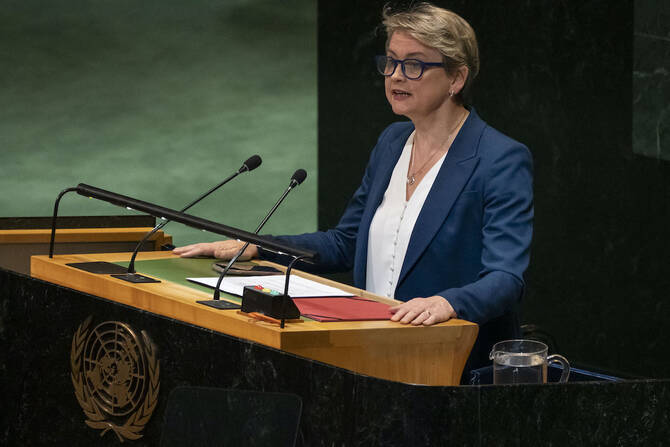

LONDON: The UK’s foreign secretary accused Israel’s Prime Minister Benjamin Netanyahu of allowing children to starve in Gaza as she explained Britain’s decision to recognize a Palestinian state.
Speaking at a landmark UN conference co-hosted by Saudi Arabia and France, Yvette Cooper pointed to Israel’s atrocities in Gaza as a key reason why the UK had made the declaration.
Britain is among at least 10 other Western nations to have recognized Palestine in recent days in response to Israel’s war in Gaza that has killed more than 65,000 people.
Cooper said statehood is the “inalienable right of the Palestinian people” and that two states is the only path to “security and lasting peace for Israelis and Palestinians.”
She said Britain’s decision reflected “a grave reality” with the road map to a lasting peace with a Palestinian and Israeli state side by side “in profound peril.”
Cooper said: “In Gaza, the unbearable humanitarian catastrophe worsens as the Netanyahu government chooses to escalate war and hold back aid. Children dying of starvation while food rots at the border.”
She said Israel’s settlement expansion in the occupied West Bank also threatened “the very viability of a Palestinian state.”
She added: “The two-state solution risks disappearing beneath the rubble. That is what extremists on all sides want.”
Her comments came during the High-Level International Conference for the Peaceful Settlement of the Question of Palestine held in New York on Monday.
Hours earlier, President Emmanuel Macron told the meeting that France would also recognize Palestine, warning against the “peril of endless wars” if a two-state solution was not realized.
Cooper said the UK’s action was also intended to freeze out Hamas from a future Palestinian state.
“This pathway is the opposite of Hamas’ hateful vision,” she said.
She called for an immediate ceasefire, the release of all Israeli hostages seized by Hamas during the deadly October 2023 raid that triggered the conflict, and the resumption of aid to Gaza that Israel has reduced to a trickle.


