

Pakistan plans Port Qasim expansion to support rising cement, clinker exports

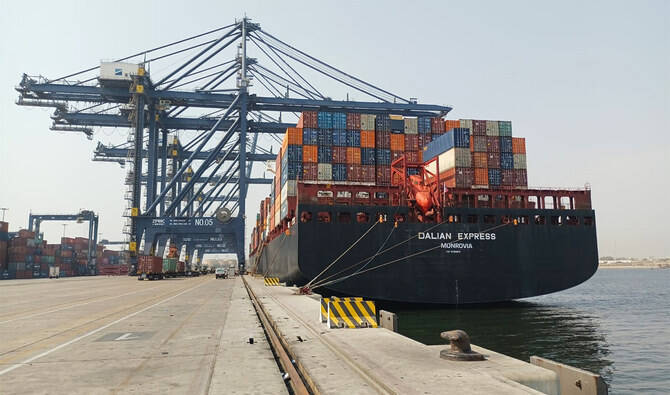
This picture taken on March 8, 2023, shows a cargo ship set to sail from a sea port in Karachi, Pakistan. (Radio Pakistan/File)
Short Url
Updated 23 September 2025
Follow

Pakistan plans Port Qasim expansion to support rising cement, clinker exports

  • The government plans two new berths, a 30,000-ton storage facility and repairs to existing infrastructure
  • Cement and clinker exports rose 23.7 percent in FY25 as overseas demand outpaced weaker domestic consumption

KARACHI: Pakistan plans to significantly upgrade Port Qasim to expand cement and clinker exports, the maritime affairs ministry said on Tuesday, outlining projects that include new berths, additional storage and improved export operations.

According to the Pakistan Bureau of Statistics, cement and clinker exports rose 23.7 percent in value and 28.7 percent in volume year-on-year, with earnings climbing to $329.79 million in FY25 compared to $266.51 million a year earlier.

Key export destinations included Afghanistan, Bangladesh, Sri Lanka, Madagascar, the United States and Ghana.

“Federal Minister for Maritime Affairs Muhammad Junaid Anwar Chaudhry has announced a series of major initiatives aimed at boosting cement and clinker exports by enhancing port infrastructure and operational capacity, with a particular focus on Port Qasim,” the ministry said.

Chaudhry said a sub-committee of all major ports, led by the Port Qasim Authority, had finalized recommendations to accelerate export capacity.

Planned measures include construction of two additional multi-purpose berths, a new 30,000-ton storage facility expected to start by end-2025 and permanent repairs to existing storage infrastructure targeted for completion by December.

The Port Qasim Authority will also work with the All Pakistan Cement Manufacturers Association to explore use of an under-utilized berth for clinker exports.

With export growth outpacing domestic demand, which weakened in recent years, Port Qasim has come under strain from limited berthing capacity, inadequate storage and logistical bottlenecks.

The government says the expansion drive is aimed at easing those pressures and strengthening Pakistan’s competitiveness in global trade.


Pakistan, UAE review bilateral ties, economic and trade cooperation

Updated 7 sec ago
Follow

Pakistan, UAE review bilateral ties, economic and trade cooperation

  • UAE Ambassador Salem Mohammed Al Zaabi meets Pakistan’s deputy PM, ministers of defense, finance and IT
  • UAE is Pakistan’s third-largest trading partner after China and the US, and home to around 2 million Pakistani expats

ISLAMABAD: UAE Ambassador Salem Mohammed Al Zaabi met Deputy Prime Minister Ishaq Dar and other members of the Pakistani cabinet on Sunday to review bilateral ties and discuss trade and economic cooperation between the two countries, the UAE embassy said. 

Al Zaabi held separate meetings with Dar, Defense Minister Khawaja Muhammad Asif, Finance Minister Muhammad Aurangzeb, IT Minister Shaza Fatima Khawaja, Railways Minister Hanif Abbasi, Senate Chairman Yousaf Raza Gilani and National Assembly Speaker Ayaz Sadiq. 

“Views on the latest developments at the regional and international levels and matters of common interest between the two friendly countries were discussed and exchanged,” the UAE embassy in Islamabad wrote on social media platform X. 

Meanwhile, the embassy said Zaabi discussed bilateral relations and ways to enhance economic and trade cooperation in his meeting with Aurangzeb. 

Pakistan enjoys cordial ties with UAE rooted in shared values, faith, culture and economic relations. The Gulf nation is Pakistan’s third-largest trading partner after China and the US.

The UAE is also home to two million Pakistani expatriates, who make it the second-largest source of foreign remittances for cash-strapped Pakistan after Saudi Arabia. 

The UAE is also a major source of foreign investment in Pakistan, which have been valued at over $10 billion in the last 20 years, according to the Gulf state’s foreign ministry. 

Policymakers in Pakistan consider the UAE an optimal export destination due to its geographical proximity, which minimizes transportation and freight costs while facilitating commercial transactions.

Both nations have signed agreements worth billions of dollars recently as Pakistan eyes greater trade and economic ties with Gulf states. In January 2024, Pakistan and the UAE signed multiple agreements worth more than $3 billion for cooperation in railways, economic zones and infrastructure.