

Dubai secures record 643 greenfield FDI projects in H1, extends global lead 

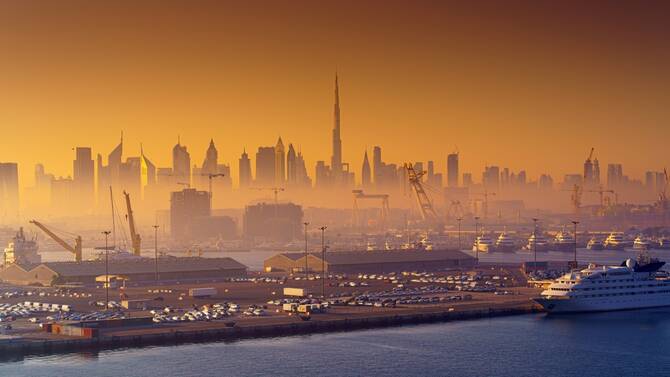
Dubai also advanced to second place worldwide for total FDI capital, a jump from its fourth-place position in the first half of 2024. Shutterstock
Short Url
Updated 23 September 2025
Follow

Dubai secures record 643 greenfield FDI projects in H1, extends global lead 

RIYADH: Dubai secured the top global spot for greenfield foreign direct investment projects in the first half of 2025, with 643 new ventures, extending its lead for an eighth straight half-year, a new ranking showed. 

The emirate drew the highest half-year tally since records began in 2003, according to Financial Times’ fDi Markets data cited by the Emirates News Agency, or WAM. That was nearly 500 more than the second-ranked city. 

This inflow of investment reflects confidence in the emirate’s long-term economic plans, including the Dubai Economic Agenda, which targets doubling its economy by 2033. 

This follows broader regional trends, with Saudi Arabia and Qatar posting notable gains. The Kingdom’s FDI inflows rose 24 percent to SR119 billion ($31.7 billion) in 2024, while Qatar attracted $2.74 billion through 241 projects, creating 9,348 jobs last year. 

Crown Prince of Dubai, Hamdan bin Mohammed bin Rashid Al-Maktoum, attributed this achievement to the city’s futuristic development vision. “The strength and resilience of Dubai’s economy continues to inspire confidence among global investors in its ability to reimagine the future and unlock emerging global technological trends and sustainable sectors,” he said, as reported by WAM. 

Al-Maktoum linked the success to the goals of the Dubai Economic Agenda, D33, which aims to double the size of Dubai’s economy by 2033. 

Key highlights from the first half of 2025 showed that Dubai advanced to second place worldwide for total FDI capital, a jump from its fourth-place position in the first half of 2024. 

The city also climbed to third place globally for jobs created by FDI. 

The city ranked first globally in several growth sectors, including technology — with strengths in artificial intelligence and fintech — along with creative industries, life sciences, and financial services. 

This was accompanied by growth across the board, with FDI capital rising 62 percent to 40.4 billion dirhams ($11 billion), projects increasing 28.7 percent to 1,090, and new jobs up 46.7 percent to more than 38,400. 

Investment covered sectors such as business services, construction, retail, and logistics, with the US as the largest source of capital, followed by the UK, France, and India. 

Helal Saeed Al-Marri, director general of Dubai’s Department of Economy and Tourism, said the results reflect the city’s “resilience, agility and capacity to keep pace with global economic transformations.” 

He added: “It is also a reflection of the trust that international investors, multinational corporations and start-ups continue to place in Dubai.”


Education spending surges 251% as students return from autumn break: SAMA

Updated 12 December 2025
Follow

Education spending surges 251% as students return from autumn break: SAMA

RIYADH: Education spending in Saudi Arabia surged 251.3 percent in the week ending Dec. 6, reflecting the sharp uptick in purchases as students returned from the autumn break.

According to the latest data from the Saudi Central Bank, expenditure in the sector reached SR218.73 million ($58.2 million), with the number of transactions increasing by 61 percent to 233,000.

Despite this surge, overall point-of-sale spending fell 4.3 percent to SR14.45 billion, while the number of transactions dipped 1.7 percent to 236.18 million week on week.

The week saw mixed changes between the sectors. Spending on freight transport, postal and courier services saw the second-biggest uptick at 33.3 percent to SR60.93 million, followed by medical services, which saw an 8.1 percent increase to SR505.35 million.

Expenditure on apparel and clothing saw a decrease of 16.3 percent, followed by a 2 percent reduction in spending on telecommunication.

Jewelry outlays witnessed an 8.1 percent decline to reach SR325.90 million. Data revealed decreases across many other sectors, led by hotels, which saw the largest dip at 24.5 percent to reach SR335.98 million. 

Spending on car rentals in the Kingdom fell by 12.6 percent, while airlines saw a 3.7 percent increase to SR46.28 million.

Expenditure on food and beverages saw a 1.7 percent increase to SR2.35 billion, claiming the largest share of the POS. Restaurants and cafes retained the second position despite a 12.6 percent dip to SR1.66 billion.

Saudi Arabia’s key urban centers mirrored the national decline. Riyadh, which accounted for the largest share of total POS spending, saw a 3.9 percent dip to SR4.89 billion, down from SR5.08 billion the previous week.

The number of transactions in the capital settled at 74.16 million, down 1.4 percent week on week.

In Jeddah, transaction values decreased by 5.9 percent to SR1.91 billion, while Dammam reported a 0.8 percent surge to SR713.71 million.

POS data, tracked weekly by SAMA, provides an indicator of consumer spending trends and the ongoing growth of digital payments in Saudi Arabia. 

The data also highlights the expanding reach of POS infrastructure, extending beyond major retail hubs to smaller cities and service sectors, supporting broader digital inclusion initiatives. 

The growth of digital payment technologies aligns with the Kingdom’s Vision 2030 objectives, promoting electronic transactions and contributing to the nation’s broader digital economy.