

Pakistan joins Arab-Islamic consultations to forge unified stance on key issues at UNGA

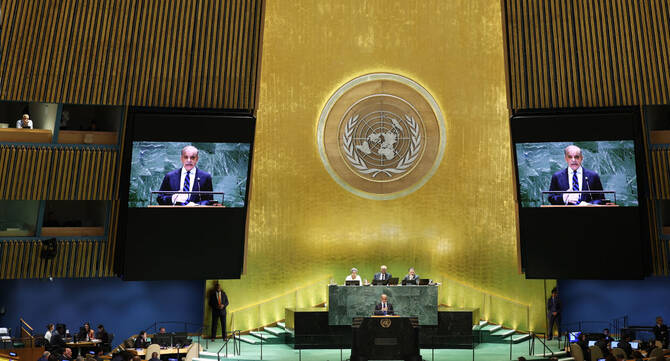
Pakistan's Prime Minister Muhammad Shehbaz Sharif speaks during the 79th Session of the United Nations General Assembly at the United Nations headquarters in New York City on September 27, 2024.
Short Url
Updated 22 September 2025
Follow

Pakistan joins Arab-Islamic consultations to forge unified stance on key issues at UNGA

  • The consultations were hosted by Qatari PM, which also included deputy PMs and FMs from Jordan, UAE, Saudi Arabia, Egypt and Indonesia
  • Deputy PM Ishaq Dar assures Islamabad’s support for all efforts aimed at fostering peace, stability and prosperity in Middle East, beyond

ISLAMABAD: Leaders from Pakistan, Arab Gulf nations and other Muslim states met on Monday in New York to ponder a unified approach on key regional and global issues at the 80th session of the United Nations General Assembly (UNGA), the Pakistani foreign office said.

Prime Minister Shehbaz Sharif led the Pakistan delegation to New York as the General Assembly High-level Week 2025 kicked off on Monday, with global leaders in attendance and Tuesday, Sept. 23 set to be the first day of the high-level General Debate at the 80th session.

On Monday, Deputy PM and Foreign Minister, Ishaq Dar, represented Pakistan in consultations hosted by Qatari PM Sheikh Mohammed bin Abdulrahman Al-Thani in New York, which also included deputy prime ministers of Jordan and the United Arab Emirates (UAE), and foreign ministers of Saudi Arabia, Egypt, Indonesia and Turkiye.

Dar underscored that the people of Pakistan had great affinity for their Muslim brethren in the Middle East and would support all constructive endeavours aimed at fostering peace, stability and prosperity in the region and beyond.

“The ministers exchanged views and coordinated positions for unified approach on some of the key issues at the UN General Assembly session,” the Pakistani foreign office said.

The UNGA session comes in the backdrop of Israel’s nearly two-year war on Gaza and the recent strikes against Hamas leaders in the Qatari capital of Doha, which raised fears of a wider military conflict in an already volatile region and drew condemnations from the Muslim world.

The 80th session of the United Nations General Assembly is being held under the theme “Better together: 80 years and more for peace, development and human rights.”

From Sept. 23 till Sept. 29, the session will feature speeches from presidents, prime ministers and monarchs who will deliver national statements, set out visions for peace, development, human rights and collective action at the iconic green marble podium.

Pakistan PM Sharif as well as various world leaders will also take part in the “High-level International Conference for the Peaceful Settlement of the Question of Palestine and the Implementation of the Two-State Solution,” which will be co-chaired by Saudi Arabia and France.

In a statement on Sunday, Pakistan’s foreign ministry said Sharif will urge the international community to resolve the crises in Palestine and disputed Kashmir territory and grant the people there the right to self-determination. The Pakistani prime minister will call for decisive action to end the suffering of the Palestinians.

“He will also highlight Pakistan’s perspective on the regional security situation as well as other issues of international concern, including climate change, terrorism, Islamophobia, and sustainable development,” the statement said.

“The prime minister will also participate in a meeting of select Islamic leaders with US President [Donald] Trump to exchange views on issues pertaining to regional and international peace and security.”

Sharif is expected to hold bilateral meetings with several world leaders and senior UN officials to discuss matters of mutual interest, according to the Pakistan foreign ministry. He will also underline Pakistan’s resolve to work with all UN member states to uphold the UN Charter, prevent conflict, foster peace and promote global prosperity in Pakistan’s current role as a member of the Security Council.


IMF board to approve Pakistan reviews today ‘if all goes well,’ say officials

Updated 4 sec ago
Follow

IMF board to approve Pakistan reviews today ‘if all goes well,’ say officials

  • IMF’s executive board is scheduled to meet today to discuss the disbursement of $1.2 billion
  • Economists say the money will boost Pakistan’s forex reserves, send positive signals to investors

KARACHI: The International Monetary Fund’s (IMF) executive board is scheduled to meet today, Monday, to approve the release of about $1.2 billion for Pakistan under the lender’s two loan facilities, said IMF officials who requested not to be named.

The IMF officials confirmed the executive board was going to decide on the Fund’s second review under the $7 billion Extended Fund Facility (EFF) and first review under the $1.4 billion Resilience and Sustainability Facility (RSF), a financing tool that provides long-term, low-cost loans to help countries address climate risks.

“The board meeting will be taking place as planned,” an IMF official told Arab News.

“The board is on today yes as per the calendar,” said another.

A well-placed official at Pakistan’s finance ministry also confirmed the board meeting was scheduled today to discuss the next tranche for Pakistan.

The IMF executive board’s meeting comes nearly two months after a staff-level agreement (SLA) was signed between the two sides in October.

Procedurally, the SLAs are subject to approval by the executive board, though it is largely viewed as a formality.

“If all goes well, the reviews should pass,” said the second IMF official.

On approval, Pakistan will have access to about $1 billion under the EFF and about $200 million under the RSF, the IMF said in a statement in October after the SLA.

The fresh transfer will bring total disbursements under the two arrangements to about $3.3 billion, it added.

Experts see smooth sailing for Pakistan in terms of the passing of the two reviews, saying the IMF disbursements will help the cash-strapped nation to strengthen its balance of payments position.

Samiullah Tariq, group head of research at Pakistan Kuwait Investment Company Limited, said the IMF board’s approval will show that Pakistan’s economy is on the right path.

“It obviously will help strengthen [the country’s] external sector, the balance of payments,” he told Arab News.

Until recently, Pakistan grappled with a macroeconomic crisis that drained its financial resources and triggered a balance of payments crisis.

Pakistan has reported financial gains since 2022, recording current account surpluses and taming inflation that touched unprecedented levels in mid-2023.

Economists also viewed the IMF’s bailout packages as crucial for cash-strapped Pakistan, which has relied heavily on financing from bilateral partners such as Saudi Arabia, China and the United Arab Emirates, as well as multilateral lenders.

Saudi Arabia, through the Saudi Fund for Development, last week extended the term of its $3 billion deposit for another year to help Pakistan boost its foreign exchange reserves, which stood at $14.5 billion as of November 28, according to State Bank of Pakistan statements.

“In our view this [IMF tranche] will be approved,” said Shankar Talreja, head of research at Karachi-based brokerage Topline Securities Limited.

“This will help strengthen reserves and will eventually help a rating upgrade going forward,” he said.

The IMF board’s nod, Talreja said, would also send a signal to the international and local investors regarding the continuation of the reform agenda by Pakistan’s government.