

Crafting for the future — Saudi youth keeping heritage alive

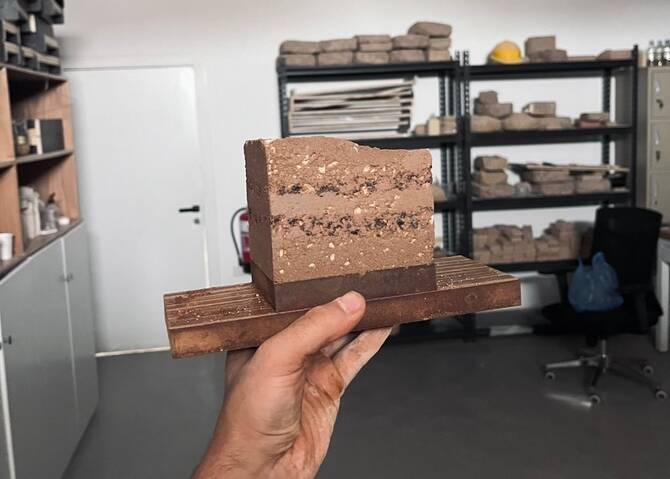
Hammad Alshammari said: This piece was designed as a souvenir within the projects of the Royal Institute for Traditional Arts. It is inspired by the rammed earth building style, locally known as Al-Madkook. (Supplied)
Short Url
Updated 22 September 2025
Follow

Crafting for the future — Saudi youth keeping heritage alive

  • Vision 2030 has created new ‘creative sector,’ says researcher
  • Greater economic opportunities, craftspeople tell Arab News

RIYADH: Many young people in Saudi Arabia are embracing traditional crafts through a number of training programs and workshops that link cultural identity with modern opportunity.

Hammad Al-Shammari, a young craftsman specializing in mud construction, said his journey began during the excavation of a historic home.

“There, I felt the value of old buildings, with their decorations, columns, and authentic architectural features,” he told Arab News recently.

“From that moment, my passion for restoring traditional homes was born.”

Al-Shammari went on to specialize in mud construction at the Royal Institute of Traditional Arts, or Wrth, where he trained in structural and restoration techniques.

“Wrth has been the greatest blessing in my journey,” he said. “It helped me develop my craft skills both practically and academically … I learned how to connect heritage identity with contemporary innovation.”


Hammad Al-Shammari, a young craftsman specializing in mud construction. (Supplied)

Wrth focuses on strengthening national identity through traditional arts. The organization trains young Saudis, honors master craftspeople, preserves both tangible and intangible heritage and raises awareness at home and abroad.

Al-Shammari said architecture reflects the Kingdom’s cultural richness.

“Each region has its own unique features, from the Al-Qatt Al-Asiri decorations of the south, to Hijazi plasterwork, Najdi mud-and-wood architecture, to the beauty of the eastern buildings that still retain their charm.”

“The greatest challenge was reviving old memories and practices within a modern society in a unique and high-quality way. I overcame this through patience, curiosity, and by learning from the experiences of elders and those with long practice,” he added.

Mamdouh Al-Harbi, an urban heritage researcher, highlighted the importance of passing on skills.

“Knowledge transfer is the lifeline of heritage crafts, without it, these practices risk becoming static artifacts in museums rather than living traditions,” he said.

He noted that in the past, crafts were family-based livelihoods, passed from parents to children. Industrialization and urban growth, however, caused many practices to decline.

Today, Vision 2030 and new legislation have reversed the trend.


Hammad Al-Shammari went on to specialize in mud construction at the Royal Institute of Traditional Arts. (Supplied)

“Traditional crafts have transformed from endangered practices into a promising creative sector that links national identity with economic development,” Al-Harbi said.

He added that youth engagement now reflects creativity and entrepreneurship. Modern technologies such as 3D printing and virtual reality are being introduced into training programs, while heritage motifs are finding their way into public buildings.

“Showcasing youth success stories that turn crafts into entrepreneurial projects reshapes public perception,” he said.

He added: “Heritage crafts will only remain attractive to youth if they are freed from rigidity and reimagined as spaces of contemporary creativity.

“Today’s generation, raised in an era of technology, engages with crafts not as repetitive traditional skills but as opportunities for experimentation, innovation, and a renewed connection to identity.”

Heritage crafts are also creating career pathways. Graduates can work in restoration projects, museums, and cultural festivals, or establish businesses in heritage-inspired decor, fashion, and tourism.

Among the more specialized crafts is manuscript-making, where young artisans learn skills that date back centuries.

Faisal Al-Jarallah, a young craftsman specializing in manuscripts, said his passion developed unexpectedly.

“Honestly, at first it wasn’t passion that led me to this field. I was assigned to work in the manuscripts department against my will. I feared it and saw it as a burden. But now, I have become passionate about it,” he said.

He described the process as “the art of making books by hand … preparing paper, creating inks from natural materials, calligraphy, gilding, ornamentation, and binding.”

He noted that Saudi Arabia holds 27 percent of the manuscripts in the Islamic world, calling it “a heavy responsibility that requires proper preservation.”

He added that the Kingdom is now moving “from preservation to presentation.”

National programs, he added, have been instrumental. “I believe the movement and competitiveness created by national initiatives are the real drivers of creativity in the field of crafts.

“Initiatives like the Royal Institute of Traditional Arts, Wrth, have played a major role in shaping this cultural scene and supporting artisans,” he said.

He described manuscripts as “a repository of diverse knowledge and sciences,” and said traditional crafts remain powerful symbols of identity.

“When a young person learns the craft of their ancestors, they not only acquire a manual skill but also connect with their roots, fostering a sense of belonging and pride,” he added.


How AI is expanding access for Saudi Arabia’s deaf community

Updated 06 March 2026
Follow

How AI is expanding access for Saudi Arabia’s deaf community

  • Real-time transcription, language tools and AI assistants are reshaping communication

DHAHRAN: On a recent evening in Dhahran, about 20 members of the local deaf community gathered, their hands moving swiftly through the air like conductors guiding intricate symphonies.

The event was organized by Riyadh-based awareness advocate Mohammad Alfayez, known on social media as “Prince Mohami.”

Alfayez is a Cued Speech user — a communication method that pairs mouth movements with hand signals to clarify spoken language for people who are deaf. He uses a cochlear implant, a surgically implanted device that bypasses the inner ear and sends sound signals directly to the auditory nerve. Multilingual, he is fluent in American Sign Language, Arabic Sign Language, and spoken and written English and Arabic.

After spending more than a decade in the US, Alfayez moved back to his hometown of Riyadh last Ramadan. Since then, artificial intelligence has become what he describes as a lifeline.

“ChatGPT helped me be more independent. I used to have to ask my little nieces: ‘Can you call for me,’ but I want to be independent. I’m over 18,” Alfayez said.

Image of Riyadh-based deaf-awareness advocate Mohammad Alfayez, known on social media as ‘Prince Mohami.’ (Supplied)

He believes Saudi Arabia’s rapid embrace of AI could significantly expand access to essential services for the deaf community, building on systems already common in the US.

“We need help with services — in hospitals, police stations, embassies — it is much more common in the US to go to a coffee shop and they would be able to sign with you because they learned it in school. You know, ASL is offered in high school and college in the US. Here in Saudi, we have French, English and other languages, why not include sign language? There are places that teach it but they are a few and limited.”

The demand is considerable.

According to the Kingdom’s 2022 disability census, approximately 84,000 people in Saudi Arabia have hearing impairments, accounting for 5.1 percent of people with disabilities.

Among those working to support the community is educator Abdulrahman Khalid, who also attended the gathering.

“I use AI daily because I teach deaf students here in Dammam,” Khalid told Arab News.

DID YOU KNOW?

• Saudi Arabia’s SAMAI initiative has trained over 1 million people in AI skills since its launch in 2024.

• At Saudi Aramco, a pilot program is exploring how AI can better support deaf employees in the workplace.

• Most teachers of deaf students in Saudi Arabia are not deaf themselves — and deaf educators remain rare.

“Sometimes, students cannot understand context because of the way the traditional news is written. In that case, they use programs like ChatGPT and say, ‘Explain this news to me.’ This helps them understand it better.”

Written language presents another hurdle, as many students with hearing impairment struggle with sentence structure and grammar.

“Using these programs helps them form sentences ‘properly’ in daily conversations. For example, a deaf student might write: ‘Today I go place…restaurant…coffee…’ You’ll notice the sentence has missing words. But with ChatGPT, they can write, ‘Correct this sentence so it becomes complete.’ Then they can use it in conversations, such as on WhatsApp,” he said.

Part of this linguistic gap stems from the fact that most teachers of students with hearing impairment are not deaf themselves — something that distinguishes Khalid.

“I am only one of a few deaf teachers who teaches the deaf in Saudi Arabia,” he said.

The shortage is partly due to strict qualification requirements for teaching roles, including licensing exams with written components that can be significantly more challenging for deaf candidates.

Deaf-awareness advocate Mohammad Alfayez, known on social media as ‘Prince Mohami’, has a big following on social media. (Supplied)

Another attendee, Khalid Al-Zahrani, brings both corporate and academic experience to the conversation. Fluent in ASL, he has worked at Saudi Aramco for three years within a division focused on AI-driven product innovation. He is currently involved in a pilot program exploring how artificial intelligence can better support deaf employees within the company.

Al-Zahrani earned a degree in ASL from Gallaudet University, a private institution founded in 1864 in Washington, DC, that specializes in education for deaf and hard-of-hearing students.

As AI has advanced rapidly in recent years, he has observed shifting attitudes toward the technology — though adoption within the deaf community remains inconsistent.

“Some people in the deaf community are scared of AI, to be honest, they are not fully aware of how to use AI, but we are dragging them to get involved with AI. Instead of hiring an interpreter, we can ‘hire a technology’ that can translate or give us a better understanding,” Al-Zahrani told Arab News.

While Saudi Aramco is developing internal AI tools, he hopes Arabic Sign Language will eventually be integrated into future systems as more qualified specialists enter the field. Such developments could lower costs while making communication faster and more accessible.

Another Gallaudet alumna, AlHanouf AlHenaki, who divides her time between Riyadh and Washington, DC, joined the discussion remotely.

Opinion

This section contains relevant reference points, placed in (Opinion field)

“As a deaf woman, I see AI as an empowering tool that enables me to participate, understand and make decisions confidently in predominantly hearing work environments,” she wrote to Arab News.

She also advocates for stronger deaf representation in the design and development of emerging technologies.

“I use AI-powered tools like real-time transcription apps, speech-to-text services, and translation assistants. These tools help me communicate both within the deaf community and with hearing colleagues,” she said.

She expressed particular enthusiasm for one widely used platform.

“ChatGPT is perfect the way it is!” she said.

According to the Ministry of Education, the SAMAI initiative, launched in 2024, has trained more than 1 million Saudis in AI-related skills.

As AI adoption accelerates across the Kingdom, advocates say expanding accessible technologies — including Arabic Sign Language recognition and real-time translation tools — will be critical to ensuring that the deaf community remains fully included in Saudi Arabia’s digital transformation.