

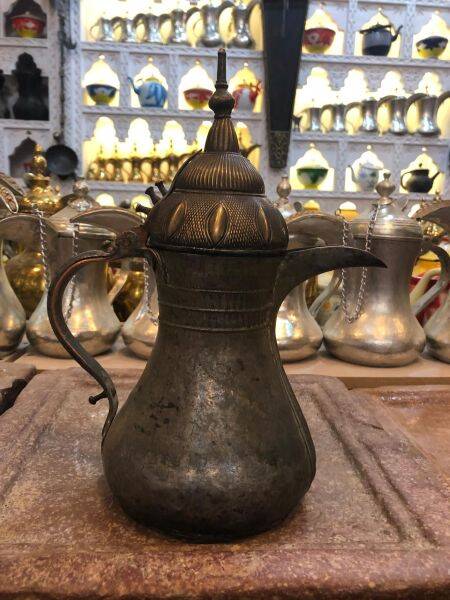
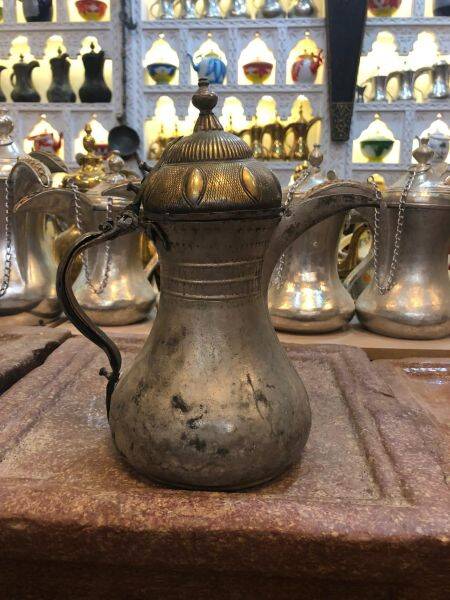
Hail’s iconic Quraishyyat coffee pot is symbol of hospitality

1 / 4
Hail has been crafting a specific type of Arabic coffee pot known as the Quraishyyat for hundreds of years. (Supplied)
2 / 4
Hail has been crafting a specific type of Arabic coffee pot known as the Quraishyyat for hundreds of years. (Supplied)
3 / 4
Hail has been crafting a specific type of Arabic coffee pot known as the Quraishyyat for hundreds of years. (Supplied)
4 / 4
Hail has been crafting a specific type of Arabic coffee pot known as the Quraishyyat for hundreds of years. (Supplied)
Short Url
Updated 23 September 2025
Follow

Hail’s iconic Quraishyyat coffee pot is symbol of hospitality

  • Distinctive design crafted in the northern city for hundreds of years
  • Item traditionally used for special occasions remains popular today

RIYADH: The northern city of Hail in Saudi Arabia has been crafting a specific type of Arabic coffee pot known as the Quraishyyat for hundreds of years.

This distinctive vessel features a longer neck and a slimmer body than the typical receptacle, and was traditionally reserved only for special occasions.

“Al-Quraishyyat is a coffee pot made of green and yellow copper and has several names such as the palace coffee pot, the khateeb coffee pot, or Hail’s Quraishyyat,” Hamid Al-Dhuwaili, owner of Al-Dhuwaili Heritage Museum in Hail, told Arab News.

He explained that making such coffee pots had been part of the culture in Hail for hundreds of years, and added: “People have practiced this craft since ancient times, before the founding of the First Saudi State. There are well-known craftsmen in Hail who excel in this industry. Currently Hail is home to a coffee pot factory considered one of the best in the Middle East.”

While other handicrafts, including carving, tent making and weaving, are also native to Hail, it is its coffee pots that most visitors and tourists find attractive.

Thanks to its cool weather, rocky landscape and groundwater resources, Hail was one of the main stopping points for traveling merchants and migrants.

It was a resting point for travelers to feed their cattle, which fostered a culture of hospitality among the people of Hail. Coffee has been a significant part of that culture for centuries.

Along with the Quraishyyat, there are other kinds of coffee pots that are also prominent in the city, including the Baghdadiyyat, which is believed to have been introduced by travelers from the Iraqi capital.

Another variation is the Raslan, which consists of pots of different sizes. The Raslan is believed to have been brought to Hail through merchants from the Levant region.

The crafting of coffee pots in Hail has been significant throughout its history as a trading post, and remains so today as the tradition welcomes visitors from near and far.


Saudi filmmaker Khaled Nadershah explores escapism in ‘ESC’ at Red Sea International Film Festival

Updated 06 December 2025
Follow

Saudi filmmaker Khaled Nadershah explores escapism in ‘ESC’ at Red Sea International Film Festival

DUBAI: Saudi director Khaled Nadershah’s short film “ESC” has been selected for the Red Sea International Film Festival, which takes place in Jeddah from Dec. 4-13. 

The film is screening in the “New Saudi Cinema Shorts” category, a section dedicated to emerging voices in the Kingdom’s film industry.

“It means a lot to have a project with this type of unique, experimental style make it in a category like that,” the director of the 25-minute film told Arab News.

“ESC” follows Hulum, a young woman burdened by grief and the responsibility of caring for her family. (Supplied)

“ESC,” named after the escape key on a keyboard, follows Hulum, a young woman burdened by grief and the responsibility of caring for her family. Her only refuge lies in a virtual reality game where she transforms into Esc, a fearless and empowered version of herself. 

“The movie tackles more the philosophy of escapism itself,” Nadershah, a graduate of London’s MetFilm School, explained. “We often believe that if we move somewhere new, reach a certain destination, or accomplish something specific, everything will be fine. But even then, some struggles stay with us. The only real way to overcome them is to face them.”

The film’s central theme of escapism reflects a consistent thread in Nadershah’s work. “The concept has been roaming my mind for a while now; even my first feature film, ‘Exit 5,’ speaks on the desire to escape in one way or another,” he said.

A lifelong anime fan, Nadershah found in the art form a perfect medium for “ESC.”


He said: “I’ve always been a huge fan of anime. However, I never thought I would be creating it myself. The first type of animation introduced to us in Saudi Arabia was through Spacetoon, which presented Japanese-style anime.

“Anime has so many subgenres, so you need to find one that pays true homage to your culture,” he said. “A big motif in the film (are) pink Taif roses. I chose them because they resemble cherry blossoms in Japan, so it was a nice way to link and merge the two worlds together.”

The film is not entirely animated or set in a virtual world, however.

“It’s not through virtual reality per se,” he said. “The character uses the VR device to transfer from one world to the other, so it was the perfect tool to transition from the vivid and colorful world inside her head to the dull and gray reality she faces in her daily life.”

Nadershah’s work as innovation and data intelligence manager at the Saudi Film Commission also shaped his creative process. “Being exposed to how filmmakers around the world are telling their stories in immersive and experimental ways really inspired me,” he said. 

Reflecting on both the film and the broader industry, he added: “The film sector is going through a transitional period. What used to sell before doesn’t anymore; audiences have become more refined, and technology is changing everything. But I believe we’re figuring out the next step, and it’s an exciting time to be part of that evolution.”