

Fresh polio case in Pakistan’s Sindh takes nationwide 2025 tally to 27

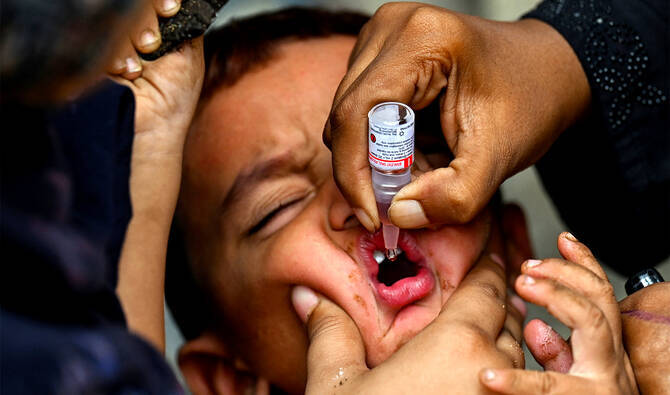
A health worker administers polio drops to a child for vaccination on the first day of a nationwide week-long poliovirus eradication campaign in Karachi on September, 1, 2025. (AFP/File)
Short Url
Updated 22 September 2025
Follow

Fresh polio case in Pakistan’s Sindh takes nationwide 2025 tally to 27

  • Pakistan’s efforts to eliminate poliovirus have been hampered by parental refusals, misinformation and militant attacks
  • The country is set to launch a nationwide polio vaccination campaign on Oct. 13-19, aiming to reach 45.4 million children

KARACHI: Health authorities have confirmed a new polio case in the southern Sindh province that brings the total number of children affected by the crippling virus this year to 27, the country’s polio program said on Tuesday.

The regional laboratory for polio eradication at Islamabad’s National Institute of Health (NIH) confirmed the new case in Sindh’s Hyderabad district, according to the country’s polio program. Of the 27 cases reported nationwide, it said, 18 are from Khyber Pakhtunkhwa, seven from Sindh, and one each from Punjab and Gilgit-Baltistan. 

Polio is a highly infectious and incurable disease that can cause lifelong paralysis. The only effective protection is through repeated doses of the Oral Polio Vaccine for every child under five during each campaign, alongside timely completion of all routine immunizations.

“Polio eradication is a collective responsibility,” the polio program said. “While dedicated frontline polio workers deliver vaccines, parents and caregivers must ensure their children receive all recommended doses, including routine immunizations.”

Pakistan and Afghanistan are the only two countries where polio remains an endemic. Pakistan recorded 74 cases in 2024, a sharp rise from six in 2023 and just one in 2021.

Pakistan’s efforts to eliminate poliovirus have been hampered by parental refusals, widespread misinformation and repeated attacks on anti-polio workers by militant groups. In remote and volatile areas, vaccination teams often operate under police protection, though security personnel themselves have also been targeted in attacks.

This month, Pakistan’s National Emergency Operations Center (NEOC) for Polio Eradication conducted a sub-national polio vaccination campaign across 88 districts of the country, which successfully reached approximately 21 million children under the age of five, according to the polio program. 

The next nationwide polio vaccination campaign is scheduled for October 13-19, with health authorities aiming to reach approximately 45.4 million children through more than 400,000 dedicated polio workers who will go door-to-door to ensure that every child is vaccinated.

“These campaigns are designed to rapidly strengthen immunity and enhance protection as part of ongoing efforts to eradicate polio from Pakistan,” the polio program said. “Vaccination remains the only effective protection against lifelong disability.”


ADB approves $381 million for climate-resilient agriculture, social services in Punjab

Updated 8 sec ago
Follow

ADB approves $381 million for climate-resilient agriculture, social services in Punjab

  • Support will upgrade Punjab’s education and nursing systems, improving learning outcomes and health care capacity
  • Package includes $124 million for agriculture, $107 million for STEM schooling and $150 million for nursing reforms

KARACHI: The Asian Development Bank (ADB) said on Saturday it approved $381 million in financing for Pakistan’s Punjab province to modernize agriculture and strengthen education and health services, with a major focus on building climate resilience after monsoon floods this year caused widespread destruction across the country’s most populous province.

The package includes concessional loans and grants for farm mechanization, STEM education, and nursing sector reforms.

ADB said the investments are intended to help Punjab, home to more than half of Pakistan’s population and a key contributor to its economy, recover from climate shocks and transition toward more sustainable and resilient development.

“Investing in education, health, and agricultural mechanization will play a transformative role in driving the growth of Punjab, a vital pillar of Pakistan’s economy,” said ADB Country Director for Pakistan Emma Fan. “These strategic investments will modernize agriculture, enhance human capital, and significantly improve livelihoods for millions of people across Punjab.”

The bank approved $120 million in concessional loans and a $4 million grant for the Punjab Climate-Resilient and Low-Carbon Agriculture Mechanization Project, which will support 220,000 rural farm households.

The program aims to reduce climate vulnerability by shifting farmers toward modern, low-emission machinery, provide alternative livelihoods for agricultural workers and train 15,000 women in new skills. It will also introduce a financing model to help small farmers access advanced equipment.

Punjab produces most of Pakistan’s wheat, rice, and maize but still relies on outdated machinery, contributing to grain losses and routine burning of crop residues, a major source of air pollution, said ADB.

It noted the new project will promote modern mechanization, including rice harvesters, to address these issues.

ADB also approved $107 million for the Responsive, Ready, and Resilient STEM Secondary Education in Punjab Program, including a $7 million grant from the Asian Development Fund.

The results-based program aims to modernize secondary schooling by expanding inclusive STEM education, improving access and quality across the province.

A further $150 million concessional loan was approved for the Punjab Nursing and Health Workforce Reform Program, which will upgrade nursing curricula, develop disaster-resilient training facilities, strengthen workforce governance, and introduce digital human-resource systems.

The program seeks to expand the pool of qualified nurses to strengthen health service delivery and meet rising national and global demand.

Key components include the establishment of three centers of excellence in Lahore, Multan and Rawalpindi, equipped with simulation labs, digital learning platforms, and gender-responsive hostels.

ADB said it remains committed to supporting climate-resilient and inclusive development across Asia and the Pacific through innovative financing tools and partnerships.