

Pakistan PM directs ministers to identify feasible projects for foreign investment

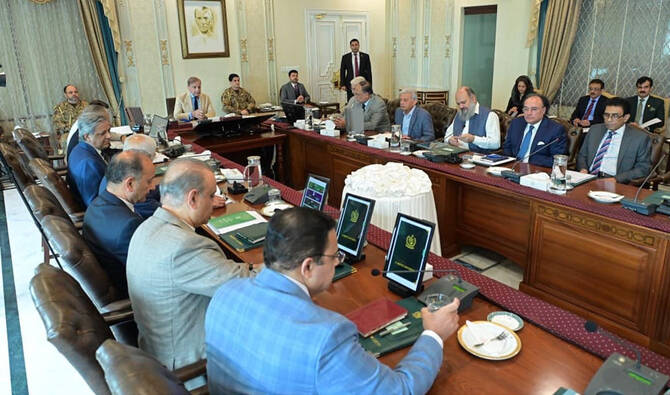
Prime Minister Shehbaz Sharif chairs a meeting of the federal cabinet in Islamabad, Pakistan, on September 10, 2025. (PID/File)
Short Url
Updated 22 September 2025
Follow

Pakistan PM directs ministers to identify feasible projects for foreign investment

  • Shehbaz Sharif identifies agriculture, IT, minerals, tourism and renewable energy as key sectors for foreign investment
  • Private sector will play a key role in the roadmap for country’s economic activities, says Sharif in high-level meeting 

ISLAMABAD: Prime Minister Shehbaz Sharif on Monday directed federal ministers to identify feasible projects for foreign investment in priority sectors, his office said in a statement, amid Pakistan’s push to attract investment to ward off its macroeconomic crisis. 

Pakistan’s government has sought closer trade and economic relations with regional allies, Gulf countries and Central Asian Republics in recent years to bolster foreign trade and investment. Islamabad formed the Special Investment Facilitation Council (SIFC), a government body comprising senior civilian and military officials, in 2023 to fast-track decisions related to investment in minerals, agriculture, tourism, IT, livestock and other sectors. 
 
The Pakistani prime minister, who is due to travel to New York today to take part in the United Nations General Assembly, chaired a meeting of senior ministers and officials in London on enhancing investment, economic, and trade activity in Pakistan. 

“The prime minister directed all ministers to immediately identify feasible projects and take steps to turn them into actionable initiatives,” the Prime Minister’s Office (PMO) said in a statement. 

It added that Sharif directed the ministers to chalk out a roadmap and transformation agenda with a “forward-looking approach” to achieve the goals. Sharif said targets have been assigned to ministries, who have been instructed to utilize all available resources to ensure the timely completion of ongoing projects. 

“Agriculture, IT, minerals, tourism, and renewable energy are key sectors that can attract foreign investment,” Sharif was quoted as saying by his office. “Along with investment, promoting trade is also a core part of our policy, so that our exports can see significant growth.”

The prime minister stressed Pakistan’s private sector will play a key role in the roadmap for the country’s economic activities, saying that their participation will be ensured. 

Sharif has frequently said his government seeks to establish trade relations and “mutually beneficial partnerships” with countries and does not seek loan from them only. Pakistan has pushed for sustainable economic growth, driven by exports and long-term financial reforms, after it came to the brink of a sovereign default in 2023. 

An International Monetary Fund (IMF) financial bailout package saved Pakistan from the default, prompting authorities to push for economic growth as the country struggles to make economic gains.


Pakistan’s Mahnoor Omer named among TIME’s ‘Women of the Year’ for 2026

Updated 01 March 2026
Follow

Pakistan’s Mahnoor Omer named among TIME’s ‘Women of the Year’ for 2026

  • Omer moved a Pakistani court against the so-called ‘period tax’ in Sept. 2025 which has since sparked a national debate
  • Taxes on sanitary pads in Pakistan can add up to 40 percent to retail price, UNICEF says only around 12 percent women use such products

ISLAMABAD: Pakistani women’s rights activist Mahnoor Omer, who fought against taxes on menstrual products, has been named among the TIME magazine’s ‘Women of the Year’ for 2026.

Omer’s efforts have been recognized alongside 16 activists, artists, athletes and businesswomen in the TIME’s Women of the Year 2026 list, including Olympic gold medalist Sydney McLaughlin-Levrone and Oscar-nominated filmmaker Chloe Zhao.

Dissatisfied with the efforts to educate Pakistani girls about sexual violence, Omer founded the Noor Foundation at the age of 14 and held her own workshops with village girls about everything from climate change to menstruation, according to the TIME magazine.

Two years later, a conversation with a domestic worker about the price of pads made her realize that not everyone could afford these essentials. She moved a court against the so-called “period tax” in Sept. 2025 and the case has sparked a national debate on the subject, considered a taboo by many in Pakistan, since its first hearing late last year.

“A decade and one law degree after her interest in activism was sparked, Omer, now 25, is putting her passion and expertise to work in the name of gender equity,” TIME wrote about Omer on its website.

Taxes imposed on sanitary products in Pakistan can add up to 40 percent to the retail price. UNICEF estimates just 12 percent of women in the country use commercially produced pads or tampons. The alternative, using cloth, risks health impacts including rashes and infections, and can make it impossible for girls to attend school while menstruating.

Omer’s suit, which awaits the government response, has sparked a national discussion. She says she spoke about menstruation to her father and male cousins, who thanked her for standing up for their daughters.
The 25-year-old, who is currently enrolled in a master’s degree in gender, peace, and security at the London School of Economics, sees this case as just the first of many.

“I’m not free until every woman is free,” she was quoted as saying by TIME. “I want to leave no stones unturned in terms of what I can do with the next few decades, as a lawyer for the women in my country and gender minorities in general.”