

Pakistan PM directs ministers to identify feasible projects for foreign investment

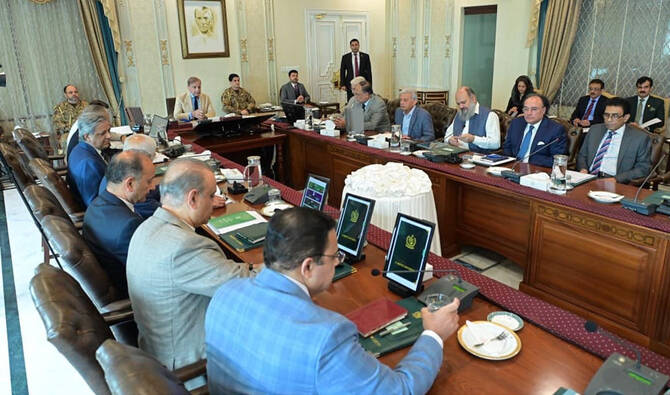
Prime Minister Shehbaz Sharif chairs a meeting of the federal cabinet in Islamabad, Pakistan, on September 10, 2025. (PID/File)
Short Url
Updated 22 September 2025
Follow

Pakistan PM directs ministers to identify feasible projects for foreign investment

  • Shehbaz Sharif identifies agriculture, IT, minerals, tourism and renewable energy as key sectors for foreign investment
  • Private sector will play a key role in the roadmap for country’s economic activities, says Sharif in high-level meeting 

ISLAMABAD: Prime Minister Shehbaz Sharif on Monday directed federal ministers to identify feasible projects for foreign investment in priority sectors, his office said in a statement, amid Pakistan’s push to attract investment to ward off its macroeconomic crisis. 

Pakistan’s government has sought closer trade and economic relations with regional allies, Gulf countries and Central Asian Republics in recent years to bolster foreign trade and investment. Islamabad formed the Special Investment Facilitation Council (SIFC), a government body comprising senior civilian and military officials, in 2023 to fast-track decisions related to investment in minerals, agriculture, tourism, IT, livestock and other sectors. 
 
The Pakistani prime minister, who is due to travel to New York today to take part in the United Nations General Assembly, chaired a meeting of senior ministers and officials in London on enhancing investment, economic, and trade activity in Pakistan. 

“The prime minister directed all ministers to immediately identify feasible projects and take steps to turn them into actionable initiatives,” the Prime Minister’s Office (PMO) said in a statement. 

It added that Sharif directed the ministers to chalk out a roadmap and transformation agenda with a “forward-looking approach” to achieve the goals. Sharif said targets have been assigned to ministries, who have been instructed to utilize all available resources to ensure the timely completion of ongoing projects. 

“Agriculture, IT, minerals, tourism, and renewable energy are key sectors that can attract foreign investment,” Sharif was quoted as saying by his office. “Along with investment, promoting trade is also a core part of our policy, so that our exports can see significant growth.”

The prime minister stressed Pakistan’s private sector will play a key role in the roadmap for the country’s economic activities, saying that their participation will be ensured. 

Sharif has frequently said his government seeks to establish trade relations and “mutually beneficial partnerships” with countries and does not seek loan from them only. Pakistan has pushed for sustainable economic growth, driven by exports and long-term financial reforms, after it came to the brink of a sovereign default in 2023. 

An International Monetary Fund (IMF) financial bailout package saved Pakistan from the default, prompting authorities to push for economic growth as the country struggles to make economic gains.


Pakistan telecom regulator urges restraint on social media amid regional tensions

Updated 28 February 2026
Follow

Pakistan telecom regulator urges restraint on social media amid regional tensions

  • PTA warns against sharing unverified content, says legal action may follow ‘fake news’
  • Advisory comes as Pakistan strikes targets in Afghanistan and Iran faces US, Israeli attacks

ISLAMABAD: Pakistan’s telecom regulator on Saturday urged citizens to avoid sharing “unverified or inflammatory” content online, warning that legal action could be taken against those spreading misinformation amid what it described as a “sensitive national situation.”

The advisory from the Pakistan Telecommunication Authority (PTA) comes as Islamabad says it is targeting militant positions inside Afghanistan following a recent flareup between the two neighbors, while Iran is under attack by the United States and Israel in an escalating regional conflict that has heightened security concerns across South and West Asia.

“In view of the prevailing sensitive national situation, Pakistan Telecommunication Authority (PTA) urges all citizens to be responsible while using social media and digital platforms,” the regulator said in a statement posted on X.

The PTA advised citizens “not to share, disseminate, forward, or upload any unverified, inflammatory, or misleading information/content that may directly or indirectly harm the national interest, public order, or state institutions.”

It said people should instead rely on authentic information based on official sources and refrain from spreading rumors and “fake news.”

“Sharing any fake news/information is liable to legal action in accordance with applicable laws,” the authority said, calling on citizens to act with “caution, maturity, and a strong sense of national responsibility” to help maintain stability and public confidence.

Pakistan in recent years has witnessed increasingly stringent implementation of the Prevention of Electronic Crimes Act (PECA), a cybercrime law that has drawn criticism from rights groups, with journalists and activists arrested and prosecuted under its provisions.