

Philippine protest arrests leave parents seeking answers

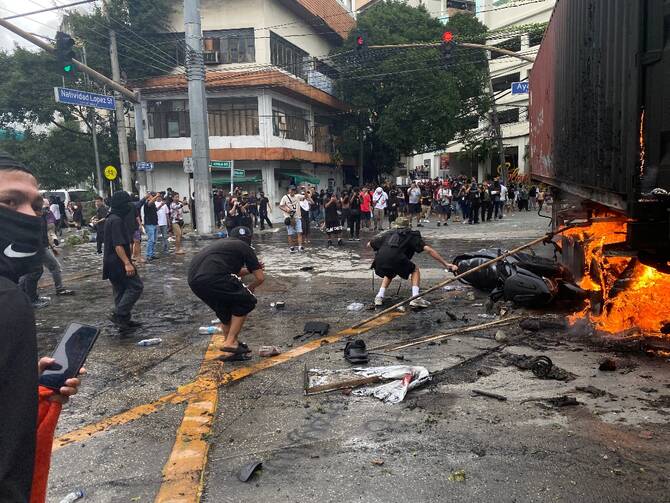
Protesters scuffle with anti riot police during a protest rally in Manila, Philippines. (EPA)
Short Url
Updated 22 September 2025
Follow

Philippine protest arrests leave parents seeking answers

  • At least 88 minors were among those taken into custody as police deployed water cannon and deafening sirens against crowds of mostly young, rock-throwing protesters

MANILA: Anxious Filipino parents braved the rain outside Manila’s police headquarters Monday, after more than 200 people – including dozens of children – were arrested in clashes that erupted during weekend anti-corruption demonstrations.

At least 88 minors were among those taken into custody as police deployed water cannon and deafening sirens against crowds of mostly young, rock-throwing protesters.

Manila City Mayor Isko Moreno said a 12-year-old boy was the youngest detained on Sunday. Michelle Blanco said her son Zoren was 13.

Standing in a line outside the Manila Police District offices, the 45-year-old saleswoman said she hadn’t been told when her son would be released despite having spent most of the day there.

“A little information about how they are doing inside or what we should do to get him out means a lot,” she said, insisting her son had only been watching when scooped off the street.

Elsie Santos said her son Reden had a speech impediment, showing AFP journalists the 27-year-old’s PWD, or person with disability, card.

“No one is explaining anything to us at this point,” she said as a small group of youth activists chanted for the prisoners’ release in the background.

“My son cannot communicate properly, and I’m scared they won’t understand him when he explains himself.”

‘Maximum tolerance’

Thousands of Filipinos rallied in Manila on Sunday to vent their anger over a ballooning scandal involving bogus flood-control projects believed to have cost taxpayers billions of dollars.

But peaceful demonstrations filled with families, activists and clergy were later overshadowed by street battles that saw police vehicles set ablaze and the windows of a precinct headquarters shattered.

“So far, none of them are saying the reasons behind their actions or if somebody paid them to do it,” regional police spokesperson Major Hazel Asilo said of those arrested.

“As soon as we know their affiliations, we can know if they were part of the protesters or if they were just causing trouble,” she added.

According to a statement released Monday by the department of health, about 50 people were taken to one Manila hospital alone following the clashes.

Police said 93 officers were injured in the melees.

Amid accusations by at least one local rights group that police had used disproportionate force, interior secretary Jonvic Remulla said their response had been one of “maximum tolerance.”

“They only had their riot gear and no firearms,” he said of the 4,000 police deployed, noting that no weapons had been discharged or tear gas fired.

Rage over so-called ghost infrastructure projects has been mounting in the Southeast Asian country since President Ferdinand Marcos put them center stage in a July state of the nation address that followed weeks of deadly flooding.

The Department of Finance has estimated the Philippine economy lost up to 118.5 billion pesos ($2 billion) from 2023 to 2025 due to corruption in flood control projects.

Greenpeace has suggested the number is actually closer to $18 billion.


How an Australian citizen of Syrian origin became the hero of Bondi Beach and his nation

Updated 3 sec ago
Follow

How an Australian citizen of Syrian origin became the hero of Bondi Beach and his nation

  • Ahmed Al-Ahmed tackled an armed attacker during the Sydney terror assault, sustaining injuries but saving countless lives
  • The son of Syrian Muslim immigrants from Idlib has been applauded by Australian and world leaders as a true national hero

LONDON: Bondi Beach, one of Australia’s most beloved seaside destinations, became the site of unspeakable violence on Sunday evening. What started as a joyful Hanukkah celebration attended by families and tourists transformed in moments into a scene of chaos and bloodshed.
Gunmen opened fire on crowds gathered for the “Chanukah by the Sea” event, leaving multiple people dead and dozens wounded. But amid the terror and panic, a single act of courage stood out.
An unarmed man tackled one of the attackers, wrestled a rifle from his hands and placed it out of reach, likely saving scores of lives. The man was Ahmed Al-Ahmed, a 43-year-old father of two, a fruit-shop owner and a Muslim Australian of Syrian heritage.
Before that night, Al-Ahmed was far from a public figure. He ran a modest fruit shop in Sydney’s Sutherland Shire, greeting customers by name and living a life centered on family, faith and community.
But his actions that evening transformed him from a quiet local business owner into a symbol of bravery recognized around the world.

According to his cousin Mustafa Al-Asaad, who spoke to Australian media after the attack, Al-Ahmed acted not out of calculation but conscience.
“When he saw people dying and their families being shot, he couldn’t bear to see people dying,” Al-Asaad said. “It was a humanitarian act, more than anything else. It was a matter of conscience.
“He’s very proud that he saved even one life. When he saw this scene, people dying of gunfire, he told me, ‘I couldn’t bear this. God gave me strength. I believe I’m going to stop this person killing people’.”
The footage that emerged soon after the attack captured the moment Al-Ahmed ran toward danger.
With chaos erupting around him, he sprinted at a gunman and brought him to the ground, disarming the attacker in the process. The images spread across television and social media, shocking viewers in Australia and beyond.

But the act of confronting an armed assailant came at great personal cost. Al-Ahmed was shot twice during the struggle, sustaining serious injuries to his hand and shoulder.
He was rushed to hospital and underwent surgery, where he remained in serious but stable condition as tributes poured in.
The attack itself has been widely condemned. Australian authorities quickly characterized it as a terrorist act, and Prime Minister Anthony Albanese made a public address praising the courage of civilians who confronted the gunmen.
“We have seen Australians today run towards danger in order to help others,” he said. “These Australians are heroes, and their bravery has saved lives.”
In a separate statement, New South Wales Premier Chris Minns wrote on Facebook: “His incredible bravery no doubt saved countless lives when he disarmed a terrorist at enormous personal risk.” 

New South Wales Premier Chris Minns visits Ahmed Al-Ahmed, who was identified on social media as the bystander who hid behind parked cars and seized a rifle from one of the gunmen during the deadly shooting at Bondi Beach on Sunday, at a hospital in Sydney, Australia, December 15, 2025. (Reuters)

Minns, who visited the injured Al-Ahmed at a hospital in Sydney on Sunday, said it was an honor to “to pass on the thanks of people across NSW.”
“There is no doubt that more lives would have been lost if not for Al-Ahmed’s selfless courage.”
Across the Pacific, US political leaders also weighed in. President Donald Trump, speaking at the White House, commended Al-Ahmed’s decisive action.
“It’s been a very, very brave person … who went and attacked frontally one of the shooters and saved a lot of lives,” Trump said. He referred to the Bondi Beach attack as “a terrible situation” but emphasized the courage that shone through in a moment of crisis. 

People pay respects at Bondi Pavilion to victims of a shooting during a Jewish holiday celebration at Bondi Beach, in Sydney, Australia, December 15, 2025. (Reuters)

For many observers, the images of Al-Ahmed intervening challenged simplistic narratives about identity and violence.
Here was a Muslim of Middle Eastern heritage, acting not out of ideology, but out of a sense of moral obligation and human solidarity, intervening to protect people — many of them Jewish — at a festival of light.
It was a moment that not only captured global attention but resonated deeply with communities confronting rising Islamophobia and antisemitism alike.
Muslim leaders in Australia and abroad condemned the violent attack while highlighting Al-Ahmed’s response as reflective of values shared across faith traditions. 

A police officer removes police tape from outside the house of the suspects of a shooting incident on a Jewish holiday celebration at Bondi Beach, in Bonnyrigg, Sydney, Australia, December 15, 2025. (Reuters)

His father, Mohamed Fateh Al-Ahmed, told reporters through an interpreter that he was proud of his son’s actions.
“He has the urge to protect people,” he said. “When he saw people lying on the ground and blood everywhere, his conscience and soul immediately compelled him to pounce on one of the terrorists and snatch the gun from him.
“I feel pride and honor — because my son is a hero of Australia.”
His mother, Malakeh Hasan Al-Ahmed, echoed her husband’s sentiments. 

People pay respects at Bondi Pavilion to victims of a shooting during a Jewish holiday celebration at Bondi Beach, in Sydney, Australia, December 15, 2025. (Reuters)

“He saw they were dying, and people were losing their lives, and when that guy (the shooter) ran out of ammo, he took it from him, but he was hit,” she said. “We pray that God saves him.”
Al-Ahmed’s family background is rooted in the Syrian diaspora. Relatives say his parents emigrated from the Idlib region, a part of northwest Syria marked by decades of conflict and displacement.
In Australia, they built a new life, working hard, raising children and becoming part of a multicultural society where people from many backgrounds live and work side by side.
It was in that environment — shaped by community ties yet rarely thrust into the spotlight — that Al-Ahmed grew up. A practising Muslim, he attended local mosque events and was known as a generous presence in his neighborhood. 

Health workers move a woman on a stretcher to an ambulance after a shooting incident at Bondi Beach in Sydney on December 14, 2025. (AFP)

His life before the attack was defined by ordinary concerns: early mornings at the fruit shop, football games with his children, weekend dinners with extended family. Nothing in his personal history suggested that he would become a symbol of defiance and courage in the face of terror.
After the attack, though, his community rallied around him. Messages of support and admiration came from across Australia, with neighbors who knew him before the tragedy expressing shock at the sudden spotlight.
Fundraisers were established to assist with medical costs and support his family, contributions arriving from customers, strangers, and community organisations alike.
Some donors said they contributed not only because of his heroism, but because his story felt like a reminder of shared humanity. 

A view of the scene at the Bondi Pavilion in the aftermath of the Bondi Beach shootings in Sydney on December 15, 2025. (AFP)

Yet Al-Ahmed himself, according to those close to him, has been humble about the attention. Friends said he does not seek accolades or applause.
The broader impact of the Bondi Beach attack has sparked national debate in Australia about public safety, religious tolerance, and how to confront extremism without dividing communities.
But across those conversations, Al-Ahmed’s act of bravery has offered a rare point of unity — a moment in which people of different backgrounds, religions and political views have recognized not just courage, but compassion.
In interviews with international outlets, scholars and civil society leaders have described Al-Ahmed’s intervention as a striking example of moral courage — an instinctive choice to protect others even at great risk to oneself. 

People gather in solidarity with victims of the Bondi beach attack in Sydney and to light the first candle of Hannukah, in front of the Australian embassy in Paris, France December 14, 2025. (Reuters)

International reaction to Al-Ahmed’s courage has also come from Jewish community leaders in Australia and abroad, many of whom expressed deep gratitude for his actions.
Some saw in his intervention an affirmation that solidarity can cross centuries-old divides, even in moments of profound fear.
When asked how he felt about the worldwide attention, one of his close friends said Al-Ahmed was overwhelmed but grateful, insisting that he hoped his story would not be used to sow division, but to encourage unity.
“I am proud that my son helped people, he saved lives, souls,” Al-Ahmed’s mother said. “God will not harm him because he was a benefactor. My son has always been brave, he helps people, that’s who he is.”