

Man goes on trial in France for cold-case murder of schoolgirl

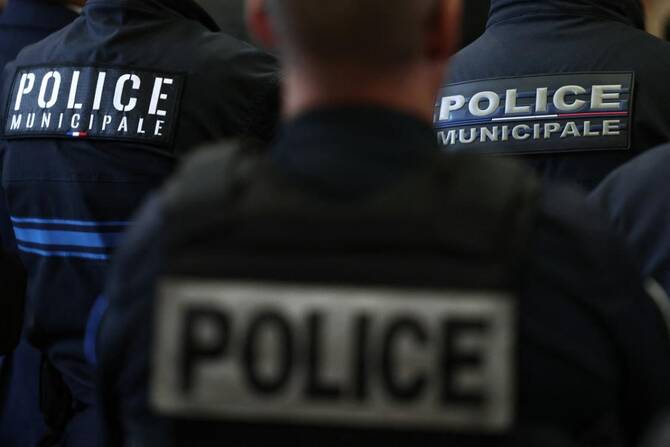
photo shows municipal police and a national police insignia on the vests of officers during a visit by the Interior minister focused on municipal police, in at the city hall of Sartrouville, nortwest of Paris, on September 2, 2025. (AFP)
Short Url
Updated 22 September 2025
Follow

Man goes on trial in France for cold-case murder of schoolgirl

LILLE, France: A man accused of murdering a schoolgirl in northern France over three decades ago goes on trial on Monday, in one of the country’s oldest cold cases to reach court in recent years.
The killing of 17-year-old Nadege Desnoix in 1994 in the Aisne region had for years remained unsolved until DNA evidence led to the arrest of Pascal Lafolie, now 58, in 2021.
Lafolie faces up to 30 years in prison if convicted by the criminal court in the town of Laon. A verdict is expected on Wednesday.
“It’s a miracle that we have got this far,” Arnaud Miel, a lawyer for the victim’s mother, told AFP.
In late May 1994, Desnoix’s stabbed body was discovered under some foliage on a side road leading to her high school in the town of Chateau-Thierry.
Near her schoolbag were a nylon cord and a freshly picked rose. An autopsy revealed no signs of sexual assault.
Investigators looked into numerous leads, including her boyfriend and the notorious serial killer Michel Fourniret, but found no concrete evidence.

- ‘Memory lapses’ -

Genetic evidence was discovered on Desnoix’s clothing, but DNA databases of suspects and people convicted in other cases failed to find a conclusive match — until 2021.
That year, new tests revealed that Lafolie’s DNA, taken a few months earlier in a domestic violence case, matched that found on a hairband Desnoix was wearing when she died.
Lafolie, who has previous convictions for rape and sexual assault, initially confessed to investigators during questioning.
But he later retracted his statement and now says he is innocent.
“His ability to remember is not complete; these events date back more than 30 years,” his lawyer, Justine Devred, told AFP.
“He admits to having been there, he remembers being there with his brother, but then he has memory lapses,” Devred said.
Lafolie says he was driving his brother to an appointment in the area on the day they crossed paths with Desnoix.
He says he tried to stop his brother from harming the girl, prompting his brother to strike him repeatedly on the head, causing gaps in his memory.
The investigation has ruled out the involvement of his brother, who died a few months before Lafolie’s arrest.


’Weak by design’ African Union gathers for summit

Updated 3 sec ago
Follow

’Weak by design’ African Union gathers for summit

ADDIS ABABA: The African Union (AU) holds its annual summit in Ethiopia this weekend at a time of genocide, myriad insurgencies and coups stretching from one end of the continent to the other, for which it has few answers.
The AU, formed in 2002, has 55 member states who are often on opposing sides of conflicts. They have routinely blocked attempts to hand real enforcement power to the AU that could constrain their action, leaving it under-funded and under-equipped.
It has missed successive deadlines to make itself self-funding — in 2020 and 2025. Today, it still relies for 64 percent of its annual budget on the United States and European Union, who are cutting back support.
Its chairman, Mahmoud Ali Youssouf, is reduced to expressing “deep concern” over the continent’s endless crises — from wars in Sudan and the Democratic Republic of Congo to insurgencies across the Sahel — but with limited scope to act.
“At a time when the AU is needed the most, it is arguably at its weakest since it was inaugurated,” said the International Crisis Group (ICG) in a recent report.

- Ignoring own rules -

With 10 military coups in Africa since 2020, the AU has been forced to ignore the rule in its charter that coup-leaders must not stand for elections. Gabon and Guinea, suspended after their coups, were reinstated this past year despite breaking that rule.
Meanwhile, there has been no “deep concern” over a string of elections marred by rigging and extreme violence.
Youssouf was quick to congratulate Tanzania’s President Samia Suluhu Hassan after she won 98 percent in a vote in October in which all leading opponents were barred or jailed and thousands of protesters were killed by security forces.
The AU praised the “openness” of an election in Burundi in June described by Human Rights Watch as “dominated by repression (and) censorship.”
The problem, said Benjamin Auge, of the French Institute of International Relations, is that few African leaders care about how they are viewed abroad as they did in the early days after independence.
“There are no longer many presidents with pan-African ambitions,” he told AFP.
“Most of the continent’s leaders are only interested in their internal problems. They certainly don’t want the AU to interfere in domestic matters,” he added.

- AU ‘supports dialogue’ -

AU representatives point out that its work stretches far beyond conflict, with bodies doing valuable work on health, development, trade and much more.
Spokesman Nuur Mohamud Sheekh told AFP that its peace efforts went unnoticed because they were measured in conflicts that were prevented.
“The AU has helped de-escalate political tensions and support dialogue before situations descend into violence,” he said, citing the work done to prevent war between Sudan and South Sudan over the flashpoint region of Abyei.
But African states show little interest in building up an organization that might constrain them.
Power remains instead with the AU Assembly, made up of individual heads of state, including the three longest-ruling non-royals in the world: Teodoro Obiang Nguema of Equatorial Guinea (46 years), Paul Biya of Cameroon (44) and Yoweri Museveni of Uganda (40).
“The African Union is weak because its members want it that way,” wrote two academics for The Conversation last year.
This weekend, the rotating presidency of the AU assembly passes to Burundi’s President Evariste Ndayishimiye, fresh from his party’s 97-percent election victory.
Coups, conflicts and rights abuses may get discussed, but the main theme is water sanitation.