

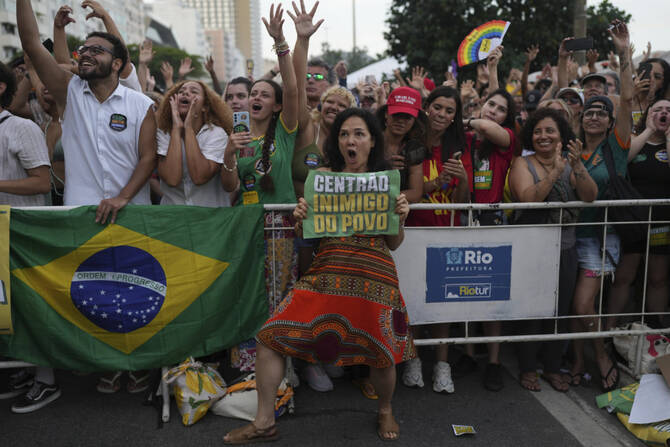

RIO DE JANEIRO, Brazil: Tens of thousands of Brazilians protested Sunday against “shameless” lawmakers seeking an amnesty that could benefit former president Jair Bolsonaro, while pushing to shield themselves from criminal charges.
Bolsonaro was sentenced last week to 27 years in jail for plotting a coup, and within days, the conservative-majority Congress had fast-tracked an amnesty bill that could include the far-right leader.
“No amnesty,” crowds roared in dozens of Brazilian cities, holding up signs and wearing stickers reading “Shameless Congress.”
Protesters were also outraged by what they dubbed the “Banditry Bill” passed this week. The law would require Congress to vote by secret ballot to give the go-ahead for one its own to be charged or arrested.
“This protection they seek is to camouflage corruption, impunity,” said Giovana Araujo, 27, a psychology student clad in a blue bikini top in the sweltering heat at a “musical protest” on Rio de Janeiro’s Copacabana beach.
Iconic octogenarians of Brazilian music, Caetano Veloso, Gilberto Gil, and Chico Buarque, took to a truck-mounted stage alongside palm trees to sing resistance songs from Brazil’s dictatorship era.
Tens of thousands sang along as a blow-up doll of Bolsonaro wearing black-and-white prison stripes bobbed next to one of US President Donald Trump, who has punished Brazil with tariffs in retaliation for the prosecution of his ally.
Veloso, 83, said musicians “could not fail to respond to the horrors that have been creeping in around us.”
The artists “were literally boycotted during the military dictatorship, and seeing them here is synonymous with resistance,” said Araujo, describing their appearance as “revolutionary.”
“Once again, artists are mobilizing the people to demand justice in this country,” said Yasmin Aimee Coelho Pessoa, a 20-year-old sociology student, with gold glitter around her eyes.
‘Choking point’
In the megalopolis Sao Paulo, protesters unfurled a giant Brazilian flag, in response to a US flag displayed at a pro-Bolsonaro march earlier this month.
The Political Debate Monitor at the University of Sao Paulo estimated crowds of 42,000 in the economic heartland, and a similar figure in Rio de Janeiro — the biggest turnout for the left since President Luiz Inacio Lula da Silva was re-elected in 2022.
Lula’s razor-thin victory set off a series of political crises that still reverberate in Brazil today.
Bolsonaro was convicted of plotting to bar Lula from taking office, in a plan that judges said only failed due to a lack of support from military top brass.
Congress is pushing to offer amnesty to 700 of his supporters who were convicted of storming government buildings a week after Lula took office in January 2023, a bill that could include a pardon for Bolsonaro.
Further stoking public anger, lawmakers passed the bill to boost their immunity, citing the need for protection against judicial overreach.
“The left is reorganizing in the face of all these atrocities. And I feel like we’ve reached that choking point — it’s stuck in our throats, ready to come out as a scream,” said Henrique Marques, a 42-year-old environmental engineer, who was among thousands protesting in the capital Brasilia.
Several deputies took to social media to apologize for voting for the controversial “Shielding Bill” saying they had faced pressure to do so in a fragmented parliament.
One state deputy, Pedro Campos, said he had voted for the bill to “prevent the boycott of important agendas” for the government of President Lula.
Both bills face an uphill battle in the Senate. Lula has vowed to veto the amnesty bill.
He also said the “Shielding Bill” was not the kind of “serious matter” that lawmakers should be dealing with.


