


RIYADH: Tom Fletcher, the UN under-secretary-general for humanitarian affairs and emergency relief coordinator, paints a stark picture of the current humanitarian landscape, warning this year may surpass the previous as the deadliest for aid workers.
Appearing on the Arab News current affairs program “Frankly Speaking,” Fletcher described the brutal conditions humanitarians face worldwide amid intensifying conflicts and crises — especially in Gaza, which has been under Israeli siege and bombardment for almost two years.
“Last year was the deadliest year to be a humanitarian worker. And of course, it’s much easier than being a civilian under the bombs in these places we work,” Fletcher told “Frankly Speaking” host Ali Itani, who was filling in for Katie Jensen.
“I fear that this may well be the most dangerous year in recorded history for aid workers.”

Appearing on the Arab News current affairs program “Frankly Speaking,” Tom Fletcher described the brutal conditions humanitarians face worldwide amid intensifying conflicts and crises — especially in Gaza. (AN Photo)
A record 383 aid workers were killed worldwide in 2024, according to UN figures released on August 19 to mark World Humanitarian Day. Nearly half of those deaths — 181 — occurred in Gaza.
So far in 2025, at least 265 aid workers have been killed globally, representing a 54 percent increase compared to the same period last year. Around 65 percent of the aid workers killed in 2025 have been in Gaza.
Fletcher highlighted the relentless physical and mental toll faced by aid workers, citing ongoing attacks that have cost lives, especially in hotspots like Gaza.
“It’s brutal and there’s not enough accountability. No one is being held to account for what’s happening to us. Where are these weapons coming from which are killing our people and killing those that we serve?” he asked.
Fletcher also paid tribute to the bravery of humanitarian teams who “continue to go into danger, towards the sound of gunfire in order to save lives” everywhere from Haiti to the Democratic Republic of Congo.
Alongside these risks, Fletcher stressed that aid organizations face severe underfunding. “We are massively underfunded. The appeals right now are only 19 percent funded,” he said, exposing a vast gap between global need and available resources.
Being candid about the UN itself, Fletcher acknowledged its flaws, yet insisted it remains the best mechanism humanity has to foster global cooperation.
The UN “of course is not perfect,” Fletcher said. “I work in it. This can be even better. That’s why the Secretary-General has set out the reform program. But it’s still the best model we have for global coexistence.”
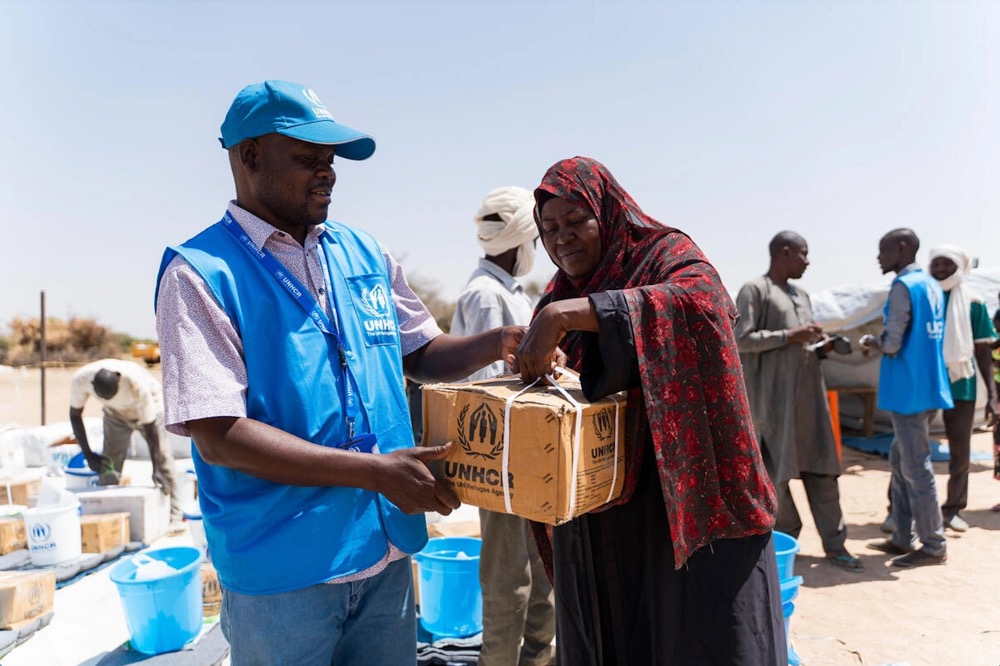
A woman receives a package of non-food items after arriving at the Dougui refugee settlement. (UNHCR)
He said that those critics who are pushing for renewal and reform are correct, describing ongoing efforts as “defining much more clearly our work around saving lives,” reducing bureaucracy, and devolving power closer to communities in need.
Addressing the humanitarian funding crisis, Fletcher painted a sobering picture. “We’re taking a battering right now,” he said. “And we will fight for the system. We won’t let this go easily. This is a hill we will die on, that we will defend at all costs.
“The appeals are only 19 percent funded. Hundreds of millions of people are not getting the life-saving support they need.”
Yet he offered a clear, precise call to global governments and citizens alike. “All we’re asking, in order to save over 100 million lives, if we got just 1 percent of what the world currently spends on arms, on defense, then we could do it,” he said.
“Somewhere along the line, the priorities are out of place. And we’ve got to get those priorities back where they should be. And we’ve got to fund this effort.”
Fletcher spoke forcefully on the ongoing humanitarian crisis in Gaza. He slammed Israel’s blockade, demanding “full, unequivocal access so that we can stop that starvation and reach all those civilians inside Gaza.”
Aid distribution in the embattled enclave is currently managed by the Gaza Humanitarian Foundation — a private aid organization established in early 2025, backed by the Israeli and US governments.
Unlike the UN and traditional humanitarian agencies, which operate numerous smaller distribution points, the GHF runs a limited number of heavily secured aid hubs mostly in southern Gaza, guarded by Israeli military oversight and armed private contractors.
The GHF says it prevents aid being diverted to Hamas. Critics argue the GHF militarizes aid, breaks humanitarian principles of neutrality, independence, and impartiality, and concentrates aid delivery in restricted locations that force civilians to travel despite evacuation orders.
Its distribution sites have been associated with repeated deadly incidents and mass killings allegedly linked to Israeli military actions, raising serious safety concerns.
Asked whether UN agencies would ever consider working with the Gaza Humanitarian Foundation, Fletcher said his colleagues were far better placed to distribute aid.
“We’ve been clear that we won’t be working through the GHF mechanism,” he said. “We know we can do this at scale. We have the trucks. We have the convoys. We have the community networks. We have the experience.”

A Palestinian carries a bag containing aid near a Gaza Humanitarian Foundation distribution center operated by the US-backed organization, Netzarim, central Gaza Strip, in August. (AP/File Photo)
He called on Israeli authorities to “let us in, let us deliver,” underscoring the urgency of removing bureaucratic obstacles and the barriers holding aid trucks at the borders.
Returning to a broader theme, Fletcher described the UN’s plan to strengthen global cooperation. “This really is, I think, the most consequential High-Level Week for a generation,” he said, highlighting Secretary-General Antonio Guterres’ bold reform agenda.
“We are reforming, we’re regrouping, particularly bringing in the voices of those who miss out, lose out in this strongman, survival-of-the-fittest world.
“But also that we’re renewing, that we’re imagining what we can be alongside defending what we do. I think this is the week that the UN and the multilateral system and global coexistence fight back.”
Syria’s new leadership is attending the UN General Assembly for the first time since the fall of the Assad regime in December last year. Fletcher said there is a collective responsibility to engage with and support the country’s development.
“It is on all of us now to demonstrate a sustained, patient, ambitious commitment to Syria’s development, long-term development, that we get behind the Syrian leadership,” he said.
Fletcher recalled an earlier visit after President Ahmad Al-Sharaa took power when Syrians expressed a desire to transition “from a position where it still needs humanitarian support to one where it is really leading its own recovery with that international backing” — a goal rooted in Syrian aspirations to regain dignity and normalcy.
Fletcher also identified Sudan as a key humanitarian concern for this year’s High-Level Week, stressing the need for increased aid access and urgent support.
“We have to keep hammering away for access to all of Sudan. We’ve got to get properly into Darfur... I’m very worried at the moment about El-Fasher, so we’ve got to get the convoys of aid moving at scale.”

During his appearance on Frankly Speaking, Fletcher also paid tribute to the bravery of humanitarian teams who “continue to go into danger, towards the sound of gunfire in order to save lives.” (AN Photo)
On September 12, Saudi Arabia, the US, Egypt, and the UAE announced a joint roadmap aiming to bring peace to Sudan, which has endured conflict since April 2023.
Their plan called for a three-month humanitarian ceasefire, followed by an immediate permanent ceasefire, and then a nine-month political transition process to establish a civilian-led government.
Fletcher praised the opening created by the quad. “We’ve got to push through that opening and make sure we’re really surging humanitarian support, because Sudan is the big one — 30 million people need our help right now.”
As High-Level Week gets underway, Fletcher underscored the challenges facing the UN system amid rising global polarization and power struggles.
“There’s a danger that as we move further from the middle of the 20th century... people forget why these institutions were created,” he said.
“They forget the horror that you get if you leave polarization, extremism, radicalism, nationalism just to take root and to spread.”
He stressed the necessity of recommitting to the values that underpin the UN and acknowledged the calls for reform as both justified and vital.
“That’s why the secretary-general has set out the reform program. But it’s still the best model we have for global coexistence.” Fletcher urged member states and the global community to rally in defense of these institutions and ideals.
His message to world leaders was both urgent and hopeful.
“We need member states, everyone coming to New York right now, to show where they stand and to stand for coexistence, to stand for those without a voice, and to get to work, to roll up their sleeves, to stop conflicts and save lives.”

keywords


