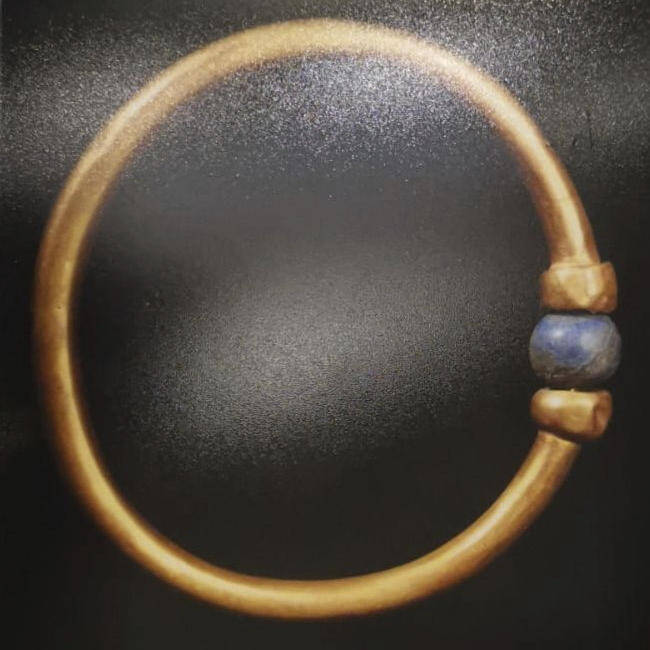
CAIRO: Egyptians reacted with outrage this week after officials said that a 3,000-year-old bracelet that had belonged to an ancient pharaoh was stolen from Cairo’s famed Egyptian Museum and then melted down for gold.
Tourism and Antiquities Minister Sherif Fathy said in televised comments late Saturday that the bracelet was stolen on Sep. 9 while officials at the museum were preparing artifacts for an exhibit in Italy. He blamed “laxity” in implementing procedures at the facility and said that prosecutors were still investigating.
The bracelet, containing a lapis lazuli bead, belonged to Pharaoh Amenemope, who reigned about 3,000 years ago. Authorities said it was taken from a restoration lab at the museum and then funneled through a chain of dealers before being melted down. The minister said the lab didn’t have security cameras.
Four suspects have been arrested and questioned, including a restoration specialist at the museum, the Interior Ministry said.
According to the Interior Ministry, the restoration specialist who was arrested confessed to giving the bracelet to an acquaintance who owns a silver shop in Cairo’s Sayyeda Zainab district. It was later sold to the owner of a gold workshop for the equivalent of about $3,800. It was eventually sold for around $4,000 to a worker at another gold workshop, who melted the bracelet down to make other gold jewelry.
The suspects confessed to their crimes and the money was seized, the ministry said in a statement on Thursday.
The ministry also released security camera video showing a shop owner receiving a bracelet, weighing it, and then paying one of the suspects.
The loss of a treasure that had survived for three millennia was painful to many people in Egypt, where there is great esteem for the nation’s ancient heritage.
Some questioned security measures at the museum and called for tightening these measures around the country’s treasures.
Monica Hanna, a prominent Egyptian archaeologist, called for suspending oversees exhibits “until better control” is implemented to secure the artifacts. Hanna is the dean at the Arab Academy for Science, Technology & Maritime Transport, and campaigns for the return of Egyptian artifacts exhibited in museums overseas.
Malek Adly, an Egyptian human rights lawyer, called the theft “an alarm bell” for the government and said better security is needed for antiquities in exhibition halls and those in storage.
Amenemope ruled Egypt from Tanis in the Nile Delta during Egypt’s 21st Dynasty. The Tanis royal necropolis was discovered by the French archaeologist Pierre Montet in 1940, according to the Egyptian Museum.
The necropolis’ collection exhibits about 2,500 ancient artifacts, including golden funerary masks, silver coffins and golden jewels. The collection was restored in 2021 in cooperation with the Louvre Museum in Paris.
The theft reminded some of past cultural losses, including the brief disappearance of a Vincent van Gogh’s “Poppy Flowers” — then valued at $50 million — from another Cairo museum in 2010. That painting was recovered within hours.


![]()
![]()

Egyptians outraged after ancient pharaoh’s bracelet was stolen from Cairo museum and melted down

Short Url
https://arab.news/ydqr6
Egyptians outraged after ancient pharaoh’s bracelet was stolen from Cairo museum and melted down
- Egyptians have expressed outrage after a 3,000-year-old bracelet belonging to an ancient pharaoh was stolen from Cairo’s Egyptian Museum and melted down for gold
- Tourism and Antiquities Minister Sherif Fathy said Saturday that the bracelet was stolen on September 9 while being prepared for an exhibit in Italy


Latest updates


© 2026 SAUDI RESEARCH & PUBLISHING COMPANY, All Rights Reserved And subject to Terms of Use Agreement.