

Pakistan health minister vaccinates daughter on live TV to counter cervical-cancer jab rumors

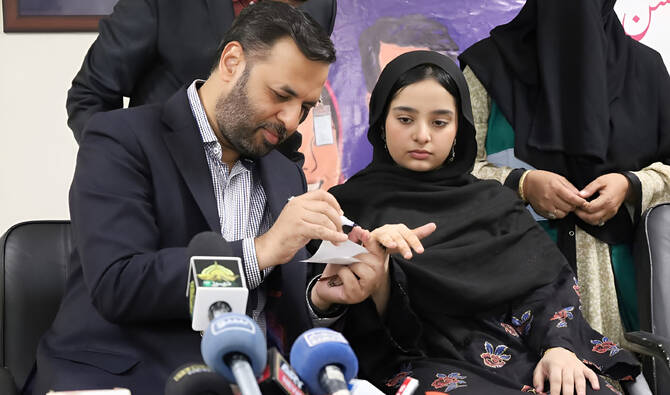
Pakistan’s Health Minister Mustafa Kamal (left) marks his daughter’s finger after she received a cervical cancer vaccine in Karachi, Pakistan, on September 20, 2025. (Facebook/Syed Mustafa Kamal)
Short Url
Updated 21 September 2025
Follow

Pakistan health minister vaccinates daughter on live TV to counter cervical-cancer jab rumors

  • Pakistan’s HPV vaccine rollout earlier this month sparked social media rumors it could cause infertility
  • Mustafa Kamal says 150 countries, including almost all Muslim states, used the vaccine before Pakistan

KARACHI: Pakistan’s health minister had his daughter vaccinated against cervical cancer on live television on Saturday to counter rumors about side effects, a symbolic move aimed at reassuring parents as the country rolls out the shot nationwide.

Since Pakistan began offering the Human Papillomavirus (HPV) vaccine this month, social media posts have circulated claiming girls were falling sick and that the jab could cause infertility.

Health officials and international agencies say the typical side effects are mild and temporary — such as soreness in the arm or a brief fever — and there is no scientific evidence linking the vaccine to infertility.

“Pakistan is the 151st country in the world where this vaccination has been administered,” Health Minister Mustafa Kamal said at a news conference after the televised inoculation. “Prior to that, this vaccine has been used in 150 countries in which almost all Muslim states are included.”

He acknowledged it was difficult to bring his family before the cameras but said he wanted to highlight prevention.

“Since the start of this vaccination, there has been negative and misleading propaganda,” he said. “Today I thought that no Pakistani mother, sister or daughter should refuse this vaccine because of false propaganda and then lose her life as a result.”

Pakistan introduced the HPV shot in September with support from the World Health Organization (WHO), UNICEF and the Gavi vaccine alliance. The first phase targets girls aged 9 to 14 in selected districts, with authorities planning to expand coverage in coming years.

The vaccine protects against cervical cancer, which develops from persistent infection with high-risk types of the HPV, a common virus that can cause cancers later in life, according to the Centers for Disease Control and Prevention.

Vaccination before exposure can prevent most cases, according to the WHO, which has recommended the jab for adolescent girls since 2006.

Cervical cancer is one of the leading cancers among women in Pakistan.

The International Agency for Research on Cancer, a WHO body, said in April there were an estimated 4,762 new cases of cervical cancer in 2023, resulting in about 3,069 deaths from the disease.


IMF board to approve Pakistan reviews today ‘if all goes well,’ say officials

Updated 4 sec ago
Follow

IMF board to approve Pakistan reviews today ‘if all goes well,’ say officials

  • IMF’s executive board is scheduled to meet today to discuss the disbursement of $1.2 billion
  • Economists say the money will boost Pakistan’s forex reserves, send positive signals to investors

KARACHI: The International Monetary Fund’s (IMF) executive board is scheduled to meet today, Monday, to approve the release of about $1.2 billion for Pakistan under the lender’s two loan facilities, said IMF officials who requested not to be named.

The IMF officials confirmed the executive board was going to decide on the Fund’s second review under the $7 billion Extended Fund Facility (EFF) and first review under the $1.4 billion Resilience and Sustainability Facility (RSF), a financing tool that provides long-term, low-cost loans to help countries address climate risks.

“The board meeting will be taking place as planned,” an IMF official told Arab News.

“The board is on today yes as per the calendar,” said another.

A well-placed official at Pakistan’s finance ministry also confirmed the board meeting was scheduled today to discuss the next tranche for Pakistan.

The IMF executive board’s meeting comes nearly two months after a staff-level agreement (SLA) was signed between the two sides in October.

Procedurally, the SLAs are subject to approval by the executive board, though it is largely viewed as a formality.

“If all goes well, the reviews should pass,” said the second IMF official.

On approval, Pakistan will have access to about $1 billion under the EFF and about $200 million under the RSF, the IMF said in a statement in October after the SLA.

The fresh transfer will bring total disbursements under the two arrangements to about $3.3 billion, it added.

Experts see smooth sailing for Pakistan in terms of the passing of the two reviews, saying the IMF disbursements will help the cash-strapped nation to strengthen its balance of payments position.

Samiullah Tariq, group head of research at Pakistan Kuwait Investment Company Limited, said the IMF board’s approval will show that Pakistan’s economy is on the right path.

“It obviously will help strengthen [the country’s] external sector, the balance of payments,” he told Arab News.

Until recently, Pakistan grappled with a macroeconomic crisis that drained its financial resources and triggered a balance of payments crisis.

Pakistan has reported financial gains since 2022, recording current account surpluses and taming inflation that touched unprecedented levels in mid-2023.

Economists also viewed the IMF’s bailout packages as crucial for cash-strapped Pakistan, which has relied heavily on financing from bilateral partners such as Saudi Arabia, China and the United Arab Emirates, as well as multilateral lenders.

Saudi Arabia, through the Saudi Fund for Development, last week extended the term of its $3 billion deposit for another year to help Pakistan boost its foreign exchange reserves, which stood at $14.5 billion as of November 28, according to State Bank of Pakistan statements.

“In our view this [IMF tranche] will be approved,” said Shankar Talreja, head of research at Karachi-based brokerage Topline Securities Limited.

“This will help strengthen reserves and will eventually help a rating upgrade going forward,” he said.

The IMF board’s nod, Talreja said, would also send a signal to the international and local investors regarding the continuation of the reform agenda by Pakistan’s government.