

Pakistan health minister vaccinates daughter on live TV to counter cervical-cancer jab rumors

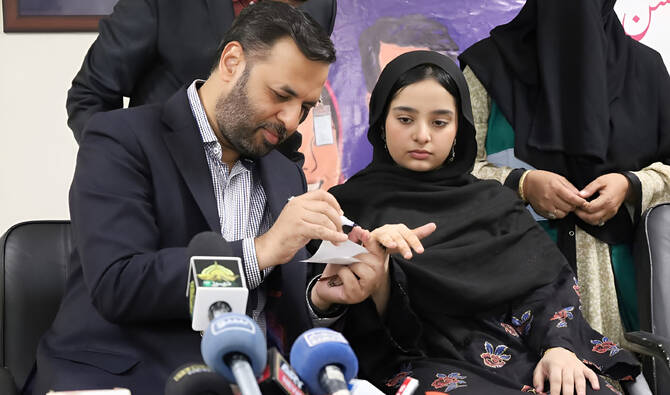
Pakistan’s Health Minister Mustafa Kamal (left) marks his daughter’s finger after she received a cervical cancer vaccine in Karachi, Pakistan, on September 20, 2025. (Facebook/Syed Mustafa Kamal)
Short Url
Updated 21 September 2025
Follow

Pakistan health minister vaccinates daughter on live TV to counter cervical-cancer jab rumors

  • Pakistan’s HPV vaccine rollout earlier this month sparked social media rumors it could cause infertility
  • Mustafa Kamal says 150 countries, including almost all Muslim states, used the vaccine before Pakistan

KARACHI: Pakistan’s health minister had his daughter vaccinated against cervical cancer on live television on Saturday to counter rumors about side effects, a symbolic move aimed at reassuring parents as the country rolls out the shot nationwide.

Since Pakistan began offering the Human Papillomavirus (HPV) vaccine this month, social media posts have circulated claiming girls were falling sick and that the jab could cause infertility.

Health officials and international agencies say the typical side effects are mild and temporary — such as soreness in the arm or a brief fever — and there is no scientific evidence linking the vaccine to infertility.

“Pakistan is the 151st country in the world where this vaccination has been administered,” Health Minister Mustafa Kamal said at a news conference after the televised inoculation. “Prior to that, this vaccine has been used in 150 countries in which almost all Muslim states are included.”

He acknowledged it was difficult to bring his family before the cameras but said he wanted to highlight prevention.

“Since the start of this vaccination, there has been negative and misleading propaganda,” he said. “Today I thought that no Pakistani mother, sister or daughter should refuse this vaccine because of false propaganda and then lose her life as a result.”

Pakistan introduced the HPV shot in September with support from the World Health Organization (WHO), UNICEF and the Gavi vaccine alliance. The first phase targets girls aged 9 to 14 in selected districts, with authorities planning to expand coverage in coming years.

The vaccine protects against cervical cancer, which develops from persistent infection with high-risk types of the HPV, a common virus that can cause cancers later in life, according to the Centers for Disease Control and Prevention.

Vaccination before exposure can prevent most cases, according to the WHO, which has recommended the jab for adolescent girls since 2006.

Cervical cancer is one of the leading cancers among women in Pakistan.

The International Agency for Research on Cancer, a WHO body, said in April there were an estimated 4,762 new cases of cervical cancer in 2023, resulting in about 3,069 deaths from the disease.


Over 200 security forces personnel killed in Balochistan militant attacks in 2025— chief minister

Updated 46 min 29 sec ago
Follow

Over 200 security forces personnel killed in Balochistan militant attacks in 2025— chief minister

  • Pakistani security forces launched thousands of operations, killed 760 militants, says Sarfraz Bugti
  • Pakistan’s military media wing says 12 “Indian-sponsored militants” killed in Balochistan’s Kalat district

ISLAMABAD: Over 200 security forces personnel were killed in several militant attacks in Pakistan’s southwestern Balochistan province this year, Chief Minister Sarfraz Bugti said on Sunday. 

Balochistan, Pakistan’s largest province by since yet its most backward by almost all social and economic indicators, has suffered from a bloody separatist insurgency for decades launched by ethnic Baloch militant groups. The most prominent among them is the Balochistan Liberation Army.

These militant outfits accuse the military and federal government of denying the local Baloch population a share in the province’s mineral wealth, charges Islamabad denies. 

“We have lost [in one year] 205 security forces personnel, including paramilitary, uniformed, police, levies, and along with that, there are six officers,” Bugti told reporters during a press conference. 

The chief minister said Balochistan had witnessed 900 militant attacks throughout the year, adding that the number of civilian casualties was recorded at 280. 

Bugti said security forces had also launched thousands of intelligence-based operations in 2025 against militants. 

“Out of those, the terrorists who have been killed so far, that is 760,” he said. 

TWELVE MILITANTS KILLED IN KALAT 

Separately, the Pakistani military’s media wing said on Sunday that security forces had killed 12 “Indian-sponsored militants” in Balochistan’s Kalat district on Dec. 6. 

It said the militants belonged to Indian proxy “Fitna al Hindustan,” a term the military uses frequently to describe ethnic Baloch militant groups who demand independence from Pakistan. Islamabad accuses New Delhi of arming and funding these separatist groups, charges India has always denied.

“Weapons, ammunition and explosives were also recovered from the terrorists, who remained actively involved in numerous terrorist activities in the area,” the ISPR said. 

Balochistan, which borders Afghanistan, has seen a surge in militant attacks in recent months. Pakistan’s military said on Saturday that security forces had killed five militants in the Dera Bugti area of the province.