

Pakistan says UNSC vote against lifting Iran sanctions risks Middle East instability

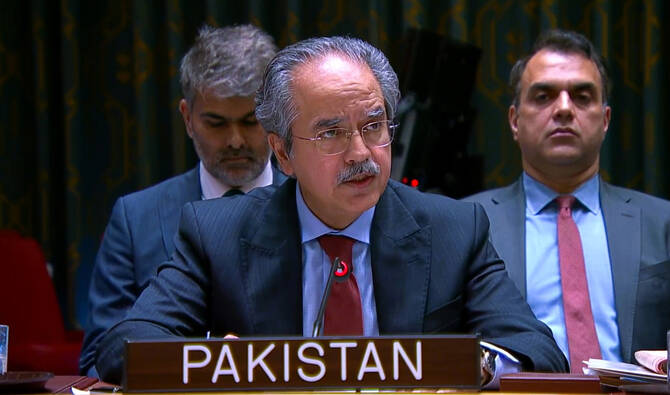
Pakistan’s permanent representative to the United Nations, Ambassador Asim Iftikhar Ahmad, speaks during a UN Security Council session at the United Nations in New York on September 20, 2025. (X/@PakistanUN_NY)
Short Url
Updated 20 September 2025
Follow

Pakistan says UNSC vote against lifting Iran sanctions risks Middle East instability

  • A UNSC resolution aimed at halting reimposition of sanctions on Iran over its nuclear program failed Friday after weeks of diplomatic talks
  • Pakistan’s envoy Asim Iftikhar Ahmad says the Middle East region cannot afford further tensions and that diplomacy should be given a chance

ISLAMABAD: Pakistan has said that it does not favor the United Nations Security Council (UNSC) decision against lifting of Iran sanctions as it risks destabilizing a region that is already mired in multiple crises, Pakistan’s UN envoy said on Friday.

A UNSC resolution aimed at halting the reimposition of sanctions on Iran over its nuclear program failed Friday after weeks of last-ditch diplomatic talks appeared to break down days before the annual UN gathering of world leaders.

The resolution put forth by South Korea, the current president of the 15-member council, did not garner the support of the nine countries required to halt the series of sanctions from taking effect at the end of the month, as outlined in Iran’s 2015 nuclear deal with world powers.

Only four countries, China, Russia, Pakistan and Algeria, supported the effort, with some using the meeting to blast the European leaders for what they called an unjustified and illegal action against Iran.

“We do not favor any action which risks destabilizing a region that is already mired in multiple crises. This region cannot afford further tensions,” Pakistan’s permanent representative to the UN, Ambassador Asim Iftikhar Ahmad, told the council.

“We believe that even at this stage, diplomacy should be given a chance.”

Last month, France, Germany and the United Kingdom moved to trigger the “snapback mechanism,” which automatically reimposes all UN sanctions that were in effect before the nuclear deal.

Those penalties included a conventional arms embargo, restrictions on ballistic missile development, asset freezes, travel bans and a ban on producing nuclear-related technology. Iran is already reeling from a 12-day war with Israel and a decades-long financial crisis.

Using the snapback mechanism will likely heighten tensions between Iran and the West. It’s unclear how Iran will respond, given that in the past, officials have threatened to withdraw from the Nuclear Nonproliferation Treaty, potentially following North Korea, which abandoned the treaty in 2003 and then built atomic weapons.

Iran’s Foreign Ministry, in a statement on Friday, emphasized its commitment to safeguarding its interests and rights, including through diplomacy, and said it reserves the right to respond appropriately to any unlawful action.

The Pakistani envoy stressed the need to continue diplomatic engagement with Iran to address any outstanding issues in a “cooperative manner, in accordance with the rights, obligations and responsibilities of the parties.

“We must prioritize this approach and never give up on a peaceful negotiated settlement. Diplomacy and intimidation do not go together,” he added.


Curfew extended in Gilgit-Baltistan, probe ordered after deadly Khamenei protests

Updated 03 March 2026
Follow

Curfew extended in Gilgit-Baltistan, probe ordered after deadly Khamenei protests

  • At least 15 people were killed in clashes with law enforcement agencies over the weekend in Gilgit-Baltistan
  • Government also announces a de-weaponization campaign, crackdown on hate speech and cybercrime in region

ISLAMABAD: The government in Pakistan’s Gilgit-Baltistan (GB) region on Tuesday extended a curfew in Gilgit district and ordered a judicial probe into violent protests over the killing of Iranian Supreme Leader Ali Khamenei in US-Israeli strikes last week, an official said.

At least 15 people were killed in clashes with law enforcement agencies over the weekend in GB, where protesters torched and vandalized several buildings, including United Nations regional offices, an army-run school, software technology park and a local charity building.

The violence prompted regional authorities to impose curfew in Gilgit and Skardu districts on March 2-4 as officials urged people to stay indoors and cooperate with law enforcers, amid widespread anger in Pakistan, particularly among members of the Shiite minority, over Khamenei’s killing.

On Tuesday, the GB government convened to review the situation and announced the extension of curfew in Gilgit among a number of security measures as well as ordered the establishment of a judicial commission to investigate the weekend violence in the region.

“The government has made it clear that the law will strictly take its course against elements involved in vandalism at government institutions, private properties and incidents of vandalism in Gilgit and Skardu and no kind of mischief will be tolerated,” Shabbir Mir, a GB government spokesperson, said in a statement.

“In view of the security situation, curfew will remain in force in Gilgit, while the decision to extend the curfew in Skardu will be taken keeping the ground realities and the changing situation in view.”

The statement did not specify how long the curfew will remain in place in Gilgit.

Besides the formation of the judicial commission to investigate the violent clashes, the government also decided to launch a large-scale de-weaponization campaign in the entire Gilgit district, for which relevant institutions have been directed to immediately complete all necessary arrangements, according to Mir.

In addition, a crackdown has been ordered on hate speech, spread of fake news and cybercrime.

“The aim of these decisions is to ensure the rule of law, protect the lives and property of citizens and crack down on miscreants,” he said. “Approval has also been given to immediately survey the affected infrastructure and start their restoration work on priority basis.”

Demonstrators in Pakistan’s southern port city of Karachi also stormed the US Consulate on Sunday, smashing windows and attempting to burn the building. Police responded with batons, tear gas, and gunfire, leaving 10 people dead and more than 50 injured.

Pakistani authorities have since beefed up security at US diplomatic missions across the country, including around the US consulate building in Peshawar, to avoid any further violence.