

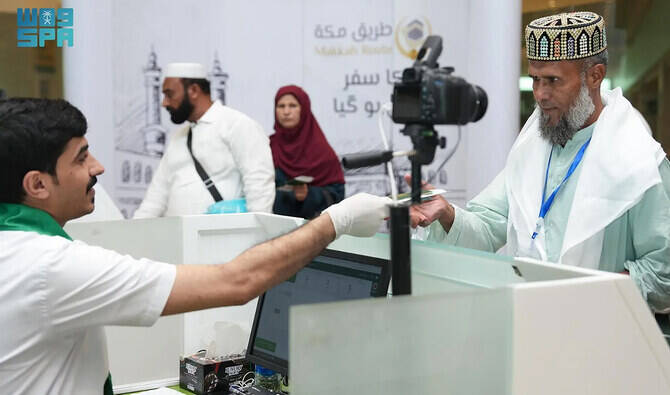
Pakistan warns 16 Hajj operators over payment breaches, threatens blacklisting

In this file photo, taken and released by the Saudi Press Agency on May 26, 2024, Saudi official hands over a passport to a Pakistani pilgrim at the Jinnah International Airport in Karachi. (SPA/File)
Short Url
Updated 20 September 2025
Follow

Pakistan warns 16 Hajj operators over payment breaches, threatens blacklisting

  • Ministry says operators collected payments directly from pilgrims instead of using designated banks
  • Private Hajj quota cut to 33 percent after 63,000 people missed last year’s pilgrimage due to mismanagement

ISLAMABAD: Pakistan’s religious affairs ministry sent a warning letter this week to 16 private Hajj companies, saying they had been taking payments from prospective pilgrims directly instead of using designated banks while threatening to blacklist them and cancel their quota if they fail to comply.

Pakistan traditionally divides the national Hajj quota equally between government and private schemes. Last year, nearly 63,000 pilgrims were unable to perform Hajj under the private scheme due to delayed payments and mismanagement, prompting the authorities to cut the private sector quota to 33 percent this year.

The ministry noted in its letter that no vouchers had been submitted by these companies, with their deposits showing a zero balance.

“This constitutes a serious violation of the Service Providers’ Agreement (SPA), Hajj Policy and Cabinet directives,” said the letter written on Sept. 15, a copy of which is in possession of Arab News.

The ministry asked these companies to ensure immediate compliance with the SPA and submit all relevant vouchers to banks.

“Please note that failure to comply with these directions shall invite strict action, including permanent blacklisting and revocation of your quota,” it added.

Federal Minister for Religious Affairs Sardar Muhammad Yousuf told Arab News earlier this month Pakistan had filled its entire quota of 179,210 Hajj pilgrims under both the government and private schemes, adding that negotiations were underway with Saudi companies to finalize transport and accommodation arrangements.

He said the ministry had taken serious action against private Hajj operators since last year, and would review their performance this time and decide their future quotas accordingly.


UN torture expert decries Pakistan ex-PM Khan’s detention

Updated 12 December 2025
Follow

UN torture expert decries Pakistan ex-PM Khan’s detention

  • Khan’s party alleges government is holding him in solitary confinement, barring prison visits
  • Pakistan’s government rejects allegations former premier is being denied basic rights in prison

GENEVA: Pakistan’s former prime minister Imran Khan is being held in conditions that could amount to torture and other inhuman or degrading treatment, the United Nations’ special rapporteur on torture warned Friday.

Alice Jill Edwards urged Pakistan to take immediate and effective action to address reports of the 73-year-old’s inhumane and undignified detention conditions.

“I call on Pakistani authorities to ensure that Khan’s conditions of detention fully comply with international norms and standards,” Edwards said in a statement.

“Since his transfer to Adiala Jail in Rawalpindi on September 26, 2023, Imran Khan has reportedly been held for excessive periods in solitary confinement, confined for 23 hours a day in his cell, and with highly restricted access to the outside world,” she said.

“His cell is reportedly under constant camera surveillance.”

Khan an all-rounder who captained Pakistan to victory in the 1992 Cricket World Cup, upended Pakistani politics by becoming the prime minister in 2018.

Edwards said prolonged or indefinite solitary confinement is prohibited under international human rights law and constitutes a form of psychological torture when it lasts longer than 15 days.

“Khan’s solitary confinement should be lifted without delay. Not only is it an unlawful measure, extended isolation can bring about very harmful consequences for his physical and mental health,” she said.

UN special rapporteurs are independent experts mandated by the Human Rights Council. They do not, therefore, speak for the United Nations itself.

Initially a strong backer of the country’s powerful military leadership, Khan was ousted in a no-confidence vote in 2022, and has since been jailed on a slew of corruption charges that he denies.

He has accused the military of orchestrating his downfall and pursuing his Tehreek-e-Insaf (PTI) party and its allies.

Khan’s supporters say he is being denied prison visits from lawyers and family after a fiery social media post this month accusing army leader Field Marshal Asim Munir of persecuting him.

According to information Edwards has received, visits from Khan’s lawyers and relatives are frequently interrupted or ended prematurely, while he is held in a small cell lacking natural light and adequate ventilation.

“Anyone deprived of liberty must be treated with humanity and dignity,” the UN expert said.

“Detention conditions must reflect the individual’s age and health situation, including appropriate sleeping arrangements, climatic protection, adequate space, lighting, heating, and ventilation.”

Edwards has raised Khan’s situation with the Pakistani government.