

Japan and Bahrain eye greater business cooperation

1 / 4
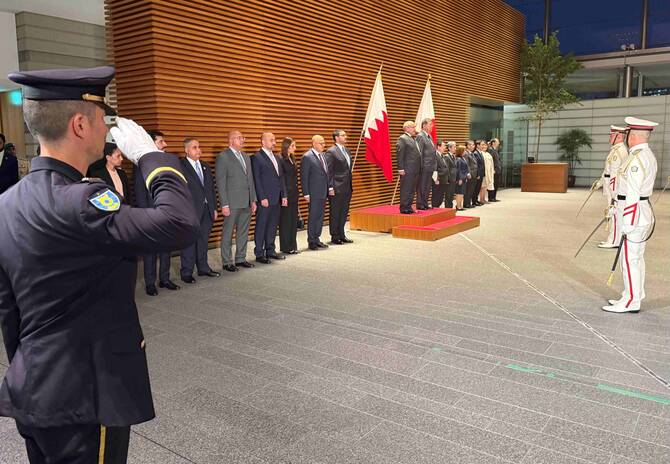
In their meeting in Tokyo on Friday, Iwaya and Prince Salman also exchanged views on the situation in the Middle East, including Gaza. (MOFA)
2 / 4
In their meeting in Tokyo on Friday, Iwaya and Prince Salman also exchanged views on the situation in the Middle East, including Gaza. (MOFA)
3 / 4
In their meeting in Tokyo on Friday, Iwaya and Prince Salman also exchanged views on the situation in the Middle East, including Gaza. (MOFA)
4 / 4
In their meeting in Tokyo on Friday, Iwaya and Prince Salman also exchanged views on the situation in the Middle East, including Gaza. (MOFA)
Short Url
Updated 19 September 2025
Follow

Japan and Bahrain eye greater business cooperation

  • Bahrain PM holds discussions with counterparts in Tokyo
  • Palestine on agenda, commitment to ‘two-state solution’

TOKYO: Japan’s Foreign Minister Takeshi Iwaya and Bahrain’s Prime Minister and Crown Prince Salman bin Hamad Al-Khalifa held talks here on Friday to boost business cooperation.

Iwaya highlighted frameworks for such cooperation including the Foreign Ministers’ Strategic Dialogue, Tokyo’s Foreign Ministry reported.

Iwaya and his Bahraini counterpart Dr. Abdullatif bin Rashid Alzayani held the first meeting under this agreement earlier this month.

Iwaya noted the nearly 100-year friendship between the two countries.

He said the relationship has expanded beyond the energy sector to politics, security, the environment, information and communication technology, space, and culture.

In their meeting in Tokyo on Friday, Iwaya and the crown prince also discussed the situation in the Middle East, including Israel’s war on Gaza.

Both sides reaffirmed the importance of realizing a “two-state solution” for Palestine and resolving conflicts through dialogue.

They also reaffirmed the critical importance of maritime security and agreed to continue close coordination in this area.

The crown prince said he was pleased that concrete projects are developing between the public and private sectors.

Later in the day, he had a meeting with Japan’s Prime Minister Shigeru Ishiba at the latter’s office. There was an honor guard ceremony before the signing of agreements and a dinner hosted by Ishiba.


Lebanon warns Israeli violations threaten stability as UN peacekeepers enter final phase of mission

Updated 11 November 2025
Follow

Lebanon warns Israeli violations threaten stability as UN peacekeepers enter final phase of mission

  • UN envoy accuses Israel of jeopardizing ‘hard-won progress’ by undermining Lebanese sovereignty and territorial integrity through airstrikes and border violations
  • He says Lebanon’s army commander has presented to ministers his second progress report on a plan to extend state authority country-wide and limit weapons to state control

NEW YORK CITY: Lebanon has warned that Israeli airstrikes and border violations risk undermining progress toward achieving stability in southern Lebanon, as the UN peacekeeping mission in the country begins preparations for its withdrawal.

Speaking before the UN General Assembly’s Fourth Committee, Lebanon’s permanent representative to the organization, Ahmad Arafa, welcomed the recent renewal of the UN Interim Force in Lebanon’s mandate under Security Council Resolution 2790. This authorized the extension of the force’s operations until Dec. 31, 2026, followed by an “orderly, safe and coordinated” drawdown within a year.

“The Lebanese Armed Forces have been working tirelessly to ensure full implementation of Resolution 1701,” Arafa said, referring to the 2006 resolution that ended the war that year between Israel and Hezbollah.

It calls for the disarmament of all militias in Lebanon, including Hezbollah. The US has consistently pressured Lebanese authorities to disarm the group, designating it a terrorist organization.

The November 2024 ceasefire deal with Israel also requires Lebanon to disarm Hezbollah and establish a state monopoly on arms. The agreement states that only state security forces should bear arms, which is interpreted by Israel and others as requiring the full disarmament of Hezbollah. The group insists it applies only to southern Lebanon.

Arafa said the commander of the Lebanese army has presented to the Council of Ministers his second progress report on a plan to extend state authority throughout the country and confine possession of weapons to legitimate state institutions.

However, he accused Israel of jeopardizing the “hard-won progress” that has been made, through what he described as ongoing violations of Lebanon’s sovereignty and territorial integrity, including airstrikes, the continued occupation of Lebanese territory, and the creation of “so-called buffer zones.”

UNIFIL spokesperson Dany Ghafri said last week that Israel had carried out more than 7,000 airspace violations since the cessation of hostilities in November last year, Arafa noted. UNIFIL has warned that the airstrikes breach Resolution 1701, “threaten the safety of civilians, and undermine progress toward a political and diplomatic solution,” he added

Lebanon also condemned Israeli attacks on UNIFIL personnel and positions, describing them as “a blatant violation of international law.”

Arafa expressed gratitude to the leadership of the UN force, and the countries that contribute troops, for their “dedication and sacrifice” since the mission was established in 1978. He called for the avoidance of any “security vacuum” during the upcoming transitional period, while maintaining stability and respect for Lebanon’s sovereignty.