

Taliban blocks fiber-optic internet ‘to prevent immoral activities’

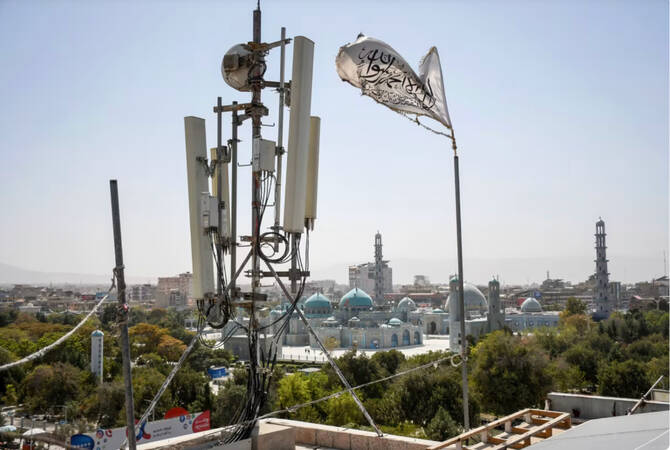
Taliban flag flutters near telecom equipment installed over a rooftop providing internet services overlooking Hazrat-e-Ali Shrine, or Blue Mosque, in Mazar-i-Sharif as the Taliban administration banned fibre-optic internet in Balkh province. (AFP)
Short Url
Updated 19 September 2025
Follow

Taliban blocks fiber-optic internet ‘to prevent immoral activities’

  • Government offices, businesses, public institutions, and homes have been left without internet access
  • Rights groups warn of catastrophic, far-reaching consequences for Afghan society, economic crisis

LONDON: Taliban authorities have blocked fiber-optic internet across northern provinces of Afghanistan, claiming the move was necessary “to prevent immoral activities.”

Local media report that as many as 10 provinces — including Kunduz, Badakhshan, Baghlan, Takhar, and Balkh — have been affected, leaving government offices, businesses, public institutions, and homes without fiber-optic access.

The ban applies only to connections via fiber-optic cable, while mobile internet remains available, according to officials.

“The measure was taken to prevent immorality, and an alternative will be developed inside the country for essential needs,” said Haji Attaullah Zaid, a Taliban provincial spokesman.

He added that the ban was ordered by Afghanistan’s Supreme Leader Hibatullah Akhundzada.

No explanation was given for why Balkh was among the first provinces targeted, or for how long the restrictions would remain in place.

Local news outlet Afghanistan International reports that the fiber-optic ban could be extended nationwide, with further provinces such as Kandahar, Uruzgan, Helmand, and Nimroz already experiencing disruptions.

Rights groups have expressed alarm, urging the Taliban to reverse the block due to far-reaching consequences for Afghan society.

Many nongovernmental organizations say the measure has especially affected women and girls, who rely on online education following Taliban bans on school and university attendance.

Fiber-optic internet is a vital resource for companies, banks, and government agencies, and its loss risks deepening the country’s existing economic crisis.

Beh Lih Yi, regional director at the Committee to Protect Journalists, called the blockade “an unprecedented escalation of censorship that will undermine journalists’ work and the public’s right to information.”


China’s national security agency in Hong Kong summons international media representatives

Updated 06 December 2025
Follow

China’s national security agency in Hong Kong summons international media representatives

HONG KONG: China’s national security agency in Hong Kong summoned international media representatives for a “regulatory talk” on Saturday, saying some had spread false information and smeared the government in recent reports on a deadly fire and upcoming legislative elections.
Senior journalists from several major outlets operating in the city, including AFP, were summoned to the meeting by the Office for Safeguarding National Security (OSNS), which was opened in 2020 following Beijing’s imposition of a wide-ranging national security law on the city.
Through the OSNS, Beijing’s security agents operate openly in Hong Kong, with powers to investigate and prosecute national security crimes.
“Recently, some foreign media reports on Hong Kong have disregarded facts, spread false information, distorted and smeared the government’s disaster relief and aftermath work, attacked and interfered with the Legislative Council election, (and) provoked social division and confrontation,” an OSNS statement posted online shortly after the meeting said.
At the meeting, an official who did not give his name read out a similar statement to media representatives.
He did not give specific examples of coverage that the OSNS had taken issue with, and did not take questions.
The online OSNS statement urged journalists to “not cross the legal red line.”
“The Office will not tolerate the actions of all anti-China and trouble-making elements in Hong Kong, and ‘don’t say we didn’t warn you’,” it read.
For the past week and a half, news coverage in Hong Kong has been dominated by a deadly blaze on a residential estate which killed at least 159 people.
Authorities have warned against crimes that “exploit the tragedy” and have reportedly arrested at least three people for sedition in the fire’s aftermath.
Dissent in Hong Kong has been all but quashed since Beijing brought in the national security law, after huge and sometimes violent protests in 2019.
Hong Kong’s electoral system was revamped in 2021 to ensure that only “patriots” could hold office, and the upcoming poll on Sunday will select a second batch of lawmakers under those rules.