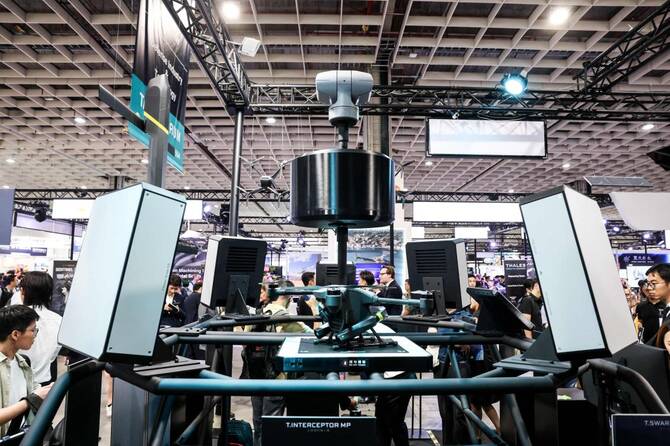
TAIPEI: Anti-drone technology battle-tested in Ukraine is on display at a Taiwanese defense expo that opened Thursday, as arms makers seek to cash in on the island’s efforts to protect itself against a potential Chinese attack.
Taiwan has boosted defense spending in recent years and acquired smaller and more nimble weaponry, including drones, to enable its military to wage asymmetric warfare against its more powerful foe.
But increasing Russian drone attacks on Ukraine have fanned concerns in Taiwan about how the democratic island would fend off swarms of unmanned aerial vehicles in any conflict with China.
Taiwan’s defense ministry is seeking up to $33 billion in special funding to upgrade its military capabilities, including investing in anti-drone technology, a senior lawmaker told AFP last week.
Counter-drone firms at the Taipei Aerospace and Defense Technology Exhibition told AFP they hoped to snatch a share of the market.
“We’d love to penetrate the Taiwanese market,” said Eloi Delort of French AI start-up Alta Ares, whose software has been used against Russian drones in Ukraine.
“I think Taiwan is facing many threats here and they could use our technology either to defend against drones or to do military surveillance,” Delort told AFP.
Taiwanese anti-drone company Tron Future Tech, whose AI systems are used in Taiwan and Ukraine, has seen demand for its technology soar as drones have become critical in warfare.
“It’s huge. It’s crazy,” said Misha Lu, a staff specialist at the company.
“Anti-drone business has contributed to more than half of our revenue and... our company has expanded from 50 people to more than 300 people in only two years,” Lu said.
Tron can produce more than 100 anti-drone systems a month in Taiwan and is expanding production while also considering manufacturing them in Europe and the United States, Lu said.
British military equipment maker BAE Systems said Taiwan’s defense ministry had expressed interest in its anti-drone Advanced Precision Kill Weapon System.
“Everyone’s worried about (drone) swarms, right?” Jonathan Lau, a regional director in the company’s electronic systems business, told AFP.
Having cheap counter-drones would be key for Taiwan in any conflict, Rupert Hammond-Chambers, president of the US-Taiwan Business Council, told reporters this week.
“Sending up F-16s to fire million-dollar missiles at a $10,000 drone is not sustainable,” he said.
“That is a significant challenge that Taiwan has to deal with.”
Taiwan has ramped up military spending over the past decade and is building up its defense industry to make more equipment and ammunition on the island.
But Taipei is under US pressure to do more.
President Lai Ching-te’s government announced last month plans to boost its 2026 defense budget to NT$949.5 billion, or more than three percent of gross domestic product.
It aims to increase spending to five percent of GDP by 2030.
Taiwan was likely to spend a minimum of between $50 billion and $60 billion procuring military equipment and ammunition over the next four years, Hammond-Chambers said.
“About a third of which will go domestic,” he said.
“About two-thirds will go international, most of which will go to the US.”


![]()

Anti-drone firms line up to sell battle-tested tech in Taiwan
Short Url
https://arab.news/6e85y
Anti-drone firms line up to sell battle-tested tech in Taiwan
- Taiwan’s defense ministry is seeking up to $33 billion in special funding to upgrade its military capabilities
- “We’d love to penetrate the Taiwanese market,” said Eloi Delort of French AI start-up Alta Ares


Latest updates


Recommended


© 2026 SAUDI RESEARCH & PUBLISHING COMPANY, All Rights Reserved And subject to Terms of Use Agreement.