Qatar meets ICC head as it mulls legal action against Israel

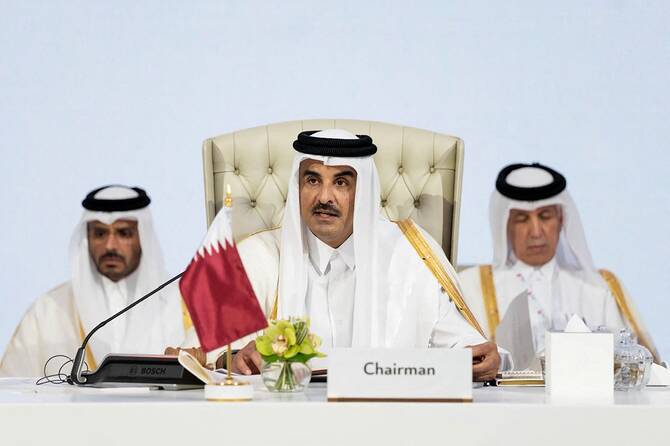
Qatar's Emir Sheikh Tamim bin Hamad Al Thani chairing the the 2025 Arab-Islamic emergency summit in Doha, Qatar. (QNA/AFP)
Short Url
Updated 18 September 2025
Follow

Qatar meets ICC head as it mulls legal action against Israel

  • Last week’s deadly Israeli strike targeted Qatar based leaders of Palestinian militant group Hamas and sent shock waves through the Gulf states that have long depended on the United States for their security
  • In a post on X Qatar's chief negotiator Khulaifi said his visit had been “part of the work of the team tasked with exploring legal avenues to respond to the illegal Israeli armed attack against the State of Qatar”

DOHA: Qatar has met with the president of the International Criminal Court as it seeks legal action against Israel over its unprecedented strike on its territory last week, an official said on Thursday.
The emirate’s chief negotiator, Mohammed Al-Khulaifi, met in The Hague on Wednesday with the president of the ICC, Judge Tomoko Akane, as it pursues “every available legal and diplomatic avenue to ensure accountability for those responsible for Israel’s attack on Qatar,” the Qatari official told AFP.
Last week’s deadly Israeli strike targeted Qatar-based leaders of Palestinian militant group Hamas and sent shock waves through the Gulf states that have long depended on the United States for their security.
Hamas has said top officials of its political bureau, hosted in Qatar with US blessing since 2012, survived the strike but it said five members were killed, along with an officer of Qatar’s internal security force.
Speaking on condition of anonymity because of the sensitivity of the discussions, the official called Israel’s attack “unlawful,” adding it “constitutes grave violations of international humanitarian law.”
Qatar, as an observer state at the ICC, cannot itself refer cases to the court.
But after emergency talks in Doha, the Arab and Islamic blocs called on their members Monday to take “all possible legal and effective measures to prevent Israel from continuing its actions.”
In a post on X after his meeting with the ICC chief, Khulaifi said his visit had been “part of the work of the team tasked with exploring legal avenues to respond to the illegal Israeli armed attack against the State of Qatar.”
Last year, the ICC launched a prosecution of Israeli Prime Minister Benjamin Netanyahu for war crimes and crimes against humanity during Israel’s war in Gaza, including by intentionally targeting civilians and using starvation as a method of war.
The ICC also sought the arrest of Israel’s former defense minister Yoav Gallant and Hamas commander Mohammed Deif, who has since been confirmed killed by Israel.
The Gaza war was triggered by Hamas’s October 2023 attack, which resulted in the deaths of 1,219 people, most of them civilians, according to an AFP tally of Israeli official figures.
Israel’s retaliatory campaign has killed at least 65,141 people, also mostly civilians, according to figures from the territory’s health ministry that the United Nations considers reliable.


Japan, UNOPS sign $4.6m project to restore customs capacity at major Yemeni ports

Updated 9 sec ago
Follow

Japan, UNOPS sign $4.6m project to restore customs capacity at major Yemeni ports

  • The notes for the project were signed and exchanged in Riyadh on Thursday

RIYADH: Japan and the United Nations Office for Project Services have signed an agreement for a new grant aid project aimed at improving customs functions at key ports in Yemen.

The notes for the project were signed and exchanged in Riyadh on Thursday by Yoichi Nakashima, Japan’s ambassador to Yemen, and Muhammad Usman Akram, representative and director of the UNOPS Operational Hub in Amman. The grant amounts to 732 million yen (approximately $4.6 million).

The initiative, titled “The Project for the Improvement of Customs Functions at Major Ports,” seeks to address mounting operational challenges facing Yemen’s customs authorities after years of conflict.

Officials said damage to cargo inspection infrastructure, particularly X-ray screening systems, has significantly reduced inspection capacity at customs facilities. As a result, only about 20 percent of cargo entering through affected ports can be scanned, while the remaining shipments are subject to manual inspection.

This imbalance has contributed to prolonged clearance times and increased risks, including the potential smuggling of weapons, narcotics and other prohibited goods, according to statements delivered at the ceremony.

The project will focus on three major entry points: Aden Sea Port in Aden Governorate, Al-Shihn Land Port in Al-Mahra, and Al-Wadiah Land Port in Hadramout.

Under the agreement, Japan will fund the rehabilitation of X-ray inspection systems and the provision of modern detection equipment. The program also includes capacity development measures, including specialized training for Yemeni customs officials.

Speaking at the event, Nakashima said the project was designed to strengthen the operational capabilities of the Yemeni Customs Authority over an 18-month period. Improving inspection efficiency would help accelerate procedures while reducing reliance on manual checks.

Strengthening customs systems was expected to facilitate smoother trade flows and improve the handling of humanitarian shipments, which remain critical amid Yemen’s ongoing humanitarian crisis, he added.

UNOPS representative Akram described the agreement as a significant step forward in supporting Yemen’s customs authorities through Japanese funding.

“Today marks a significant step forward in strengthening the Yemeni Customs Authority through vital and much appreciated funding from our longstanding partner, the Government of Japan,” he said during the ceremony.

He added the project aimed to address key operational challenges facing the Yemen Customs Authority and enhance efficiency by strengthening institutional capacity in cargo inspection and clearance procedures.

According to Akram, the initiative is expected to reduce the time and costs associated with importing goods into Yemen, including humanitarian assistance.

To achieve these objectives, UNOPS will draw on its procurement expertise to acquire cargo inspection devices and critical spare parts required to restore existing vehicle and container scanners, alongside other necessary equipment.

Akram added that the program will also include capacity-building and training components to support effective operationalization of the upgraded systems.

He said Yemen had a historical role as a major trading crossroads linking the Red Sea and the Gulf of Aden, describing the measures under the project as an important step toward revitalizing and modernizing the country’s customs infrastructure.

The improvements, he said, were expected to facilitate trade, strengthen revenue collection and support the Yemeni government’s broader reconstruction and development priorities.

Akram also expressed appreciation to the Government of Japan for its continued partnership, as well as to Yemeni authorities for their cooperation in facilitating operational and logistical processes related to UNOPS projects.

“UNOPS remains committed to supporting the efforts of the Government of Yemen towards reconstruction and sustainable development with the valuable support of the international community,” he said.

Yemen’s Deputy Finance Minister Hani Wahab welcomed the agreement, describing the project as a major step in improving customs infrastructure and operational efficiency.

Speaking during the ceremony, he said the initiative would contribute to modernizing automated inspection systems, providing spare parts for equipment and supporting personnel training. He added improved customs capacity would help facilitate trade, strengthen revenue collection and combat the trafficking of illegal goods.

Nakashima also highlighted Japan’s broader development engagement with Yemen, saying the country had provided technical support in customs management through training programs implemented by JICA in recent years.

With the latest grant, total Japanese assistance to Yemen since 2015 has reached approximately $497 million. Japan said it would continue working with UN agencies and international partners to support peace and institutional resilience in Yemen.

This article also appears on Arab News Japan