

Punjab sees gradual return to normalcy after floods as monsoon spell persists

Men place mud bags outside a property to protect from flood, following monsoon rains and rising water levels of Indus River on the outskirts of Dadu, Sindh province, Pakistan September 15, 2025. (REUTERS)
Short Url
Updated 17 September 2025
Follow

Punjab sees gradual return to normalcy after floods as monsoon spell persists

  • PDMA reports normal water flow in major rivers, with only localized flooding on the Sutlej
  • Flash floods may occur in streams around Rawalpindi, Murree and Galiyat on Sept. 18-19

ISLAMABAD: Pakistan’s eastern Punjab province is seeing a gradual return to normalcy after heavy floods this month, even as more monsoon rains are forecast in several districts until Sept. 19, the Provincial Disaster Management Authority (PDMA) said on Wednesday.

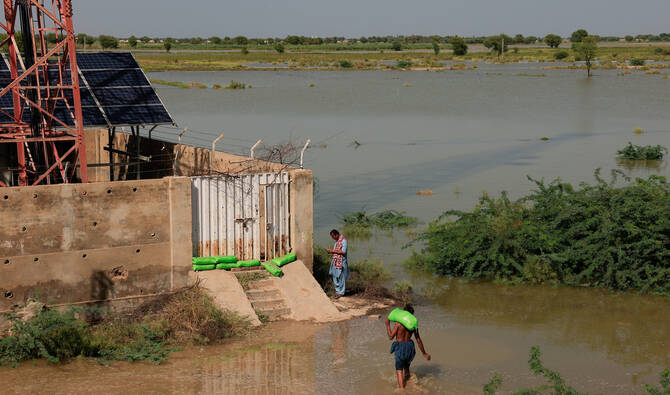
Heavy rains and excess water released from Indian dams caused Punjab’s rivers to swell late last month, inundating more than 4,700 villages in the country’s agricultural heartland, destroying crops and homes and forcing millions to flee.

Since the onset of the monsoon season on June 26, Punjab has reported 296 deaths out of a nationwide toll of 998, according to the National Disaster Management Authority (NDMA). Other casualties include 504 deaths in northwestern Khyber Pakhtunkhwa province, 80 in Sindh, 41 in Gilgit-Baltistan, 38 in Azad Kashmir, 30 in Balochistan and nine in Islamabad.

“The flow of water in Punjab’s rivers is returning to normal,” the PDMA said in a statement. “The Indus, Jhelum and Ravi rivers are at normal levels. The flow of water in the Chenab at Marala, Khanki, Qadirabad and Trimmu has normalized, while there is a medium-level flood in the Sutlej at Ganda Singh Wala and a low-level flood at Sulemanki and Islam headworks.”

The authority said Panjnad currently carries 194,000 cusecs of water with a low-level flood and that hill torrents in Dera Ghazi Khan have normalized.

A flood discharge report from the Flood Forecasting Division at 6 a.m. Wednesday showed most key river sites, including Tarbela, Kalabagh, Chashma and Taunsa on the Indus, as well as Mangla and Rasul on the Jhelum and all major Chenab stations, at normal levels.

Guddu and Sukkur barrages on the Indus in the southern Sindh province were at high flood while Kotri was at low flood.

The PDMA warned the monsoon’s 11th spell would continue until Sept. 19, with rain expected in Rawalpindi, Murree, Galiyat, Attock, Chakwal, Jhelum, Gujranwala, Lahore, Gujrat and Sialkot, and chances of showers in Narowal, Hafizabad, Mandi Bahauddin, Okara, Sahiwal, Kasur, Jhang, Sargodha and Mianwali.

Flash floods could occur in streams around Rawalpindi, Murree and Galiyat on Sept. 18 and 19.

The provincial administration remains on alert on the instructions of Punjab’s chief minister, the PDMA said.


OIC states discuss Islamophobia with UN officials, Pakistan envoy stresses solidarity

Updated 5 sec ago
Follow

OIC states discuss Islamophobia with UN officials, Pakistan envoy stresses solidarity

  • OIC Core Group meets UN General Assembly president to discuss commemorations of International Day to Combat Islamophobia
  • Pakistan top diplomat at UN says the observance symbolizes global unity against anti-Muslim prejudice and discrimination

ISLAMABAD: A group of Organization of Islamic Cooperation (OIC) member states on Tuesday discussed the upcoming commemoration of the International Day to Combat Islamophobia with senior United Nations officials, with Pakistan’s envoy describing the observance as a symbol of global solidarity against prejudice, hostility and discrimination directed at Muslims worldwide.

The International Day to Combat Islamophobia is observed annually on March 15, following its designation by the United Nations General Assembly in 2022, aimed at raising awareness of discrimination and violence targeting Muslims and promoting tolerance and inclusion.

Pakistan’s Permanent Mission to the United Nations said representatives of the OIC Core Group on Islamophobia met Annalena Baerbock, President of the General Assembly, along with the UN Special Envoy on Islamophobia and the High Representative of the UN Alliance of Civilizations.

“The International Day holds immense significance for the OIC and symbolizes global solidarity in combating Islamophobia,” Pakistan’s top diplomat at the UN, Ambassador Asim Iftikhar Ahmad, said during the meeting.

The OIC Core Group at the UN is an informal coordination bloc of Muslim countries that works within the United Nations system to align positions, draft statements and lead negotiations on issues of shared concern to OIC member states.

According to the Pakistani mission, the Core Group exchanged views with the General Assembly president on plans to mark the upcoming commemoration and ways to strengthen international engagement around the issue.

Ambassador Iftikhar recalled that the first such observance was held in 2023 under Pakistan’s chairmanship of the OIC Council of Foreign Ministers, followed by commemorations in 2024 and 2025.

He also welcomed the contributions of the UN Special Envoy in advancing international efforts to address anti-Muslim prejudice and promote tolerance.