

Talks begin between Pakistani PM, Saudi crown prince on bilateral ties, economic cooperation

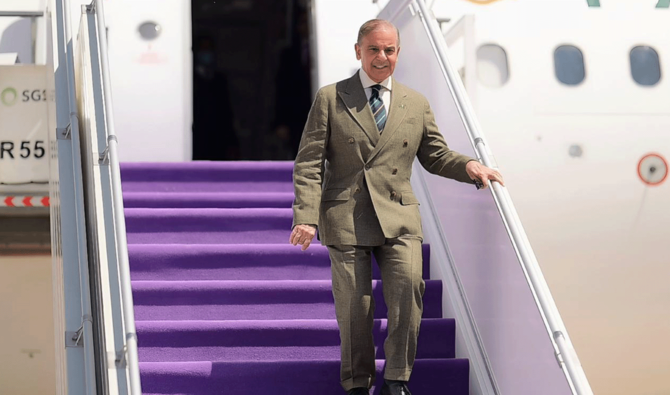
Pakistan's Prime Minister Shehbaz Sharif descending from an aircraft upon his arrival in Riyadh, Saudi Arabia, on September 17, 2025. (Government of Pakistan)
Short Url
Updated 17 September 2025
Follow

Talks begin between Pakistani PM, Saudi crown prince on bilateral ties, economic cooperation

  • Leaders reviewing bilateral ties in Riyadh as Pakistan seeks deeper Saudi investment
  • Visit comes amid heightened regional tensions after Israeli strikes in Doha on Sept. 9

ISLAMABAD: Prime Minister Shehbaz Sharif began a meeting with Saudi Crown Prince Mohammed bin Salman in Riyadh on Wednesday, with the two leaders expected to review bilateral ties, strengthen economic cooperation and exchange views on regional developments, the premier’s office said.

Sharif’s trip comes at a time of heightened tensions in the Middle East, following Israel’s Sept. 9 airstrikes in Doha targeting Hamas leaders. The Pakistani leader had also met the crown prince on the sidelines of the Arab-Islamic summit in Qatar last week, where he pledged full support for Doha.

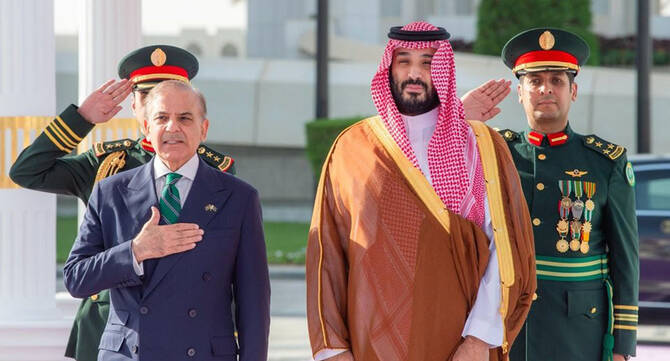
The Prime Minister’s Office said Crown Prince Mohammed personally received Sharif at the royal court, where he was greeted with a guard of honor by Saudi armed forces. 

“During the bilateral meeting, all aspects of Pakistan-Saudi Arabia relations will be reviewed in detail,” the Prime Minister’s Office said. “The two leaders will also exchange views on regional and global developments of mutual interest.”

The statement added that progress on enhancing cooperation in various sectors is expected during Sharif’s visit.

Back in Islamabad, the city’s red zone, home to embassies and government buildings including parliament, the presidency and the supreme court, was lit up in green and decorated with posters celebrating Pak-Saudi “brotherhood.”

Saudi Arabia remains a critical economic and strategic partner for Pakistan. In October last year, the two sides signed 34 agreements and memoranda of understanding worth $2.8 billion, aimed at boosting private sector collaboration and commercial partnerships.

The Kingdom has also extended vital support to Pakistan during economic crises in the past, including external financing and assistance tied to International Monetary Fund (IMF) loan programs.

Saudi Arabia is the largest source of remittances for Pakistan, with more than 2.5 million expatriates sending money home — a key lifeline for Islamabad’s fragile $350 billion economy.


Rating firm S&P says it won’t rush Iran war downgrades, sees risks for countries like Pakistan

Updated 12 March 2026
Follow

Rating firm S&P says it won’t rush Iran war downgrades, sees risks for countries like Pakistan

  • Agency says it is monitoring indebted energy importers as higher oil prices strain finances
  • Gulf economies seen better placed to weather shock, though Bahrain flagged as vulnerable

LONDON: S&P Global ‌said it would not make any knee-jerk sovereign rating cuts following the outbreak of war in the ​Middle East, but warned on Thursday that soaring oil and gas prices were putting a number of already cash-strapped countries at risk.

The firm’s top analysts said in a webinar that the conflict, which has involved US and Israeli strikes ‌against Iran and Iranian ‌strikes against Israel, ​US ‌bases ⁠and Gulf ​states, ⁠was now moving from a low- to moderate-risk scenario.

Most Gulf countries had enough fiscal buffers, however, to weather the crisis for a while, with more lowly rated Bahrain the only clear exception.

Qatar’s banking sector could ⁠also struggle if there were significant ‌deposit outflows in ‌reaction to the conflict, although there ​was no evidence ‌of such strains at the moment, they ‌said.

“We don’t want to jump the gun and just say things are bad,” S&P’s head global sovereign analyst, Roberto Sifon-Arevalo, said.

The longer the crisis ‌was prolonged, though, “the more difficult it is going to be,” he ⁠added.

Sifon-Arevalo ⁠said Asia was the second-most exposed region, due to many of its countries being significant Gulf oil and gas importers.

India, Thailand and Indonesia have relatively lower reserves of oil, while the region also had already heavily indebted countries such as Pakistan, Bangladesh and Sri Lanka whose finances would be further hurt by rising energy prices.

“We ​are closely monitoring ​these (countries) to see how the credit stories evolve,” Sifon-Arevalo said.
