

Japan won’t recognize a Palestinian state given US ties, media report says

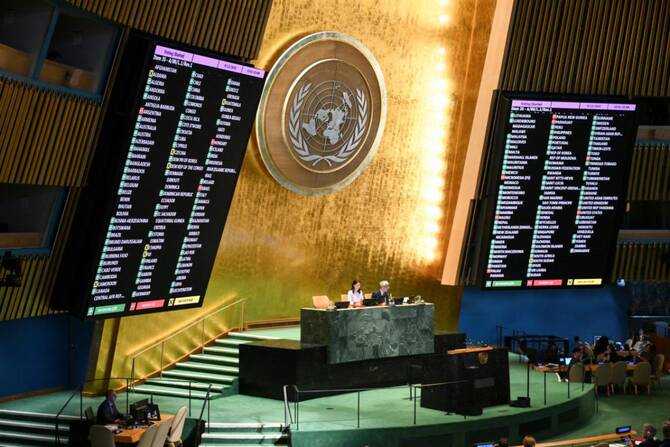
Results are displayed during a General Assembly meeting to vote on the two states solution to the Palestinian question at United Nations headquarters (UN) on September 12, 2025 in New York City. (AFP)
Short Url
Updated 17 September 2025
Follow

Japan won’t recognize a Palestinian state given US ties, media report says

  • Several governments, including those in Britain, France, Canada and Australia, have said they will recognize a Palestinian state at the UN General Assembly this month
  • The US had prompted Japan to forgo the recognition of a Palestinian state through several diplomatic channels

TOKYO: Japan will not recognize a Palestinian state for now, a decision likely taken to maintain relations with the United States and to avoid a hardening of Israel’s attitude, the Asahi newspaper reported on Wednesday, citing unidentified government sources.

Several governments, including those in Britain, France, Canada and Australia, have said they will recognize a Palestinian state at the UN General Assembly this month, adding international pressure on Israel over its actions in the territory.
The US had prompted Japan to forgo the recognition of a Palestinian state through several diplomatic channels, while French Foreign Minister Jean-Noel Barrot had strongly urged his Japanese counterpart to recognize it, Kyodo news agency reported last week.
Japan has been conducting a “comprehensive assessment, including appropriate timing and modalities, of the issue of recognizing Palestinian statehood,” Foreign Minister Takeshi Iwaya told a news briefing on Tuesday.
Chief Cabinet Secretary Yoshimasa Hayashi, the government’s top spokesperson, repeated the statement at a news conference on Wednesday when asked about the Asahi report. But Hayashi expressed a “grave sense of crisis” over the Israeli ground assault on Gaza City, saying “the very foundations of a two-state solution could be collapsing.”
He urged Israel to “take substantive steps to end the severe humanitarian crisis, including famine, as soon as possible.” At a UN meeting on Friday, Japan was among 142 nations that voted in favor of a declaration outlining “tangible, timebound, and irreversible steps” toward a two-state solution between Israel and the Palestinians.
But Asahi said Japanese Prime Minister Shigeru Ishiba is set to skip a September 22 meeting on the subject during the UN gathering in New York. Within the Group of Seven nations, German and Italian officials have called an immediate recognition of Palestine “counterproductive.”


Children dying from cold as storm batters Gaza, killing 13

Updated 52 min 34 sec ago
Follow

Children dying from cold as storm batters Gaza, killing 13

  • Three children die from exposure as winter rains flood displacement camps
  • Wet weather causes war-damaged buildings and walls to collapse, killing 10

GAZA CITY: Gaza’s civil defense agency on Friday said at least 13 people had died in the last 24 hours, including three children who died from exposure to the cold, as a winter storm batters the territory.
Heavy rain from Storm Byron has flooded tents and temporary shelters across the Gaza Strip since late Wednesday, compounding the suffering of the territory’s residents, nearly all of whom were displaced during more than two years of war.
Gaza’s civil defense agency, which operates as a rescue force under Hamas authority, told AFP three children had died from exposure to the cold — two in Gaza City and one in Khan Yunis in the south.

A Palestinian youth walks through a flooded area in a temporary tent camp after heavy rainfall in Deir Al-Balah, central Gaza Strip, Friday. (AP)

Al-Shifa Hospital in Gaza City confirmed the deaths of Hadeel Al-Masri, aged nine, and Taim Al-Khawaja, who it said was just several months old.
Nasser Hospital in Khan Yunis on Thursday said eight-month-old Rahaf Abu Jazar had died in the nearby tented encampment of Al-Mawasi due to the cold.
With most of Gaza’s buildings destroyed or damaged, thousands of tents and homemade shelters now line areas cleared of rubble.
Civil defense spokesman Mahmud Bassal said six people died when a house collapsed in the Bir Al-Naja area of the northern Gaza Strip.
Four others died when walls collapsed in multiple separate incidents, he said.
In a statement, the civil defense said its teams had responded to calls from “13 houses that collapsed due to heavy rains and strong winds, mostly in Gaza City and the north.”

Palestinians search for victims in a destroyed house that collapsed amid heavy rains, in Beit Lahia, in the northern Gaza Strip, Friday. (Reuters)

Under gloomy skies in Nuseirat in the central Gaza Strip, Palestinians used bowls, buckets and hoes to try and remove the water that had pooled around their tents made of plastic sheeting.
Young children, some barefoot and others wearing open sandals, trudged and hopped through ponds of muddy water as the rain continued to fall.
“The mattress has been soaked since this morning, and the children slept in wet bedding last night,” Umm Muhammad Joudah told AFP.
“We don’t have any dry clothes to change into.”
Saif Ayman, a 17-year-old who was on crutches due to a leg injury, said his tent had also been submerged.

A displaced Palestinian boy uses a shovel as he stands in muddy water in a tent camp on a rainy day in Nuseirat, central Gaza Strip, Friday. (Reuters)

“In this tent we have no blankets. There are six of us sleeping on one mattress, and we cover ourselves with our clothes,” he said.
The Hamas-run interior and national security ministry gave a preliminary toll of 14 dead due to the effects of the winter rains since Wednesday.
A ceasefire between Israel and militant group Hamas that took effect in October has partially eased restrictions on goods and aid entering into the Gaza Strip.

Displaced Palestinians ride a donkey-drawn cart on a rain-flooded street in Gaza City, on Friday. (Reuters)

But supplies have entered in insufficient quantities, according to the United Nations, and the humanitarian needs are still immense.
The UN’s World Health Organization warned on Friday that thousands of families were “sheltering in low-lying or debris-filled coastal areas with no drainage or protective barriers.”
“Winter conditions, combined with poor water and sanitation, are expected to drive a surge in acute respiratory infections,” it added.