

Pakistan’s PIA posts first half-year profit in 20 years ahead of privatization sale

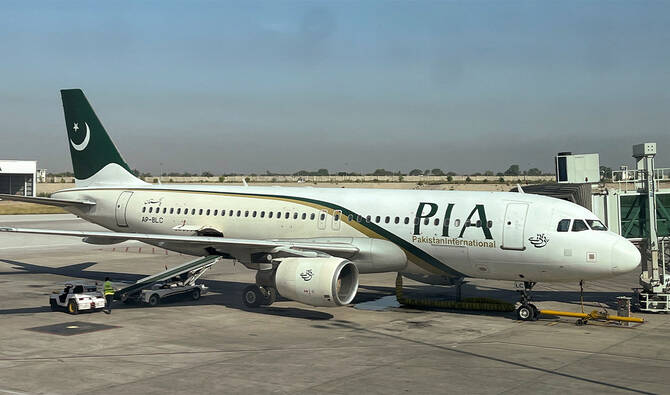
View of a Pakistan International Airlines (PIA) passenger plane, taken through a glass panel, at Islamabad International Airport, Pakistan, on October 3, 2023. (REUTERS/File)
Short Url
Updated 16 September 2025
Follow

Pakistan’s PIA posts first half-year profit in 20 years ahead of privatization sale

  • PIA reports $40.6 million pre-tax profit in Jan–June, its first since 2004
  • Islamabad preparing long-delayed privatization under $7 billion IMF bailout

KARACHI: Pakistan International Airlines (PIA) posted a pre-tax profit in the first half of 2025, which a company source said is its first such for the period in about two decades, ahead of a planned sale of the national carrier later this year.

PIA, part of PIA Holding Company, recorded a pre-tax profit of 11.5 billion Pakistani rupees ($40.64 million) in the six months to June, compared with the same period in 2024 when it remained in a loss before taxes and only managed a rare annual profit through deferred tax adjustments. Net profit for the current half year stood at 6.8 billion rupees.

The disclosure comes as Islamabad presses ahead with a fresh attempt to privatise the airline, a key condition under Pakistan’s $7 billion IMF bailout.

A company source said it was the state-run airline’s first such profit since 2004. Financial records before 2014 are no longer publicly available on the airline’s and the stock exchange’s websites.

The planned sale of Pakistan International Airlines would mark the country’s first major privatization in about two decades, with divestment of loss-making state firms a central plank of last year’s bailout.

LUCRATIVE UK ROUTES

High fuel and service costs continue to weigh, but a steep drop in finance costs after Islamabad assumed about 80 percent of PIA’s legacy debt last year was a decisive factor in its return to profit. Despite the gain, PIA’s equity remains negative, underscoring the fragility of its turnaround.

A previous privatization attempt collapsed last year after a single lowball offer was received, but the government has since drawn interest from five domestic business groups including Airblue, Lucky Cement, investment firm Arif Habib and military-backed Fauji Fertilizer. Final bids are expected later this year.

Britain lifted in July a five-year ban on Pakistani airlines imposed after a fatal 2020 crash and a pilot licensing scandal, allowing PIA to reapply for lucrative UK routes. The move follows similar steps by the European Union late last year.

PIA had previously estimated an annual revenue loss of around 40 billion rupees from the British ban, with London, Manchester and Birmingham among its most profitable routes.

($1 = 283.0000 Pakistani rupees) 


EU, Pakistan sign €60 million loan agreement for clean drinking water in Karachi

Updated 59 min 3 sec ago
Follow

EU, Pakistan sign €60 million loan agreement for clean drinking water in Karachi

  • Project will finance rehabilitation, construction of water treatment facilities in Karachi city, says European Investment Bank
  • As per a report in 2023, 90 percent of water samples collected from various places in city was deemed unfit for drinking

ISLAMABAD: The European Investment Bank (EIB) and Pakistan’s government on Wednesday signed a €60 million loan agreement, the first between the two sides in a decade, to support the delivery of clean drinking water in Karachi, the EU said in a statement. 

The Karachi Water Infrastructure Framework, approved in August this year by the EIB, will finance the rehabilitation and construction of water treatment facilities in Pakistan’s most populous city of Karachi to increase safe water supply and improve water security. 

The agreement was signed between the two sides at the sidelines of the 15th Pak-EU Joint Commission in Brussels, state broadcaster Radio Pakistan reported. 

“Today, the @EIB signed its first loan agreement with Pakistan in a decade: a €60 million loan supporting the delivery of clean drinking water for #Karachi,” the EU said on social media platform X. 

Radio Pakistan said the agreement reflects Pakistan’s commitment to modernize essential urban services and promote climate-resilient infrastructure.

“The declaration demonstrates the continued momentum in Pakistan-EU cooperation and highlights shared priorities in sustainable development, public service delivery, and climate and environmental resilience,” it said. 

Karachi has a chronic clean drinking water problem. As per a Karachi Water and Sewerage Corporation (KWSC) study conducted in 2023, 90 percent of water from samples collected from various places in the city was deemed unsafe for drinking purposes, contaminated with E. coli, coliform bacteria, and other harmful pathogens. 

The problem has forced most residents of the city to get their water through drilled motor-operated wells (known as ‘bores’), even as groundwater in the coastal city tends to be salty and unfit for human consumption.

Other options for residents include either buying unfiltered water from private water tanker operators, who fill up at a network of legal and illegal water hydrants across the city, or buying it from reverse osmosis plants that they visit to fill up bottles or have delivered to their homes.

The EU provides Pakistan about €100 million annually in grants for development and cooperation. This includes efforts to achieve green inclusive growth, increase education and employment skills, promote good governance, human rights, rule of law and ensure sustainable management of natural resources.