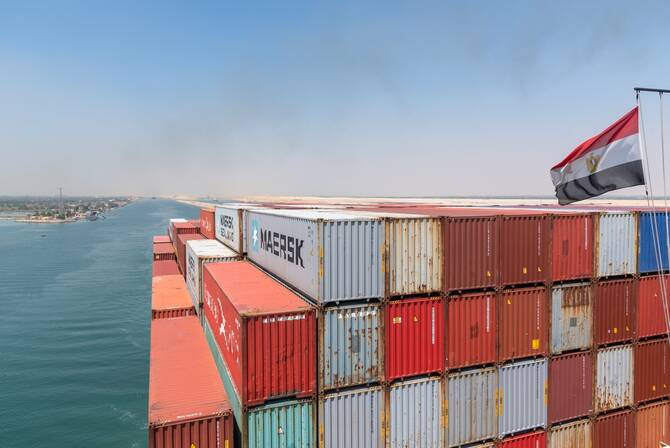
Suez Canal Economic Zone reports 38% revenue growth, secures $6.3bn in projects

During the 2024-25 fiscal year, the authority finalized 129 projects valued at $4.4 billion, generating over 31,000 direct jobs. Shutterstock
Short Url
Updated 16 September 2025
Follow

Suez Canal Economic Zone reports 38% revenue growth, secures $6.3bn in projects

RIYADH: The Suez Canal Economic Zone has attracted $6.3 billion in new investments across 155 projects over the past 14 months, while reporting record revenues of 11.6 billion Egyptian pounds ($237 million) for the 2024-25 fiscal year — up 38 percent year on year.
At its second board meeting of the fiscal year, held in Egypt’s new administrative capital, the authority approved its final accounts, showing net profits of 8.6 billion pounds, a 51 percent increase on the previous year and nearly triple budget expectations. Expenditure stood at 2 billion pounds.
SCZONE Chairman Walid Gamal El-Din emphasized that the zone’s performance came despite a 54 percent decline in Suez Canal transit revenues caused by reduced shipping traffic in the Red Sea. 
He noted that growth was supported by contracts worth $8.6 billion covering 297 industrial, service, and port projects.
During the 2024-25 fiscal year, the authority finalized 129 projects valued at $4.4 billion, generating over 31,000 direct jobs. From July through mid-September of the current fiscal year, an additional 26 industrial and logistics contracts were signed in Sokhna and Qantara West with a combined value of $1.85 billion, expected to create 21,800 jobs.
Since mid-2022, SCZONE has secured a total of 334 projects worth $10.4 billion. Of these, 323 projects are located in industrial zones, accounting for $8.9 billion in investment and nearly 100,000 planned jobs, while 11 projects in the seaports represent $1.5 billion. The investment portfolio spans sectors including solar panels, tires, garments, metals, logistics, and recycled materials.
Qantara West has emerged as a key growth hub, now hosting 40 projects worth $1.05 billion and projected to create 55,900 jobs. For the first time, projects have also been launched in Ismailia East’s Technology Valley in Sinai.
The board also endorsed five new projects totaling $155 million in investment across 441,000 sq. meters, expected to generate 5,100 jobs. Four will be located in Qantara West, including ventures from Chinese and Pakistani firms in textiles and garments, along with a facility for recycled PVC flooring and wall panels. The fifth, led by Egyptian-Turkish joint venture SIGMA EGYPT, will establish bonded container yards in Qantara West and Sokhna.


European gas prices soar almost 50% as Iran conflict halts Qatar LNG output

Updated 02 March 2026
Follow

European gas prices soar almost 50% as Iran conflict halts Qatar LNG output

  • Analysts warn prolonged disruption could push prices higher
  • Some shipments of oil, LNG through Strait of Hormuz suspended
  • Benchmark Asian LNG price up almost 39 percent

LONDON: ​Benchmark Dutch and British wholesale gas prices soared by almost 50 percent on Monday, after major liquefied natural gas exporter Qatar Energy said it had halted production due to attacks in the Middle East.

Qatar, soon to cement its role as the world’s second largest LNG exporter after the US, plays a major role in balancing both Asian and European markets’ demand of LNG.

Most tanker owners, oil majors and ‌trading houses ‌have suspended crude oil, fuel and liquefied natural ​gas shipments ‌via ⁠the ​Strait of ⁠Hormuz, trade sources said, after Tehran warned ships against moving through the waterway.

Europe has increased imports of LNG over the past few years as it seeks to phase out Russian gas following Russia’s invasion of Ukraine.

Around 20 percent of the world’s LNG transits through the Strait of Hormuz and a prolonged suspension or full closure would increase global competition for other ⁠sources of the gas, driving up prices internationally.

“Disruptions to ‌LNG flows would reignite competition between ‌Asia and Europe for available cargoes,” said ​Massimo Di Odoardo, vice president, gas ‌and LNG research at Wood Mackenzie.

The Dutch front-month contract at the ‌TTF hub, seen as a benchmark price for Europe, was up €14.56 at €46.52 per megawatt hour, or around $15.92/mmBtu, by 12:55 p.m. GMT, ICE data showed.

Prices were already some 25 percent higher earlier in the day but extended gains ‌after QatarEnergy’s production halt.

Benchmark Asian LNG prices jumped almost 39 percent on Monday morning with the S&P Global ⁠Energy Japan-Korea-Marker, widely used ⁠as an Asian LNG benchmark, at $15.068 per million British thermal units, Platts data showed.

“If LNG/gas markets start to price in an extended period of losses to Qatari LNG supply, TTF could potentially spike to 80-100 euros/MWh ($28-35/mmBtu),” Warren Patterson, head of commodities strategy at ING, said. The British April contract was up 40.83 pence at 119.40 pence per therm, ICE data showed.

Europe is also relying on LNG imports to help fill its gas storage sites which have been depleted over the winter and are currently around 30 percent full, the latest data from Gas Infrastructure ​Europe showed. In the European carbon ​market, the benchmark contract was down €1.10 at €69.17 a tonne