



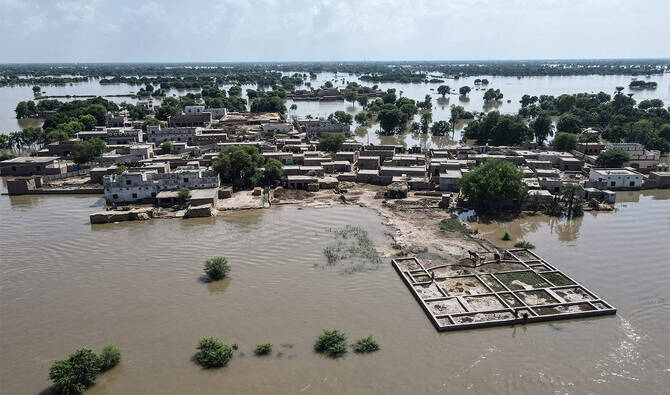
KARACHI/ISLAMABAD: The government of Pakistan's eastern Punjab province said on Tuesday it had begun a survey to assess damages caused by devastating floods, as the official death toll in the province from the latest spell of monsoon deluges since late August rose to 112.
Heavy rains and excess water released from Indian dams caused Punjab’s rivers to swell late last month, inundating more than 4,700 villages in the country’s agricultural heartland, destroying crops and homes, and forcing millions to flee.
Since the onset of the monsoon season on June 26, Punjab has reported 290 deaths out of a nationwide toll of 992, according to the National Disaster Management Authority (NDMA). Other casualties include 504 deaths in northwestern Khyber Pakhtunkhwa province, 80 in Sindh, 41 in Gilgit-Baltistan, 38 in Azad Kashmir, 30 in Balochistan and nine in Islamabad.
In a statement to media, Punjab Relief Commissioner Nabeel Javed said citizens’ losses would be compensated.
“A survey has been initiated to assess the damages caused by the floods,” Javed said, adding that more than 4.72 million people had been affected in Punjab.
He said 363 relief camps and 446 medical camps had been set up in flood-hit districts, while 2.6 million people had been relocated to safer areas.
RIVER FLOWS MOVE DOWNSTREAM
According to the Punjab Disaster Management Authority’s Sept. 16 update, water levels on the Ravi, Chenab and Sutlej rivers, which together drain much of Punjab before merging into the Indus, are now steady or falling at most points.
At major control points known as headworks — large barrage-like structures that regulate river flow into canals — levels on the Chenab remained stable: Marala (66,381 cusecs), Khanki (66,422 cusecs), and Qadirabad (63,420 cusecs). Further downstream, the Chenab at Trimmu was measured at 78,756 cusecs.
On the Ravi, inflows at Jassar (9,219 cusecs), Ravi Syphon (10,645 cusecs) and Shahdara near Lahore (10,479 cusecs) were also reported steady, while Balloki and Sidhnai headworks showed moderate flows of around 27,610 and 24,808 cusecs respectively.
On the Sutlej, flows remained high but stable: Ganda Singh Wala (89,060 cusecs), Sulemanki (90,547 cusecs), and Islam Headworks (64,924 cusecs). At Panjnad Headworks, where all five of Punjab’s major rivers meet before entering the Indus, inflows were reported at 234,755 cusecs.
Downstream on the Indus, the Guddu Barrage in Sindh — a critical flood control structure — recorded 609,137 cusecs, while Sukkur Barrage further south remained at “high flood” with 502,667 cusecs of outflow.
At Kotri Barrage, the last major control point before the Indus empties into the Arabian Sea, flows eased into the “medium flood” range at around 293,000 cusecs. Authorities warned high levels would persist at Sukkur for several days before gradually receding toward Kotri.
DENGUE FEARS
As floodwaters linger, Pakistani authorities have warned of a heightened risk of dengue fever in major urban centers. Dengue is a mosquito-borne viral infection that can cause severe illness and death.
An alert issued by the Pakistan Meteorological Department on Sept. 15 said stagnant water and poor drainage in flood-hit areas had created “conducive environmental conditions” for mosquito breeding. It added that hot and humid conditions, with intermittent rainfall in southern Sindh and coastal areas, would further raise the risk.
“The combined impact of favorable weather thresholds and flood-related waterlogging has made condition conducive from 20th September 2025 for the dengue onset,” the department said.
It warned of an “unprecedentedly high risk” of outbreaks in ten major cities including Karachi, Lahore, Islamabad, Faisalabad, Sialkot, Rawalpindi, Peshawar, Sukkur, Hyderabad and Multan, as well as rural flood-affected districts.
Despite contributing less than one percent of global greenhouse gas emissions, Pakistan ranks among the countries most affected by climate change. In 2022, catastrophic floods left nearly 1,700 people dead, submerged one-third of the country at one point, and inflicted more than $30 billion in losses, according to government estimates.
Officials and experts warn that increasingly erratic rainfall patterns and glacial melt are compounding risks, putting millions at risk each monsoon season.


