

Mo Amer and Mo Gawdat explore personal storytelling and AI at Abu Dhabi conference

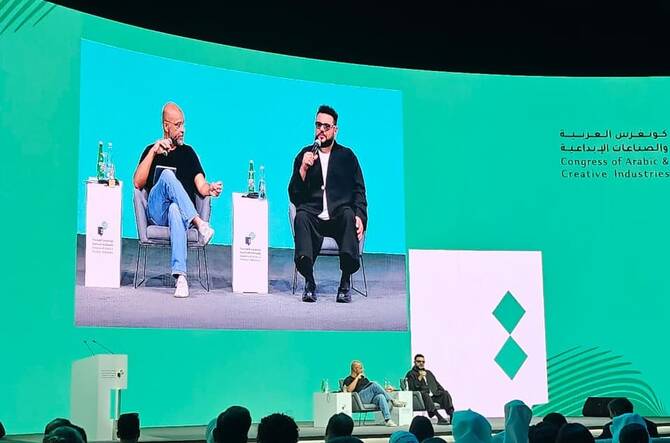
Mo Gawdat and Mo Amer at the Congress of Arabic and Creative Industries at Etihad Arena, Abu Dhabi. (AN Photo)
Short Url
Updated 15 September 2025
Follow

Mo Amer and Mo Gawdat explore personal storytelling and AI at Abu Dhabi conference

ABU DHABI: Etihad Arena in Abu Dhabi hosted a thought-provoking exchange on Sunday as Palestinian-American stand-up comedian and actor Mo Amer joined Egyptian technologist and author Mo Gawdat for a panel titled “The Power of Personal Narratives in the Age of AI” at the annual Congress of Arabic and Creative Industries.

Over the course of the discussion, Gawdat — Google X’s former chief business officer and a prominent voice on artificial intelligence — warned of the rapid pace of technological change. “AI is already smarter than us in everything,” he said, adding that society faces a choice: use these tools to improve life or allow them to fuel greed, war, and control.

While he acknowledged AI’s transformative potential, Gawdat insisted that “it will never create a comedian,” because true comedy requires a uniquely human spark.

Amer responded with his trademark humor and touching perspective. Born in Kuwait and raised in the US, he recalled discovering stand-up in Houston and realizing immediately “this was it” because of the raw storytelling the art form allows.

“Comedy is the greatest art,” he told the audience, emphasizing that every comedian offers a different truth and connection. Amer reflected on his own journey to representation on platforms such as Netflix, hoping young viewers can see themselves in his story and feel empowered to tell their own.

The conversation moved fluidly between technology, faith, and creativity. Gawdat mused on whether AI could ever possess a “spark of spirit,” while Amer countered that humanity’s heart and soul cannot be replicated by machines.

When asked if he is scared that he could be replaced by AI, Amer said: “I’m not scared of AI because AI can never be me. A joke written by me, delivered by someone else, will never be the same. That’s happened to me before where I go up on stage and be like, ‘Let me show you how the joke is done.’ The joke kills and everyone’s laughing and they go, ‘Oh, it’s the person who is delivering the joke, who is the author of the joke, who really lands it.’”




‘The Wild Within’ sees artists breathe new life into Mideast buildings

Updated 16 December 2025
Follow

‘The Wild Within’ sees artists breathe new life into Mideast buildings

DUBAI: Lens-based artist Ryan Koopmans and digital artist Alice Wexell are staging a showcase at Dubai’s Leila Heller Gallery that breathes new life into regional buildings.

The series of digital artworks is part of the exhibition “The Wild Within,” featuring images of old structures in Beirut, Istanbul, and Abu Dhabi filled with wild flowers.

Two of the largest works, “Heartbeats” and “The Wish,” are displayed using Ventana, a microLED architectural display surface created by visual technology company Megapixel.

'Around Us' by Ryan Koopmans and Alice Wexell. (Supplied) 

The former artwork depicts the entrance hall of Qasr Al-Watan, the UAE’s presidential palace in Abu Dhabi, while the latter reimagines the upper floors of the Emirates Palace Mandarin Oriental in Abu Dhabi.

“Each building we work with comes to us through a combination of research, travel, and intuition,” the artists told Arab News in a joint statement.

'Constellations' by Ryan Koopmans and Alice Wexell. (Supplied) 

“We are drawn to structures that carry both emotional and historical resonance, often buildings that once embodied human ambition and now exist in a state of quiet transformation.”

Koopans and Wexell made sure to research the context of each building they choose to recreate, saying “an old villa in Jeddah or a former school in Sharjah each hold their own cultural memory, influencing everything from the lighting and atmosphere to the plants and flowers that we digitally sculpt and implement into the photographs.”

'Heart of Sharjah' by Ryan Koopmans and Alice Wexell. (Supplied) 

The hypnotic works depict the interior of buildings in the region, with digitally rendered flowers carpeting the floor in a bid to “(reimage) these spaces (and) explore the relationship between nature, place, and time, while celebrating each site as a unique work of architecture with its own spirit and story,” the artists said.

Koopmans is of dual Canadian and Dutch heritage, while Wexell is Swedish and based in Stockholm, so it is noteworthy that both artists chose to explore the Middle East for their latest project.

'Blossom of the Ancestors' by Ryan Koopmans and Alice Wexell. (Supplied) 

“In the Middle East especially, the architecture reflects a layered past that merges different styles and eras, while also expressing a sense of renewal and forward-looking energy, particularly in the region’s fantastic contemporary buildings. We are drawn to the symmetry, geometry and patterns that are found not only in nature itself, but in the architectural language of the region both past and present,” they said.

The series — featuring works such as “Adore You,” “Between Worlds,” and “Blossom of the Ancestors” — explores contrasts between the natural world and human-made forms, as well as the traditional and contemporary worlds.

“We are interested in how these elements coexist and merge into one another, creating a sense of hyperrealism that feels both familiar and imaginary. By merging photography with digital sculpture, the artworks question where the boundary lies between documentation and invention, and how technology can extend rather than replace our sense of the natural world.”

'Under the Rain of Light' by Ryan Koopmans and Alice Wexell. (Supplied) 

Although the scale of the artworks ensures they leave the viewer entranced, it did pose challenges, according to the artists.

“Presented at a large scale, every texture in these artworks becomes visible, which can be demanding but is also incredibly rewarding. The magnified detail allows the visceral and atmospheric layers of the pieces to come through with greater impact,” they said, adding that each piece took “many months” to create.

“Ultimately, we want our collectors to experience a sense of wonder and contemplation, as if they are standing inside a dream that feels both entirely real yet unreal.”

The exhibition runs until Jan. 15, 2026.