MANILA: The Philippine president on Monday encouraged the public to express their outrage over massive corruption that has plagued flood-control projects in one of Asia’s most typhoon-prone countries but said street protests should be peaceful.
President Ferdinand Marcos Jr. vowed that an investigation by an independent commission would not spare even his allies in the House of Representatives and the Senate, where several legislators have been identified and accused in televised congressional hearings of pocketing huge kickbacks, along with government engineers and construction companies. Marcos first spoke about the corruption scandal in July in his annual state of the nation speech.
Unlike recent violent protests in Nepal and Indonesia, street rallies against alleged abuses in the Philippines have been smaller and relatively peaceful. Outrage has largely been vented online, including by Catholic church leaders, business executives and retired generals.
A planned protest on Sept. 21 in a pro-democracy shrine in the Manila metropolis near guarded upscale neighborhoods, where some of the corruption suspects live in affluence, is expected to draw a larger crowd. Police forces and troops have been placed on alert.
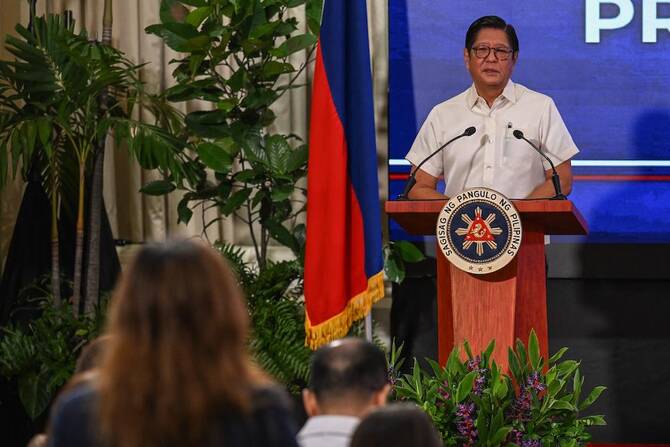
“If I wasn’t president, I might be out in the streets with them,” Marcos said of anti-corruption protesters.
“Of course they are enraged, of course they are angry, I’m angry,” Marcos added, calling on the protesters to demand accountability. “You let them know your sentiments, you let them know how they hurt you, how they stole from you, shout at them and do everything, demonstrate, just keep it peaceful.”
But Communications Undersecretary Claire Castro said over the weekend that “people who have ill intentions and want to destabilize the government” should not exploit the public’s outrage.
Defense Secretary Gilberto Teodoro, Jr. and military chief of staff Gen. Romeo Brawner Jr. issued a joint statement late Friday rejecting a call for the country’s armed forces to withdraw support from Marcos in response to public outrage over the corruption scandal. They did not elaborate, but underscored that the 160,000-member military was non-partisan, professional and “abides by the constitution through the chain-of-command.”
During a recent rally, a speaker called on the military to end its loyalty to Marcos and called on Filipinos to stage a non-violent “people power” revolt similar to army-backed uprisings that ousted Ferdinand Marcos, the current president’s late father and namesake, in 1986 and Joseph Estrada in 2001.
The House of Representatives and the Senate have been investigating alleged substandard and non-existent flood-control projects in separate televised inquiries. Dozens of legislators, senators, construction companies and public works engineers have been identified and accused of pocketing huge kickbacks that financed lavish lifestyles with mansions, European luxury cars and high-stakes casino gambling in a country still wracked by poverty.
The Philippines has spent an estimated 545 billion pesos ($9.6 billion) for thousands of flood mitigation projects in the last three years alone. The projects were under government review to determine which ones are substandard or non-existent, as Marcos said he found during recent inspections in some flood-prone areas, including in Bulacan, a densely populated province north of Manila.

Philippine president supports public outrage over corruption but says protests should be peaceful
https://arab.news/6q6ge
Philippine president supports public outrage over corruption but says protests should be peaceful
- Massive corruption has plagued flood-control projects in one of Asia’s most typhoon-prone countries
- The Philippines spent an estimated $9.6 billion for thousands of flood mitigation projects in the last three years alone
Australia to toughen gun laws as it mourns deadly Bondi attack
- Footage showed one man, identified by local media as fruit seller Ahmed al Ahmed, grabbing one of the gunmen as he fired
- Prime Minister Anthony Albanese convened a meeting of leaders of Australia’s states and territories in response on Monday, agreeing with them “to strengthen gun laws across the nation”
SYDNEY: Australia’s leaders have agreed to toughen gun laws after attackers killed 15 people at a Jewish festival on Bondi Beach, the worst mass shooting in decades decried as antisemitic “terrorism” by authorities.
Dozens fled in panic as a father and son fired into crowds packing the Sydney beach for the start of Hanukkah on Sunday evening.
A 10-year-old girl, a Holocaust survivor and a local rabbi were among those killed, while 42 others were rushed to hospital with gunshot wounds and other injuries.
Prime Minister Anthony Albanese convened a meeting of leaders of Australia’s states and territories in response on Monday, agreeing with them “to strengthen gun laws across the nation.”
Albanese’s office said they agreed to explore ways to improve background checks for firearm owners, bar non-nationals from obtaining gun licenses and limit the types of weapons that are legal.
Mass shootings have been rare in Australia since a lone gunman killed 35 people in the town of Port Arthur in 1996, which led to sweeping reforms long seen as a gold standard worldwide.
Those included a gun buyback scheme, a national firearms register and a crackdown on ownership of semi-automatic weapons.
But Sunday’s shooting has raised fresh questions about how the two suspects — who public broadcaster ABC reported had possible links to the Daesh group — obtained the guns.
- ‘An act of pure evil’ -
Police are still unraveling what drove Sunday’s attack, although authorities have said it targeted Jews.
Albanese called it “an act of pure evil, an act of antisemitism, an act of terrorism on our shores.”
A string of antisemitic attacks has spread fear among Australia’s Jewish communities after the October 7, 2023, Hamas assault on Israel and the ensuing war in Gaza.
The Australian government this year accused Iran of orchestrating a recent wave of antisemitic attacks and expelled Tehran’s ambassador nearly four months ago.
But Israeli Prime Minister Benjamin Netanyahu accused Australia’s government of “pouring oil on the fire of antisemitism” in the months before the shooting, referring to Canberra’s announcement that it would recognize Palestinian statehood in August.
Other world leaders expressed revulsion, with US President Donald Trump condemning the “antisemitic attack.”
The gunmen opened fire on an annual celebration that drew more than 1,000 people to the beach to mark Hanukkah.
They took aim from a raised boardwalk at a beach packed with swimmers cooling off on the steamy summer evening.
Witness Beatrice was celebrating her birthday and had just blown out the candles when the shooting started.
“We thought it was fireworks,” she told AFP. “We’re just feeling lucky we’re all safe.”
Carrying long-barrelled guns, they peppered the beach with bullets for 10 minutes before police shot and killed the 50-year-old father.
The 24-year-old son was arrested and remains under guard in hospital with serious injuries.
Australian media named the suspects as Sajid Akram and his son Naveed Akram.
Tony Burke, the home affairs minister, said the father arrived in Australia on a student visa in 1998 and had become a permanent resident. The son was an Australia-born citizen.
Hours after the shooting, police found a homemade bomb in a car parked close to the beach, saying the “improvised explosive device” had likely been planted by the pair.
Rabbi Mendel Kastel said his brother-in-law was among the dead.
“We need to hold strong. This is not the Australia that we know. This is not the Australia that we want.”
Wary of reprisals, police have so far avoided questions about the attackers’ religion or ideological motivations.
Misinformation spread quickly online after the attacks, some of it targeting immigrants and the Muslim community.
Police said they responded to reports on Monday of several pig heads left at a Muslim cemetery in southwestern Sydney.
- Panic and bravery -
A brave few dashed toward the beach as the shooting unfolded, wading through fleeing crowds to rescue children, treat the injured and confront the gunmen.
Footage showed one man, identified by local media as fruit seller Ahmed al Ahmed, grabbing one of the gunmen as he fired.
The 43-year-old wrestled the gun out of the attacker’s hands, before pointing the weapon at him as he backed away.
A team of off-duty lifeguards sprinted across the sand to drag children to safety.
“The team ran out under fire to try and clear children from the playground while the gunmen were firing,” said Steven Pearce from Surf Life Saving New South Wales.
Bleeding victims were carried across the beach atop surfboards turned into makeshift stretchers.
On Monday evening, a flower memorial next to Bondi Beach swelled in size as mourners gathered.
Hundreds, including members of the Jewish community, sang songs, clapped and held each other.
Leading a ceremony to light a menorah candle, a rabbi told the crowd: “The only strength we have is if we bring light into the world.”


