

‘Qatar is not alone. Arab and Islamic worlds stand beside it,’ says Arab League chief

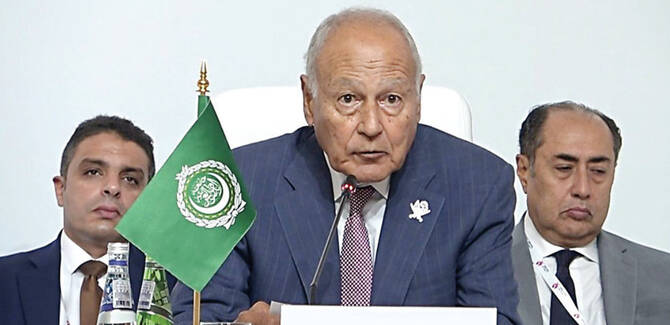
Arab League chief Ahmed Aboul Gheit speaks at Sunday’s preparatory meeting in Doha ahead of the summit of Arab and Muslim leaders. (Supplied)3
Short Url
Updated 15 September 2025
Follow

‘Qatar is not alone. Arab and Islamic worlds stand beside it,’ says Arab League chief

  • Secretary-General Ahmed Aboul Gheit addresses preparatory meeting as Qatar’s PM urges the world to punish Israel

DOHA: Arab League Secretary-General Ahmed Aboul Gheit on Sunday criticized Israel and warned that “silence in the face of a crime ... paves the way for more crimes.”

Speaking at a preparatory meeting on the eve of an emergency summit of Arab and Islamic leaders in Doha, Aboul Gheit said  that the summit itself sends a powerful message: “Qatar is not alone. The Arab and Islamic worlds stand beside it.”

He warned that Israel’s actions are “the direct outcome of two years of international silence on the genocide in Gaza, which has emboldened the occupiers to act without consequence.”

Qatar organized the summit after Israel carried out an unprecedented air strike targeting the residences of several Hamas officials in Doha on Sept. 9, 2025.

According to Qatar’s Foreign Ministry spokesman, Majed Al-Ansari, Monday’s meeting of Arab and Islamic leaders will consider “a draft resolution on the Israeli attack on the state of Qatar.”

Speaking during the same preparatory meeting, Qatar's Prime Minister Sheikh Mohammed bin Abdulrahman Al-Thani urged the international community to “stop using double standards” and punish Israel for what he described as its “crimes.”

“The time has come for the international community to stop using double standards and to punish Israel for all the crimes it has committed, and Israel needs to know that the ongoing war of extermination that our brotherly Palestinian people is being subjected to, and whose aim is to expel them from their land, will not work,” said Sheikh Mohammed, who also serves as foreign minister.

Although the Israeli strike, which killed six people, missed the Hamas peace negotiators who were its real targets, the brazen act  represented “an attack on the principle of mediation itself.”

The attack “can only be described as state terrorism, an approach pursued by the current extremist Israeli government, which flouts international law,” Sheikh Mohammed said. 

“The reckless and treacherous Israeli aggression was committed while the state of Qatar was hosting official and public negotiations, with the knowledge of the Israeli side itself, and with the aim of achieving a ceasefire in Gaza,” he said.

Ahead of the summit, Egyptian Foreign Minister Badr Abdelatty held phone consultations with his counterparts in Saudi Arabia, Turkiye, and Pakistan.

Egypt’s Foreign Ministry said the talks focused on assessing the crisis and “exploring ways to confront the severe political and security challenges facing the region.”

The ministers emphasized the need for Arab-Islamic unity and for sustained coordination across political, diplomatic, and economic fields to safeguard common interests and stabilize the region.

Among the leaders attending will be Iranian President Masoud Pezeshkian and Iraqi Prime Minister Mohammed Shia Al-Sudani. Palestinian President Mahmud Abbas arrived in Doha on Sunday.

Turkish President Recep Tayyip Erdogan was also expected to attend, Turkish media reported.


Syrians, EU officials hold meeting in Damascus

Updated 16 November 2025
Follow

Syrians, EU officials hold meeting in Damascus

  • Al-Shibani added that Saturday’s meetings represent “a solid partnership with the civil society and our partners in the EU”

DAMASCUS: Representatives of Syria’s civil society held open discussions in Damascus in the presence of officials from the EU and the government. 
They touched on sensitive topics, including sectarian tensions and ethnic divisions.
The EU-organized meetings known as “The Day of Dialogue” are the first to be held in Damascus after taking place in past years Brussels. 
Saturday’s meetings came nearly a year after the fall of the 54-year Assad family rule in Syria in early December.
The meetings that used to take place within the framework of the Brussels Conferences were mostly boycotted by then-President Bashar Assad’s government. 
The EU said Saturday’s meetings were organized in cooperation with Syrian civil society and the Syrian authorities.
“The meeting that used to be held to talk about Syria is now being held in Syria,” Syria’s Foreign Minister Asaad Al-Shibani said in a speech at the opening session held at a conference center in the southern outskirts of Damascus.
Al-Shibani added that Saturday’s meetings represent “a solid partnership with the civil society and our partners in the EU.”
Michael Ohnmacht, chargé d’affaires of the EU delegation to Syria, said 500 people from Syria’s different religious and ethnic groups took part in the meetings and “this is something very positive.”
“This is what we hope for Syria’s future, to see this inclusive state which will be a state in the form of all its citizens,” Ohnmacht said.
Social Affairs Minister Hind Kabawat said: “Today’s dialogue is the beginning of change, and rebuilding Syria only happens through partnership based on respect between the state and civil society.”
During one of the sessions on transitional justice and the fate of the missing, Syrians demanded answers on issues still pending, such as more than 130,000 people who went missing under Assad’s rule, while an ethnic Kurd spoke about state discrimination they have faced for decades. 
Mazen Darwish, a Syrian lawyer and one of the country’s most prominent activists who was repeatedly jailed in Syria before he went into exile years ago, said no one regrets the fall of the Assad family rule.
“Today we have an opportunity in Syria and we have to take advantage of it,” Darwish said.