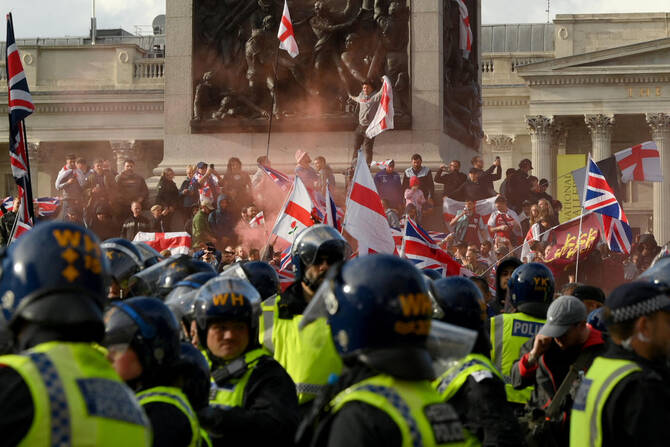
LONDON: Prime Minister Keir Starmer said Sunday Britain would not tolerate people feeling intimidated “because of their background or the color of their skin” after a large far-right protest was marked by battles with police.
In his first comments on Saturday’s rally organized by far-right activist Tommy Robinson and attended by up to 150,000 people, according to police, Starmer also condemned attacks on police on officers.
The clashes left 26 officers injured, four seriously, and led to 24 arrests. London police have pledged to make more arrests in coming days.
“People have a right to peaceful protest. It is core to our country’s values,” Starmer said on X, the day after the protesters massed near his Downing Street office amid a sea of English and British flags.
“But we will not stand for assaults on police officers doing their job or for people feeling intimidated on our streets because of their background or the color of their skin.”
The leader of the center-left Labour government, who was the target of persistent criticism at the rally, added “Britain is a nation proudly built on tolerance, diversity and respect.”
“Our flag represents our diverse country and we will never surrender it to those that use it as a symbol of violence, fear and division,” Starmer said.
London’s Metropolitan Police said it had so far arrested 24 people after officers faced “unacceptable violence” trying to control up to 150,000 people at the event.
That was two fewer arrests than the force last reported, after discovering what it called “two duplicate records.”
Twenty-six police were injured, four seriously, in clashes on the fringes of Robinson’s “Unite the Kingdom” rally.
Of those arrested, three were women and 21 were men, with the oldest person arrested aged 58 and the youngest 19 years-old, according to police.
It said alleged offenses included common assault, criminal damage, assault on an emergency worker, and possession of an offensive weapon, noting a number of people were arrested on suspicion of more than one offense.
“A post-event investigation is under way, with officers working to identify other people involved in disorder with a view to making further arrests in the coming days and weeks,” the force added.
The attacks on police occurred after some activists tried to enter sealed off areas near counter-protesters at a Stand Up to Racism march which had ended close by, according to the Met.
Officers were “assaulted with kicks and punches” while “bottles, flares and other projectiles were thrown,” it said.
Protesters at Robinson’s event had marched over Westminster Bridge before rallying near Downing Street for speeches by figures associated with the far right from across Europe and North America, including billionaire tycoon Elon Musk.
In an address by video, the X owner called for the dissolution of Britain’s parliament and the replacement of the center-left Labour government while claiming “violence is coming to you.”
“You either fight back or you die,” he told the crowds.
Assessing the speeches and attendees, anti-racism charity Hope Not Hate called the event Britain’s largest ever far-right protest.
“Seeing such a big crowd cheering speeches that called for banning all public expression of non-Christian religions, demanded the ‘remigration’ of legal migrants... and claimed Britain is being ‘invaded’ and its population ‘replaced’ is unprecedented,” it said.
“For anyone worried about the rise of far-right activism and the normalization of viciously anti-migrant, anti-Muslim sentiment, it could be a sign of dark times to come.”


![]()

Starmer: UK won’t tolerate racial intimidation after far-right rally
Short Url
https://arab.news/4nefz
Starmer: UK won’t tolerate racial intimidation after far-right rally
- Police were attacked during a far-right rally in London attended by up to 150,000 people
- British PM says people have right to peaceful protest but won't stand for intimidating people because of skin color


Latest updates





© 2026 SAUDI RESEARCH & PUBLISHING COMPANY, All Rights Reserved And subject to Terms of Use Agreement.