

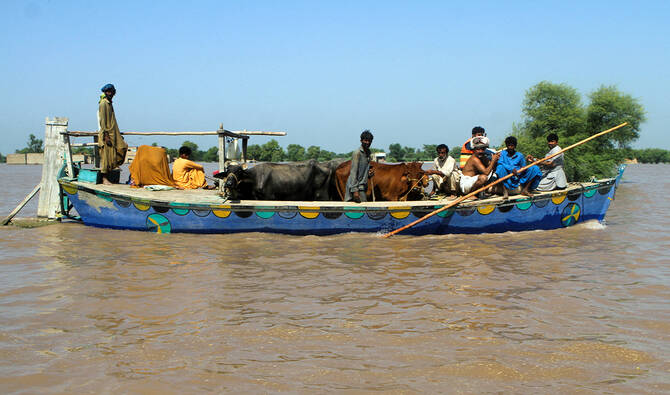

ISLAMABAD/KARACHI: Pakistan’s southern Sindh province remained wary of a high flood level at Guddu Barrage on Sunday, as the death toll from rains and deluges in Punjab since late August reached 104, the provincial disaster management authority (PDMA) said.
Floods in Pakistan’s eastern Punjab province since late August have wreaked havoc by affecting more than 4.5 million people and inundating over 4,700 settlements. Heavy monsoon rains and excess water released by Indian dams have caused rivers Ravi, Chenab and Sutlej in Punjab to swell and overflow downstream, raising the risks of catastrophic floods in Sindh.
The Punjab Disaster Management Authority (PDMA) has said that while a fresh spell of monsoon rains across the upper catchment of the country’s major rivers was expected next week from Sept. 16-19, Director General PDMA Irfan Ali Kathia said on Saturday that the water level in Punjab’s rivers is expected to decrease in the next 48 hours.
Sindh Information Minister Sharjeel Inam Memon said the provincial government is keeping a close watch on the water levels at the province’s barrages, saying authorities were carrying out relief and rescue operations there.
“There is a high-level flood at Guddu Barrage and a medium-level flood at Sukkur Barrage,” Memon was quoted as saying by the provincial information ministry.
Guddu and Sukkur barrages are the two main structures that channel water into central and southern Sindh. Memon said the upstream flow of water at Guddu Barrage has been recorded at 612,269 cusecs and the downstream flow at 582,942 cusecs. The barrage is designed to hold up to 1.1 million cusecs of water.
At Sukkur Barrage, the upstream flow has been recorded at 488,820 cusecs and the downstream flow at 438,390 cusecs, the minister added.
Memon said the total number of people relocated to safer areas in Sindh has reached 163,364, adding that the number of people in relief camps has climbed to 469.
He said the provincial government has set up 177 fixed and mobile health sites, where 6,596 patients were treated in the past 24 hours. So far, a total of 84,118 patients have been provided with medical facilities while the number of livestock relocated to safer areas has reached 438,835.
Meanwhile, in Punjab, the PDMA shared that water levels were on the decline at most points in river Chenab. Water flows at Marala, Khanki, Qadirabad and Chiniot bridge were all recorded at steady levels while at Trimmu Headworks, one of the river’s major control points, the water level was recorded at 84,756 cusecs at a falling level.
River Ravi also showed receding levels of water, with Jassar, Ravi Syphon, Shahdara and Balloki water levels all recorded at steady levels. Further downstream, at Panjnad, where the Ravi, Chenab and Sutlej converge before meeting the Indus, flows were recorded at 402,919 cusecs.
Nationwide, the death toll from rain-related incidents since Jun. 26 has reached 972, with the highest number of casualties reported from the northwestern Khyber Pakhtunkhwa (KP) province, 504.
IMF ASSESSING FLOOD DAMAGES
Meanwhile, as Pakistan reels from the floods, a top International Monetary Fund (IMF) official in Pakistan said on Saturday his organization is assessing damages caused by the deluges and will use its next review mission to evaluate appropriate policy responses to support affected people and strengthen national resilience.
“We extend our heartfelt condolences to the people of Pakistan as they endure the devastating floods,” said Mahir Binici, Resident Representative of the IMF in Pakistan. “We are deeply saddened by the tragic loss of life.”
“An assessment of the flood damage caused by torrential monsoon rains is still ongoing, as the situation continues to evolve,” he continued.
“The upcoming EFF review mission provides an opportunity to discuss the appropriate policy response to support flood-affected populations and protect the most vulnerable.”
Binici also noted that both the EFF and the IMF’s Resilience and Sustainability Facility (RSF) provide frameworks crucial for external and financial stability amid these natural calamities.
The RSF, approved in May, offers Pakistan around $1.4 billion to help build economic resilience against climate vulnerabilities and disasters, though its disbursement depends on successful reviews under the EFF.
Separately, Prime Minister Shehbaz Sharif announced immediate relief for households in flood-hit districts, ordering power distribution companies to suspend collection of August electricity bills and adjust any payments already received in the next billing cycle.


