

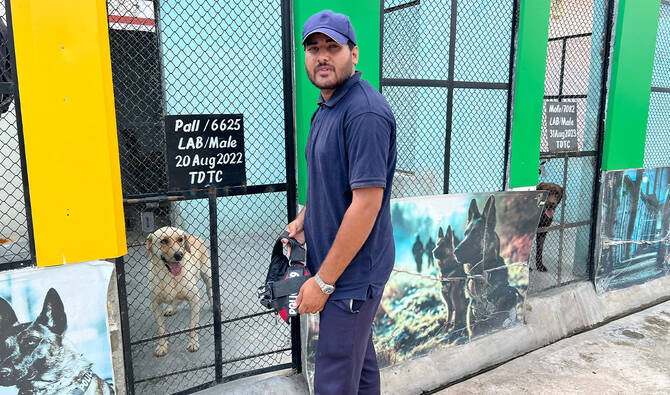

ISLAMABAD: As Saqlain Arshad, 25, steps into a colorful kennel, Paal, a tracker dog at the Islamabad police’s Canine Unit, stands ready to join duty. This time, however, it is not an outside assignment but a mock training session that handlers regularly conduct to keep these dogs, whom their handlers proudly call “silent heroes,” in shape to take up field assignments.
Arshad holds out a cap belonging to a colleague who hid a few hundred feet away. As soon as he loosens the leash, Paal leaps and pauses briefly to scent the cap before heading straight to the target crouched behind a car. Upon finding the target, Muhammad Salman, the unit’s 60-year-old supervisor, tosses a tennis ball that Paal catches midair — his reward for a job well done.
Daily rehearsals like these ensure Islamabad police dogs are always prepared and prove their effectiveness in tracking drugs and criminals. Police solved one such case this year, when they received a missing complaint about 28-year-old Hamza Khan, who left his home in Islamabad for Mansehra on March 15, but never returned, with his family naming a retired Islamabad police superintendent, Arif Shah, as the last person Khan had gone to meet over a financial dispute.
Shah claimed Khan had left for the capital after their meeting him, a claim seemingly supported by the last known location of Khan’s phone in Islamabad, though the device was found dumped at a greenbelt in the city days later. On April 15, police took Paal and his two-year-old companion, Mofe, to Shah’s residence and investigators placed Khan’s clothes in front of Paal.
“While sniffing those articles, because of the footprints, he reached his target, and we found the dead body [buried at Shah’s home],” Arshad, Paal’s handler, told Arab News.

The photograph taken on September 4, 2025, shows statues of a police officer and a canine at the entrance of the Islamabad Police Canine Unit in Islamabad, Pakistan. (AN Photo)
Khan’s body had been hidden inside an animal shed and Paal led officers directly to the site. For his role, Arshad was awarded Rs100,000 ($352) and Paal received special recognition certificate.
Paal and Mofe are among 19 canine officers procured from the Army Canine Center in Rawalpindi, when Islamabad police established its Canine Unit in Nov. 2024 under the Bomb Disposal Squad.
“Initially, we got 11 handlers trained for three months at the Army Canine Center, while the rest were trained in-house,” said Umer Amin Khan, head of the unit.
Currently, the unit maintains 13 dogs, trained in explosives and arms detection, four for narcotics, and two tracker dogs. The explosives team is trained to detect 12 types of devices, while narcotics dogs are trained on more than half a dozen substances.
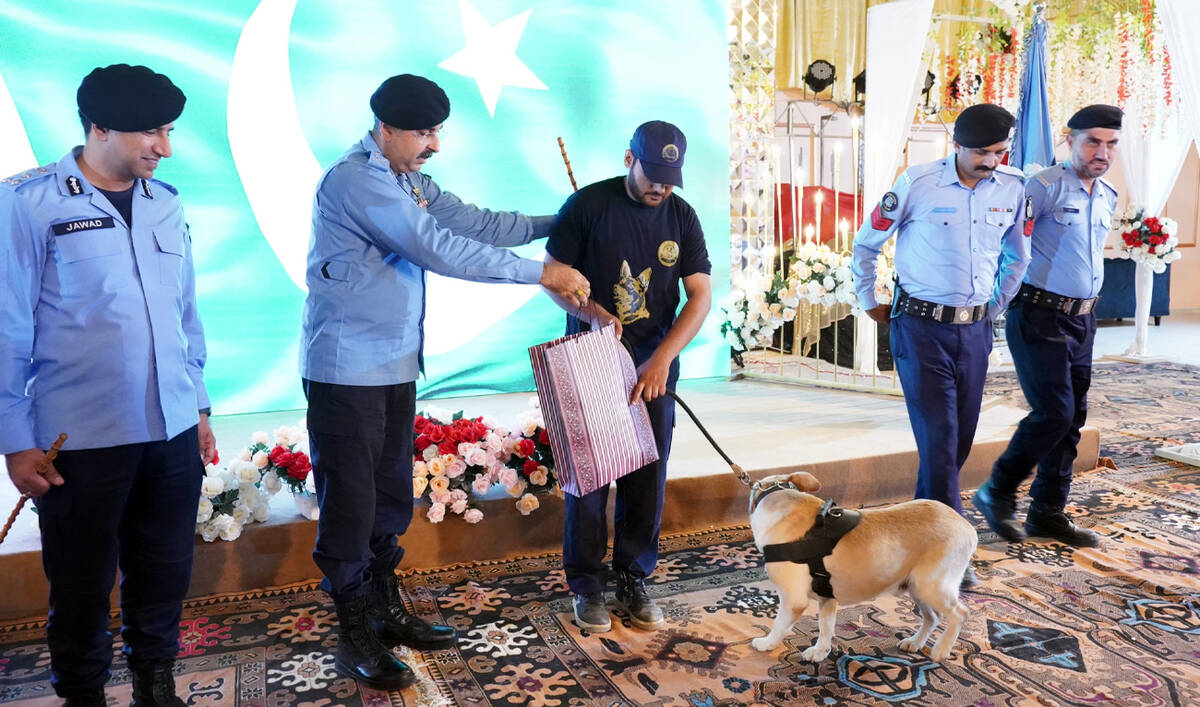
The photograph released by Islamabad Police on September 13, 2025, shows Inspector General Ali Nasir Rizvi (second left) presenting a prize to Paal’s handler, Saqlain Arshad (center), during a ceremony in Islamabad, Pakistan. (Islamabad Police/Handout)
“The training process is separate for all dogs,” Salman, supervisor of the Canine Unit, told Arab News. “Those who are for explosives [searching], they have separate [training modules], narcotics [dogs] have separate.”
Explosive detection dogs conduct daily clearance searches at sensitive installations in the capital each morning, including the president’s and the prime minister’s offices and the Supreme Court, while narcotics and suspect trackers are deployed upon requests by police stations.
Each dog works in half-hour shifts before being given up to 45-minute rest, after which they can be redeployed.
Veterinary staff at the unit say puppies learn very quickly.
“By the time they are six months old, they can already be put to professional work and remain effective for five to six years,” said Haider Ali, a veterinarian who has been with the unit since joining four months ago.
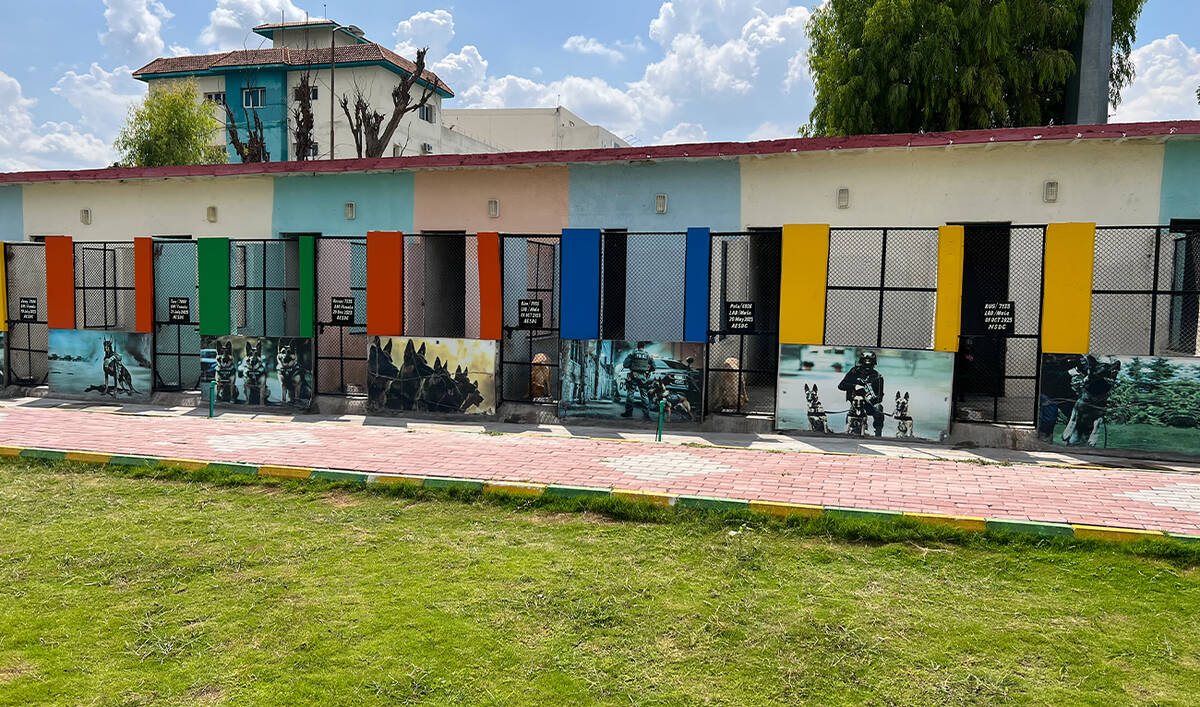
Police dogs inside their kennels at the Islamabad Police Canine Unit in Islamabad, Pakistan, on September 4, 2025. (AN Photo)
All dogs in the unit were procured through the Army Canine Center, which introduced breeds through the British Army. Labrador retrievers are often trained for tracking due to their lineage, while Belgian Malinois and German Shepherds are primarily used for search operations.
To keep them healthy, the dogs are treated like athletes.
Their diet consists of protein-rich meals twice a day, including chicken necks, rice and specialized feed. Two veterinary doctors, one for each shift, monitor their health, while each dog undergoes a checkup before and after deployment.
“Our main focus here is timely treatment, vaccination, and deworming,” Ali said. “This is essential not only for their health but also for the safety of the handlers working with them.”

Veterinarian Haider Ali poses for a photograph with canine officers at the Islamabad Police Canine Unit in Islamabad, Pakistan, on September 4, 2025. (AN Photo)
The sense of smell of dogs, far superior to humans’, allows them to detect traces and follow trails that technology can miss, which is why these canine officers continue to play a vital role worldwide.
“These are silent heroes, all our dogs,” said Umer, the unit’s in-charge. “You do not see them in the field, but to secure Islamabad, their role is very crucial.”


