

Pakistan, Egypt condemn Israeli strikes on Doha, discuss upcoming OIC summit

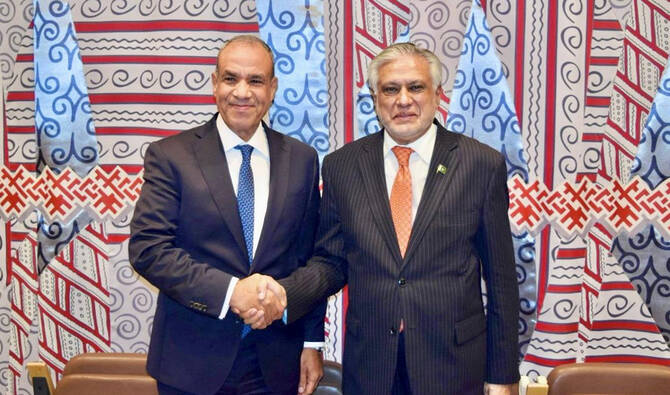
Pakistan’s Deputy Prime Minister and Foreign Minister, Ishaq Dar, meets Egyptian Foreign Minister, Dr. Badr Abdelatty (left) in New York, US, on July 28, 2025. (MOFA/File)
Short Url
Updated 13 September 2025
Follow

Pakistan, Egypt condemn Israeli strikes on Doha, discuss upcoming OIC summit

  • Israel attempted to kill the political leaders of Hamas with the attack in Doha on Tuesday
  • The strike has risked derailing efforts to broker a ceasefire in nearly two-year war on Gaza

ISLAMABAD: Pakistan and Egypt on Saturday condemned Israeli airstrike targeting Hamas leaders in Qatar’s capital of Doha, the Pakistani foreign ministry said, with the two sides also discussing modalities for an upcoming Organization of Islamic Cooperation (OIC) summit in Doha.

Israel attempted to kill the political leaders of Hamas with the attack in Doha on Tuesday, a strike that risked derailing United States-backed efforts to broker a truce in Gaza and end the nearly two-year-old conflict.

The attack was widely condemned in the Middle East and beyond as an act that could escalate tensions in a region already on edge, while Pakistan on Friday pledged its support to Qatar for the defense of its sovereignty.

On Saturday, Pakistan’s foreign minister Ishaq Dar spoke with his Egyptian counterpart Dr. Badr Abdelatty about the recent developments in the Middle East as well as the OIC foreign ministers’ meeting in Doha.

“Both leaders strongly condemned the Israeli unprovoked illegal strikes on Doha, and discussed the modalities and details of the forthcoming OIC Council of Foreign Ministers in Doha, scheduled for Sunday, 14 September,” the Pakistani foreign office said after their conversation.

The development comes a day after the OIC, which is currently chaired by Turkiye, urged the UN Security Council to “take firm measures” against Israel following its airstrike in Doha.

Delivering a statement on behalf of the OIC, Turkiye’s UN envoy Ahmet Yildiz condemned “in the strongest terms this despicable and unwarranted attack against the State of Qatar and in flagrant violation of its territorial sovereignty and national security.”

“There is no doubt that this dastardly action constitutes a blatant violation of the norms of international law and certainly the Charter of the United Nations, much as it represents an overt threat to both the security of the Middle East region and indeed international peace and security,” Yildiz said.

On Saturday, Qatar’s Foreign Ministry said an emergency Arab-Islamic Summit in Doha will discuss a draft resolution on Israel’s attack against the Gulf state, according to the Qatar News Agency (QNA).

“The summit will discuss a draft resolution on the Israeli attack on the State of Qatar, submitted by the preparatory meeting of Arab and Islamic foreign ministers, which will be held tomorrow Sunday,” foreign ministry spokesperson Majid bin Mohammed Al Ansari told QNA. 

Qatar has been a main mediator in long-running negotiations for a ceasefire between Israel and Hamas in Gaza, for the release of Israeli hostages held in Gaza, and for a post-conflict plan for the territory.

Israel’s assault on Gaza since October 2023 has killed over 64,000 people, according to Palestinian health officials, while internally displacing almost all Gaza’s population, and setting off a starvation crisis. Multiple rights experts and scholars say Israel’s military assault on Gaza amounts to genocide.


Pakistan reports current account surplus in Jan. owing to improved trade, remittances

Updated 17 February 2026
Follow

Pakistan reports current account surplus in Jan. owing to improved trade, remittances

  • Pakistan’s exports crossed the $3 billion mark in Jan. as the country received $3.5 billion in remittances
  • Last month, IMF urged Pakistan to accelerate pace of structural reforms to strengthen economic growth

ISLAMABAD: Pakistan recorded a current account surplus of more than $120 million in January, the country’s finance adviser said on Tuesday, attributing it to improved trade balance and remittance inflows.

Pakistan’s exports rebounded in January 2026 after five months of weak performance, rising 3.73 percent year on year and surging 34.96 percent month on month, according to data released by the country’s statistics bureau.

Exports crossed the $3 billion mark for the first time in January to reach $3.061 billion, compared to $2.27 billion in Dec. 2025. The country received $3.5 billion in foreign remittances in Jan. 2026.

Khurram Schehzad, an adviser to the finance minister, said Pakistan reported a current account surplus of $121 million in Jan., compared to a current account deficit of $393 million in the same month last year.

“Improved trade balance in January 2026, strong remittance inflows, and sustained momentum in services exports (IT/Tech) continue to reinforce the country’s external account position,” he said on X.

Pakistan has undergone a difficult period of stabilization, marked by inflation, currency depreciation and financing gaps, and international rating agencies have acknowledged improvements after Islamabad began implementing reforms such as privatizing loss-making, state-owned enterprises (SOEs) and ending subsidies as part of a $7 billion International Monetary Fund (IMF) loan program.

Late last month, the IMF urged Pakistan to accelerate the pace of these structural reforms to strengthen economic growth.

Responding to questions from Arab News at a virtual media roundtable on emerging markets’ resilience, IMF’s director of the Middle East and Central Asia Jihad Azour said Islamabad’s implementation of the IMF requirements had been “strong” despite devastating floods that killed more than 1,000 people and devastated farmland, forcing the government to revise its 4.2 percent growth target to 3.9 percent.

“What is important going forward in order to strengthen growth and to maintain the level of macroeconomic stability is to accelerate the structural reforms,” he said at the meeting.

Azour underlined Pakistan’s plans to privatize some of the SOEs and improve financial management of important public entities, particularly power companies, as an important way for the country to boost its capacity to cater to the economy for additional exports.

“This comes in addition to the effort that the authorities have made in order to reform their tariffs, which will allow the private sector of Pakistan to become more competitive,” the IMF official said.