

Pakistan’s Sindh says floodwaters rushing downstream from Punjab pose no imminent threat

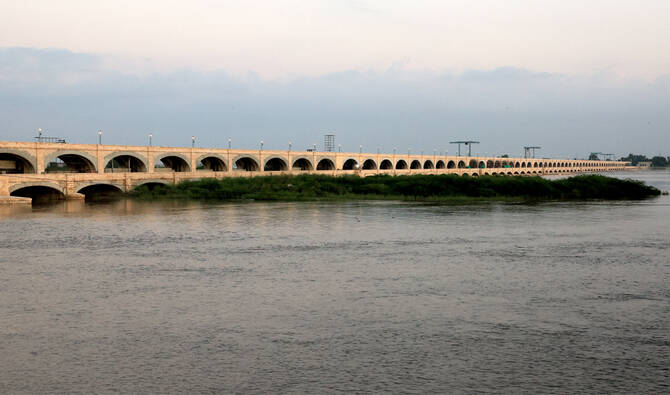
View of the Sukkur Barrage, as flood water passes through, following monsoon rains and rising levels of the Indus River in Sukkur district of Sindh province, Pakistan, on September 12, 2025. (REUTERS)
Short Url
Updated 13 September 2025
Follow

Pakistan’s Sindh says floodwaters rushing downstream from Punjab pose no imminent threat

  • Rains, floods have killed at least 97 people and affected over 4,500 villages in Punjab since late August
  • Sindh official says there are 1,651 villages that can be partially inundated if flows reached 700,000 cusecs

KARACHI: Authorities in Pakistan’s Sindh said on Saturday that floodwater rushing downstream from the eastern Punjab province pose no major threat to the southern province.

The floodwaters have been rushing southwards to Sindh after devastating Punjab, where 97 people have been killed and submerging over two million acres of farmland has been submerged since late August.

The inflow of water was 537,220 cusecs at Guddu Barrage on the Indus river, 460,490 cusecs at Sukkur Barrage and 261,234 cusecs at Kotri Barrage in Sindh, according to the provincial information department.

Syed Salman Shah, head of the Sindh Provincial Disaster Management Authority (PDMA), acknowledged that some villages in Sindh’s Dadu district have been inundated, but the situation is “not alarming.”

“The situation in Sindh is not alarming... We have identified 1,651 such villages across Sindh that could be partially inundated in case of a water flow of 700,000 cusecs,” he told Arab News.

“The residents of these villages have already been evacuated and shifted to safe locations, where they are being provided with health care, food, and other facilities.”

Shah said riverside villages in Sindh were likely to be affected if the water flows reached 700,000 cusecs.

“But since these homes are built at height after the last floods [in 2010], there may be no damages to these villages,” he said.

The floods resulted from unusually high rains and India’s release of excess water that swelled Chenab, Ravi and Sutlej rivers in Punjab, which travel southwards to merge in the Indus river in Sindh.

The deluges have affected more than 4,500 villages and over 4.4 million people in Punjab, the country’s breadbasket province, according to Relief Commissioner Punjab Nabeel Javed. Rescuers have so far transported 2.4 million people and 19.1 million livestock to relief camps after rescuing them from marooned villages in several districts.

On Saturday, the Pakistani military, which has been engaged in rescue and relief activities, said Army Chief Field Marshall Asim Munir visited flood-affected areas of Kasur and Jalalpur Pirwala in Punjab to review the prevailing flood situation and ongoing relief efforts.

“The visit to flood affected areas of Kasur and Multan focused on enhancing synergy between the civil administration and the military to ensure effective assistance for the affected population,” the Inter-Services Public Relations (ISPR), the military’s media wing.

Monsoon season brings Pakistan up to 80 percent of its annual rainfall, but increasingly erratic and extreme weather patterns are turning the annual rains, which are vital for agriculture, food security and the livelihoods of millions of farmers, into a destructive force.

Rains, floods, landslides and similar incidents have killed at least 946 people nationwide since June 26, according to the National Disaster Management Authority (NDMA). The disaster has revived memories of the 2022 deluges, when a third of the country was submerged, over 1,700 people were killed and losses exceeded $35 billion.


UN torture expert decries Pakistan ex-PM Khan’s detention

Updated 12 December 2025
Follow

UN torture expert decries Pakistan ex-PM Khan’s detention

  • Khan’s party alleges government is holding him in solitary confinement, barring prison visits
  • Pakistan’s government rejects allegations former premier is being denied basic rights in prison

GENEVA: Pakistan’s former prime minister Imran Khan is being held in conditions that could amount to torture and other inhuman or degrading treatment, the United Nations’ special rapporteur on torture warned Friday.

Alice Jill Edwards urged Pakistan to take immediate and effective action to address reports of the 73-year-old’s inhumane and undignified detention conditions.

“I call on Pakistani authorities to ensure that Khan’s conditions of detention fully comply with international norms and standards,” Edwards said in a statement.

“Since his transfer to Adiala Jail in Rawalpindi on September 26, 2023, Imran Khan has reportedly been held for excessive periods in solitary confinement, confined for 23 hours a day in his cell, and with highly restricted access to the outside world,” she said.

“His cell is reportedly under constant camera surveillance.”

Khan an all-rounder who captained Pakistan to victory in the 1992 Cricket World Cup, upended Pakistani politics by becoming the prime minister in 2018.

Edwards said prolonged or indefinite solitary confinement is prohibited under international human rights law and constitutes a form of psychological torture when it lasts longer than 15 days.

“Khan’s solitary confinement should be lifted without delay. Not only is it an unlawful measure, extended isolation can bring about very harmful consequences for his physical and mental health,” she said.

UN special rapporteurs are independent experts mandated by the Human Rights Council. They do not, therefore, speak for the United Nations itself.

Initially a strong backer of the country’s powerful military leadership, Khan was ousted in a no-confidence vote in 2022, and has since been jailed on a slew of corruption charges that he denies.

He has accused the military of orchestrating his downfall and pursuing his Tehreek-e-Insaf (PTI) party and its allies.

Khan’s supporters say he is being denied prison visits from lawyers and family after a fiery social media post this month accusing army leader Field Marshal Asim Munir of persecuting him.

According to information Edwards has received, visits from Khan’s lawyers and relatives are frequently interrupted or ended prematurely, while he is held in a small cell lacking natural light and adequate ventilation.

“Anyone deprived of liberty must be treated with humanity and dignity,” the UN expert said.

“Detention conditions must reflect the individual’s age and health situation, including appropriate sleeping arrangements, climatic protection, adequate space, lighting, heating, and ventilation.”

Edwards has raised Khan’s situation with the Pakistani government.