

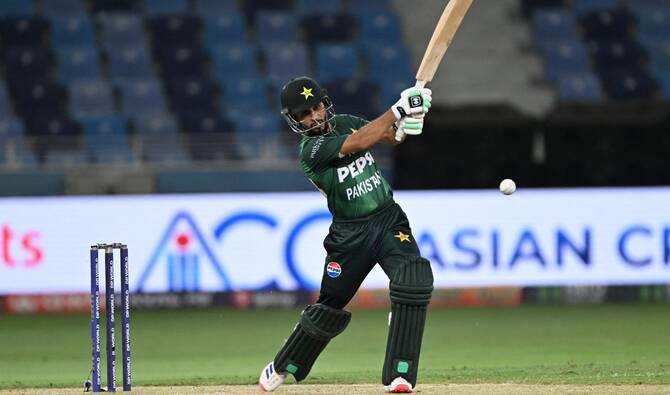
Pakistan begins Asia Cup with 93-run win over Oman in Dubai

Pakistan's Mohammad Haris plays a shot during the Asia Cup 2025 Twenty20 international cricket match between Oman and Pakistan at the Dubai International Stadium in Dubai on September 12, 2025. (AFP)
Short Url
Updated 12 September 2025
Follow

Pakistan begins Asia Cup with 93-run win over Oman in Dubai

  • Pakistan piled up 160-7 and bowled Oman out for 67 to seal an opening win in the Asia Cup
  • Pakistan will next faces arch-rival India on Sunday in the tournament’s marquee T20 clash

DUBAI: Pakistan thumped Oman by 93 runs to begin its Asia Cup campaign thanks to Mohammad Haris’ 66 off 43 balls at Dubai International Stadium on Friday.

Pakistan scored 160-7 after opting to bat and Oman was bundled out for 67 in 16.4 overs.

Haris struck seven fours and three sixes on his way to 50 off 32 balls.

Pakistan takes on India in the Twenty20 tournament’s most high profile clash on Sunday at the same venue.

Haris crossed the 20-run mark in T20s for the first time in 12 innings. His best in 11 innings prior was 15 against Afghanistan in the preceding tri-series. He was 107 not out in June against Bangladesh at Lahore.

Opener Shahibzada Farhan (29) and Haris put on 85 off 64 balls to drive the innings.

Saim Ayub was out for a golden duck, as was skipper Salman Agha, both falling to left-arm spinner Aamir Kaleem.

Kaleem also bowled Haris in the 13th over and finished with 3-31 in four overs — his career best against a full ICC member.

Fakhar Zaman hit 23 not out off 16 balls and Mohammad Nawaz scored 19 off 10 balls to help Pakistan pass 150. It lost its last five wickets for 56 runs in seven overs.

In a chase that never got going, Hammad Mirza top-scored for Oman with 27 off 23 balls.

Oman collapsed from 41-2 to 51-9, losing seven wickets for 10 runs across 34 deliveries. The innings ended in the 17th over, with the last pair adding 16 runs.

Spinners Saim Ayub and Suyiyan Muqeem, and medium pacer Faheem Ashraf shared six wickets across seven overs in the rout.


Sindh assembly passes resolution rejecting move to separate Karachi

Updated 21 February 2026
Follow

Sindh assembly passes resolution rejecting move to separate Karachi

  • Chief Minister Shah cites constitutional safeguards against altering provincial boundaries
  • Calls to separate Karachi intensified amid governance concerns after a mall fire last month

ISLAMABAD: The provincial assembly of Pakistan’s southern Sindh province on Saturday passed a resolution rejecting any move to separate Karachi, declaring its territorial integrity “non-negotiable” amid political calls to carve the city out as a separate administrative unit.

The resolution comes after fresh demands by the Muttahida Qaumi Movement (MQM) and other voices to grant Karachi provincial or federal status following governance challenges highlighted by the deadly Gul Plaza fire earlier this year that killed 80 people.

Karachi, Pakistan’s largest and most densely populated city, is the country’s main commercial hub and contributes a significant share to the national economy.

Chief Minister Syed Murad Ali Shah tabled the resolution in the assembly, condemning what he described as “divisive statements” about breaking up Sindh or detaching Karachi.

“The province that played a foundational role in the creation of Pakistan cannot allow the fragmentation of its own historic homeland,” Shah told lawmakers, adding that any attempt to divide Sindh or separate Karachi was contrary to the constitution and democratic norms.

Citing Article 239 of Pakistan’s 1973 Constitution, which requires the consent of not less than two-thirds of a provincial assembly to alter provincial boundaries, Shah said any such move could not proceed without the assembly’s approval.

“If any such move is attempted, it is this Assembly — by a two-thirds majority — that will decide,” he said.

The resolution reaffirmed that Karachi would “forever remain” an integral part of Sindh and directed the provincial government to forward the motion to the president, prime minister and parliamentary leadership for record.

Shah said the resolution was not aimed at anyone but referred to the shifting stance of MQM in the debate while warning that opposing the resolution would amount to supporting the division of Sindh.

The party has been a major political force in Karachi with a significant vote bank in the city and has frequently criticized Shah’s provincial administration over its governance of Pakistan’s largest metropolis.

Taha Ahmed Khan, a senior MQM leader, acknowledged that his party had “presented its demand openly on television channels with clear and logical arguments” to separate Karachi from Sindh.

“It is a purely constitutional debate,” he told Arab News by phone. “We are aware that the Pakistan Peoples Party, which rules the province, holds a two-thirds majority and that a new province cannot be created at this stage. But that does not mean new provinces can never be formed.”

Calls to alter Karachi’s status have periodically surfaced amid longstanding complaints over governance, infrastructure and administrative control in the megacity, though no formal proposal to redraw provincial boundaries has been introduced at the federal level.