

‘We want to take the language barrier out of the equation,’ CAMB.AI CEO tells Dutch tech show

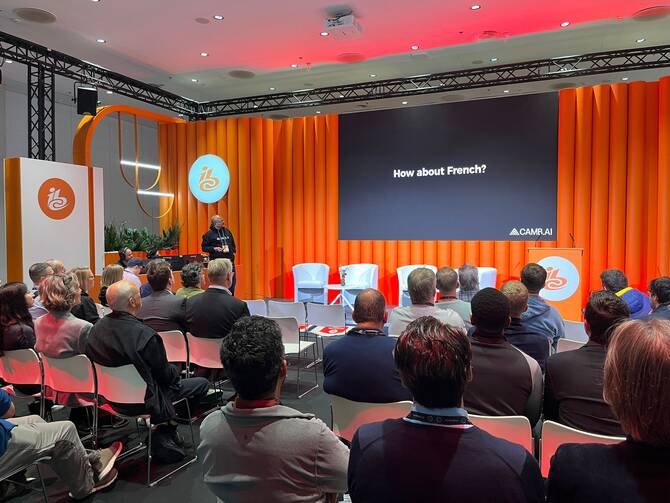
Founded in 2023, CAMB.AI has emerged as a major player in the localization and live multilingual translation industry. (AN/File)
Short Url
Updated 12 September 2025
Follow

‘We want to take the language barrier out of the equation,’ CAMB.AI CEO tells Dutch tech show

  • Avneesh Prakash said his Dubai-based startup provides AI-powered content translation in 150+ languages

AMSTERDAM: The CEO of Dubai-based AI-powered translation platform CAMB.AI said on Friday that his company is working to make the language barrier a thing of the past.

Speaking at the IBC 2025 tech show in Amsterdam, Avneesh Prakash said he envisions a “world which is free of language (barriers).”

Prakash continued: “We are working in languages — with the diversity of languages — and (what) we want is to take the language (barrier) out of the equation. Completely.”

CAMB.AI is an advanced AI speech synthesis and translation company which, Prakash said, enables the translation and localization of content — whether video, audio, or text — into more than 150 languages.

Prakash said CAMB.AI already works with major clients including Comcast, MLS, Google, and IMAX to “localize everything — from content to conversation, from sports, entertainment, healthcare, even spirituality.”

He added: “When you are on the right side of the language divide, when you get to consume the best possible content in the world available in a certain language, life seems good. Seems very fair. But when you are on the wrong side of the divide, life isn’t all that fair, right? Language should not divide.”

Less than 17 percent of people worldwide speak English, yet the majority of content is created with English speakers in mind, Prakash stated.

“Times are changing,” he continued. “Now we have some of the biggest OTT (Over-the-Top) hits which are not English originals. You have more foreign-language films at the Oscars. Indian and Saudi sports leagues are booming.”

Founded in 2023, CAMB.AI has emerged as a major player in the localization and live multilingual translation industry. Recently, the startup partnered with Vox Cinemas to convert a film originally shot in Arabic into multiple languages, including Mandarin.

It has also worked across live sporting events, including NASCAR races and Major League Soccer matches, converting live commentary into multiple languages in what Prakash described as a “first in the history of mankind.”

The company has released two language models: MARS, a text-to-speech model, and BOLI, a neural machine translation model.

Prakash explained that rather than providing “word-for-word translation,” the technology processes “content that makes sense and has meaning,” delivering translations within seconds.

“We don’t have to wait for something finished,” he said, claiming that the system works “while we preserve the soul of the original content — and that’s what differentiates us.

“We actually mimic the performance or the swirl or the emotions or the prosody of the original content,” he continued. “If there’s a stutter, we will stutter. We do zero-shot (learning) processing, and we stay true to what is happening right there, at that moment.”

Israeli journalist who reported on alleged sexual abuse of prisoner faces threats, harassment

Updated 18 November 2025
Follow

Israeli journalist who reported on alleged sexual abuse of prisoner faces threats, harassment

  • Since broadcast of the footage, Guy Peleg has faced sustained attacks by right-wing activists, media and politicians
  • Media watchdog Committee to Protect Journalists called the abuse ‘deploring,’ contributing to a climate of fear

LONDON: Israeli journalist Guy Peleg has faced sustained threats and harassment following his broadcast of leaked footage in 2024 that purportedly shows the sexual abuse of a Palestinian prisoner at the Sde Teiman detention center.

After airing the video — obtained from the Military Advocate General Corps — Peleg has been targeted by right-wing activists, politicians and media figures. Israeli Heritage Minister Amichay Eliyahu suggested on social media that Peleg should be jailed for distributing the footage.

Broadcast in August 2024 on an Israeli news channel, the footage showed reserve soldiers at the Sde Teiman military base in southern Israel taking aside a detainee, then surrounding him with riot shields to block visibility while he was allegedly beaten and stabbed in the rectum with a sharp object.

Prime Minister Benjamin Netanyahu dismissed the video as “cooked up” and “edited,” claiming it inflicted “unspeakable damage to the State of Israel and the Israel Defense Forces.”

The controversy has triggered a fierce debate over military accountability, culminating in the resignation of the military advocate general, Yifat Tomer-Yerushalmi.

In a statement on Monday, US-based media watchdog the Committee to Protect Journalists called the attacks against Peleg “deploring,” saying officials “should be safeguarding their (journalists) ability to report” instead of inciting retaliation and intimidation.

“The threats against Guy Peleg are unacceptable and contribute to a climate of fear around publishing critical reporting on Israel’s security establishment,” CPJ Regional Director Sara Qudah said.

On Nov. 12, right-wing activist Mordechai David, accompanied by others, confronted Peleg outside a building in Tel Aviv, taunting him and blocking access to his car.

“Why did you distribute a video about IDF soldiers? Guy Peleg, anywhere in the world you will need a police escort to get to your car so that you don’t get blocked,” David shouted, as seen in an online video.

In any earlier incident, a small group from the “Lions of the Right” demonstrated outside Peleg’s home in Herzliya, prompting police to provide him and his family with protection. Channel 12 subsequently assigned Peleg a security detail pending further notice.

According to Israeli newspaper Haaretz, David — who has a record of assaulting anti-government and pro-hostage deal demonstrators — was later questioned by police and prohibited from contacting Peleg for 15 days.

Discussing the ordeal on his 103 FM radio show, Peleg described the pressures he faces as symptomatic of “rising political extremism.” He added, “The problem is that he’s not alone (referring to David). The problem is that he is embraced by central ministers in the government.”

The incident comes amid growing concerns about press freedom in Israel, highlighted by official moves to restrict independent reporting and public criticism of the military.
