

Turkish hackers video call Israeli defense minister, leak his number online

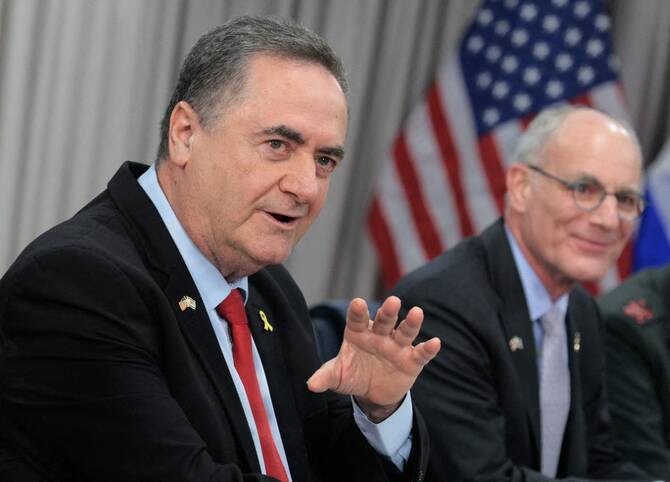
In August 2024, while serving as foreign minister, Katz sparked controversy by attacking Turkish President Recep Tayyip Erdogan on X. (AFP/File)
Short Url
Updated 13 September 2025
Follow

Turkish hackers video call Israeli defense minister, leak his number online

  • Hackers released screenshots of messages sent to Israel Katz via WhatsApp, which appeared to contain insults and threats, including “We will kill you”
  • The incident took place on Thursday evening, with other Knesset members reportedly being targeted on Friday

LONDON: A group of Turkish hackers reportedly managed to video call Israeli Defense Minister Israel Katz and subsequently leaked his phone number online.

According to local media reports, Katz accepted a video call from one of the hackers on Thursday evening, who then took a screenshot and published it online.

The hackers also released screenshots of multiple messages sent to Katz via WhatsApp, which appeared to contain insults and threats, including “We will kill you.”

“Hey Katz, never forget this, your death is near, we are the defenders of Qassam, we will bury you and your country in history,” read one of the messages, apparently referencing the armed wing of Hamas.

Israeli media reported that Katz had maintained the same phone number for several years and that it had previously been circulated in various groups. The number has since been blocked.

In a post on his X account, Katz claimed the hackers belonged to “organized Islamist-jihadist gangs from various countries around the world.”

He wrote: “Let them continue to call and threaten and I will continue to order the elimination of their fellow terrorist leaders.”

Other members of the ruling Likud party, including Ofir Katz, David Bitan, and Moshe Saada, have also been targeted by hackers, Israeli media reported Friday.

After reportedly receiving hundreds of WhatsApp video calls from unknown numbers, which they did not answer, the politicians also received text messages containing images of Palestinian flags.

It remains unclear whether the hackers accessed any sensitive information, or if the breach represents a broader security vulnerability.

In August 2024, while serving as foreign minister, Katz sparked controversy by attacking Turkish President Recep Tayyip Erdogan on X, accusing him of turning Turkiye into a dictatorship due to his “support for the murderers and rapists of Hamas.”

The post included an AI-generated image of Erdogan against Istanbul’s backdrop with a burning Turkish flag, provoking outrage in Turkey.

Since assuming his role as defense minister in November, Katz has generated further controversy by reportedly spearheading plans to confine Palestinians in what critics have labeled a “concentration camp” built on the ruins of Rafah in southern Gaza.



Study finds nearly half of UK news stories on Muslims show signs of bias

Updated 09 March 2026
Follow

Study finds nearly half of UK news stories on Muslims show signs of bias

  • Centre for Media Monitoring finds 20,000 out of 40,913 articles from 30 major news outlets contain bias and 70% link Muslims to negative behaviors or themes
  • Findings reveal ‘deeply concerning evidence of structural bias’ in portrayal of Muslims by UK press and point to ‘systemic problem’ within the media, says center’s director

LONDON: Nearly half of news articles published in the UK in 2025 that referenced Muslims or Islam contained some degree of bias, according to a report issued on Monday by the Centre for Media Monitoring. It also found that about 70 percent of stories linked Muslims to negative behaviors or themes.

The nonprofit organization, which tracks the ways in which Muslims and Islam are portrayed in the media, examined 40,913 articles from 30 major news outlets and found that about 20,000 showed some form of bias.

The study looked at “structural patterns” in coverage that “shape public narratives” about Muslims amid rising hostility toward the community.

“As the largest study of its kind ever conducted in the UK, this report presents deeply concerning evidence of structural bias in how Muslims are portrayed in the UK press,” said Rizwana Hamid, the director of the organization.

It found that 70 percent of the articles it reviewed highlighted negative aspects related to Muslims, though not all of the stories were biased in themselves. The wider patterns were also troubling: 44 percent of the coverage omitted key context, 17 percent relied on generalizations, and 13 percent included outright misrepresentation.

Taken together, the monitoring center said, the findings amounted to evidence of an “information integrity crisis” that distorts public understanding, and “a deeply concerning trend” in reporting on Muslims.

The research points to a “systemic problem within our media ecosystem,” Hamid said.

“When entire communities are repeatedly framed through lenses of suspicion or threat, it inevitably shapes public attitudes, political debate and the everyday lives of British Muslims,” she added.

News brands targeting right-wing audiences were more likely to produce biased coverage, the report found.

The Spectator magazine and GB News were identified as having the highest proportion of “very biased” articles, and as the “worst across all five bias categories”: negative framing, generalizations, misrepresentation, lack of context, and problematic headlines.

Other outlets highlighted for displaying high levels of biased content about Muslims included The Telegraph, The Jewish Chronicle, Daily Express, The Sun, Daily Mail and The Times.

In contrast, the BBC, other broadcasters and left-leaning outlets recorded the lowest rates of bias in the study.

The research comes as British Muslims report rising levels of discrimination. Official figures published in October revealed that religious hate crimes against Muslims rose by 19 percent in the year to March 2025 compared with the previous 12 months.