

South Sudan’s opposition says government trying to enforce ‘one-tribe rule’

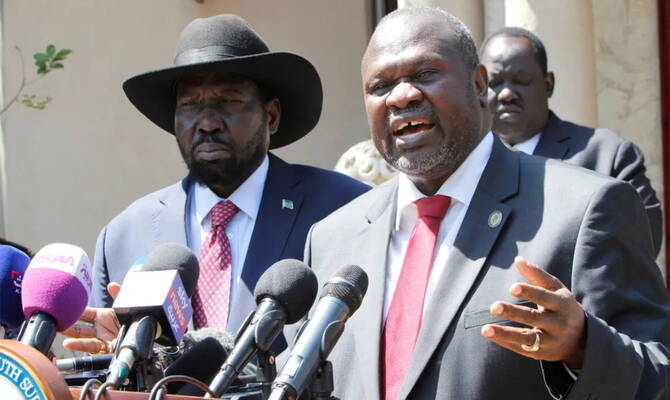
South Sudan's opposition has accused the government of trying to enforce "authoritarian control and one-tribe rule" after First Vice President Riek Machar was charged with orchestrating militia attacks and suspended from his role. (Reuters/File)
Short Url
Updated 12 September 2025
Follow

South Sudan’s opposition says government trying to enforce ‘one-tribe rule’

  • “The charges are fabricated to abrogate the (peace agreement), sideline Dr. Machar and the SPLM-IO, and entrench total government control,” SPLM-IO party said
  • Political analysts say Kiir has long been seeking to replace Machar with his close ally, Second Vice President Benjamin Bol Mel

JUBA: South Sudan’s opposition has accused the government of trying to enforce “authoritarian control and one-tribe rule” after First Vice President Riek Machar was charged with orchestrating militia attacks and suspended from his role.

Machar’s SPLM-IO party rejected the charges against him and 20 others which included murder, treason and crimes against humanity for their alleged involvement in raids by the White Army militia in the northeast in March.

Machar’s detention under house arrest since March has ignited international fears of a renewal of a devastating 2013-2018 civil war between his ethnic Nuer forces and Dinka fighters loyal to his longtime rival President Salva Kiir.

Kiir and Machar served in a unity government as part of a peace deal that ended that war, but their partnership remained strained and sporadic violence has continued between the two sides.

“The charges are fabricated to abrogate the (peace agreement), sideline Dr. Machar and the SPLM-IO, and entrench total government control,” Machar’s SPLM-IO party said in a statement late on Thursday shortly after the justice ministry announced the charges.

Political analysts say Kiir has long been seeking to replace Machar with his close ally, Second Vice President Benjamin Bol Mel, who was sanctioned by the US over suspicions that he received preferential treatment in securing government contracts.

South Sudanese officials have asked the US to lift those sanctions during recent bilateral discussions, Joseph Szlavik, a lobbyist working for Juba in Washington, told Reuters last month.

Those conversations have also touched on sending more US deportees to South Sudan following the arrival in July of eight men, including seven from third countries, Szlavik said.


Macron vows stronger cooperation with Nigeria after mass kidnappings

Updated 07 December 2025
Follow

Macron vows stronger cooperation with Nigeria after mass kidnappings

  • Macron wrote on X that France “will strengthen our partnership with the authorities and our support for the affected populations”

PARIS: French President Emmanuel Macron said Sunday that France will step up cooperation with Nigeria after speaking with his counterpart, as the West African country faces a surge in abductions.
Nigeria has been wracked by a wave of kidnappings in recent weeks, including the capture of over 300 school children two weeks ago that shook Africa’s most populous country, already weary from chronic violence.
Macron wrote on X that the move came at Nigerian President Bola Tinubu’s request, saying France “will strengthen our partnership with the authorities and our support for the affected populations,” while urging other countries to “step up their engagement.”
“No one can remain a spectator” to what is happening in Nigeria, the French president said.
Nigeria has drawn heightened attention from Washington in recent weeks, after US President Donald Trump said in November that the United States was prepared to take military action there to counter the killing of Christians.
US officials, while not contradicting Trump, have since instead emphasized other US actions on Nigeria including security cooperation with the government and the prospect of targeted sanctions.
Kidnappings for ransom by armed groups have plagued Nigeria since the 2014 abduction of 276 school girls in the town of Chibok by Boko Haram militants.
The religiously diverse country is the scene of a number of long-brewing conflicts that have killed both Christians and Muslims, often indiscriminately.
Many scholars say the reality is more nuanced, with conflicts rooted in struggles for scarce resources rather than directly related to religion.