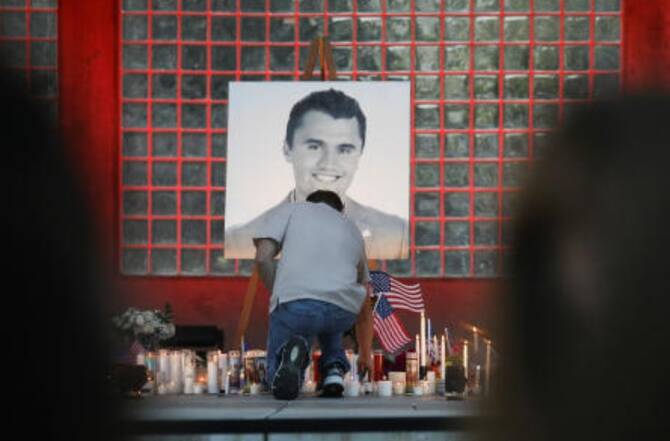
UTAH, USA: The man accused of assassinating Charlie Kirk had expressed opposition to the conservative activist’s viewpoints and indicated that he was responsible for the shooting, authorities said Friday as they announced an arrest in the killing that raised fresh alarms about political violence in a deeply polarized United States.
Tyler Robinson, 22, had become “more political” in the run-up to the shooting and mentioned during a dinner with family that Kirk would be visiting Utah, Gov. Spencer Cox told a news conference. The governor cited as evidence engravings on bullet casings found in the rifle that authorities believe was used in the attack, as well as chat app messages attributed to the suspect that a roommate shared with law enforcement.
“Ladies and gentlemen, we got him,” Cox told a news conference soon after the arrest was first heralded by President Donald Trump on the Fox News show “Fox & Friends.”
Robinson is believed to have acted alone, and the investigation is ongoing, Cox said. He was arrested on suspicion of capital murder, weapons and obstruction offenses.
Robinson’s arrest late Thursday capped a frenetic day-and-a-half search that just hours earlier seemed stuck when authorities pleaded for tips and leads from the public. The assassination captivated the public not only because of Kirk’s outsize influence in conservative political circles and his close connections with Trump but also because of the pressing questions it raised about the escalating toll of political violence that has spanned the ideological spectrum.
“This is our moment: Do we escalate or do we find an off ramp?” Cox asked, making an impassioned plea for young people to bridge differences through common ground rather than violence. “It’s a choice.”
New details on evidence
Authorities have yet to reveal a motive, but they did describe evidence they recovered they said shed potential light on the slaying.
That includes engravings on bullet casings recovered from the high-powered rifle believed used in the attack, including one that said, “Hey, fascist! Catch!” Cox said.
In addition, a roommate shared with authorities messages from the chatting app Discord that involved a contact named Tyler and discussed a rifle wrapped in a towel, engraved bullets and a scope, the governor said.
The clothes the suspect wore when confronted by law enforcement late Thursday were consistent with what he had on when he arrived on campus a day earlier, Cox said. A Mauser .30-caliber, bolt-action rifle was found in a towel in a wooded area along the path investigators believe Robinson took after firing a shot from a distant roof and then fleeing.
A breakthrough came when a Robinson family member communicated to a family friend that Robinson had confessed or implied that he was responsible, information that was then shared with law enforcement.
Robinson’s father recognized him from the photos released by the FBI and told him to turn himself in. Robinson refused at first, but then changed his mind, according to a law enforcement official who spoke on the condition of anonymity to discuss an ongoing investigation.
His father reached out for help to their youth pastor, who also occasionally works with the US Marshals and called the agency so he could turn himself in.
Family members of Robinson did not immediately return messages seeking comment. It was not clear if he had a lawyer.
Kirk was killed by a single shot in what police said was a targeted attack and the governor called a political assassination. Kirk co-founded the nonprofit political organization Turning Point USA, based in Arizona. He had had been speaking at a debate hosted by Turning Point at Utah Valley University at the time of Wednesday’s shooting.
“He wanted to help young people, and he didn’t deserve this,” Trump said Friday. “He was really a good person.”
Grisly video shared online
The attack, carried out in broad daylight as Kirk spoke about social issues, was captured on grisly videos that spread on social media.
The videos show Kirk, who was influential in rallying young Republican voters, speaking into a handheld microphone when suddenly a shot rings out. Kirk reaches up with his right hand as blood gushes from the left side of his neck. Stunned spectators gasp and scream before people start running away.
The shooter, who investigators believe blended into the campus crowd because of a college-age appearance, fired one shot from the rooftop, according to authorities. Video released Thursday showed the person then walking through the grass and across the street before disappearing.
“I can tell you this was a targeted event,” said Robert Bohls, the top FBI agent in Salt Lake City.
Trump, who was joined by Democrats in condemning the violence, said he would award Kirk the Presidential Medal of Freedom, the highest civilian honor in the US Vice President JD Vance and his wife, Usha, visited with Kirk’s family Thursday in Salt Lake City. Vance posted a remembrance on X chronicling their friendship, dating back to initial messages in 2017, through Vance’s Senate run and the 2024 election.
“So much of the success we’ve had in this administration traces directly to Charlie’s ability to organize and convene,” Vance wrote. “He didn’t just help us win in 2024, he helped us staff the entire government.”
Kirk’s casket was flown aboard Air Force Two from Utah to Phoenix, where his nonprofit political youth organization is based. Trump told reporters he planned to attend Kirk’s funeral. Details have not been announced.
Kirk was taking questions about gun violence
Kirk was a conservative provocateur who became a powerful political force among young Republicans and was a fixture on college campuses, where he invited sometimes-vehement debate on social issues.
One such provocative exchange played out immediately before the shooting as Kirk was taking questions from an audience member about gun violence.
The debate at the Sorensen Center on campus was billed as the first stop on Kirk’s “American Comeback Tour.”
The event generated a polarizing campus reaction. An online petition calling for university administrators to bar Kirk from appearing received nearly 1,000 signatures. The university issued a statement last week citing First Amendment rights and affirming its “commitment to free speech, intellectual inquiry and constructive dialogue.”
Last week, Kirk posted on X images of news clips showing his visit was sparking controversy. He wrote, “What’s going on in Utah?”


![]()
![]()

Suspect in Charlie Kirk assassination expressed opposition to conservative activist’s views

Short Url
https://arab.news/gjtdj
Suspect in Charlie Kirk assassination expressed opposition to conservative activist’s views
- Tyler Robinson, 22, had become “more political” in the run-up to the shooting and mentioned during a dinner with family that Kirk would be visiting Utah
- Robinson is believed to have acted alone, and the investigation is ongoing


Latest updates



© 2026 SAUDI RESEARCH & PUBLISHING COMPANY, All Rights Reserved And subject to Terms of Use Agreement.