

Barca Liga homecoming against Valencia reduced to tiny stadium

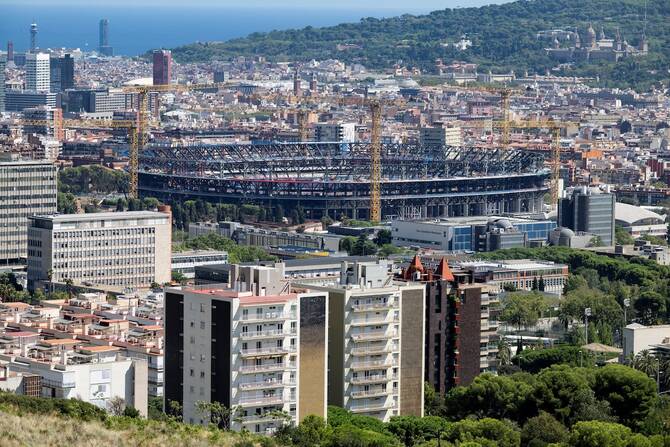
A picture taken on September 3, 2025 shows the ongoing construction of the new FC Barcelona's Camp Nou Stadium in Barcelona. (FILE/AFP)
Short Url
Updated 12 September 2025
Follow

Barca Liga homecoming against Valencia reduced to tiny stadium

  • The Catalan giants will host Valencia at their 6,000-capacity Johan Cruyff training ground stadium as they bid to keep pace with leaders Real Madrid and Athletic Bilbao

BARCELONA: After three weeks on the road to start the La Liga season champions Barcelona play their first home match on Sunday, although it won't be the glorious return to the rebuilt Spotify Camp Nou they had hoped for.

The Catalan giants will host Valencia at their 6,000-capacity Johan Cruyff training ground stadium as they bid to keep pace with leaders Real Madrid and Athletic Bilbao.

Barca, fourth, are two points behind the top two after a 1-1 draw at Rayo Vallecano before the international break in which Hansi Flick's side were outplayed.

After being given permission to play away at the start of the season so the Camp Nou could be readied, Barca's time ran out.

They did not announce the venue for their game against Valencia until Tuesday, in the hopes they would get the permits they needed to play before a reduced-capacity crowd at their revamped stadium.

With a concert being held at the Olympic stadium -- where Barcelona have been playing the last two seasons during building work at Camp Nou, which is due to be completed in 2026 -- the club have been reduced to playing before a tiny crowd.

Rivals Real Madrid also played at their Alfredo Di Stefano training ground stadium during renovations at the Santiago Bernabeu, but it was mainly during the 2020/21 season when fans were not allowed to attend because of the Covid-19 pandemic.

"We will go back to Camp Nou as soon as possible, we're really looking forward to returning," said Barcelona president Joan Laporta on Thursday.

The Catalans thumped Italian side Como 5-0 at the Johan Cruyff stadium in August in a friendly, which they had also hoped to play at the Camp Nou, originally due to reopen in November 2024.

Barcelona granted Valencia 290 tickets for the match, which quickly sold out.

"We have to adapt even though we know that we want to play in big stadiums," complained Valencia midfielder Pepelu.

"In the end we can do little other than just playing the game and winning it."

Flick's rampant Barcelona thrashed Valencia 7-1 at the Olympic stadium last season but Pepelu expects a closer game on Sunday.

"We're ready to see if we can get a good result. We've worked to correct things from last year and we're convinced it will be a good match," he added.

Flick suggested his Barcelona team needed to keep their egos in check if they are to succeed this season following their domestic treble. Playing at the Johan Cruyff might bring them down to earth.

"It's important there are no egos, that kills the chances of success," said Flick, upset after the team's poor display against Rayo at Vallecas.

Teenage sensation Lamine Yamal also insisted Barcelona stars needed to be focussed after returning from international duty.

"We did not start (the season) with the intensity that we finished, we made mistakes," admitted Yamal.

"We are hungry for more, you have to give us time."

Real Madrid visit Real Sociedad while Athletic Bilbao host Alaves, both on Saturday, in a Basque Country double-header.


German soccer want compensation for developing players who switch to other nations

Updated 11 November 2025
Follow

German soccer want compensation for developing players who switch to other nations

  • “We’re currently checking whether there’s a possibility of coaching compensation when players switch national associations,” Rettig said
  • Germany have long seen players with one or two parents born abroad opt to represent their country of their roots

BERLIN: The German soccer federation (DFB) want compensation when players opt to represent other countries after representing Germany at youth levels.
“It simply makes no sense to me why a player who has been coached primarily at his club for five years but also by the federation as a junior partner should be able to switch national associations for free,” DFB managing director Andreas Rettig told news agency dpa on Tuesday.
German-born Juventus star Kenan Yıldız is a Turkish international, having played for Turkiye’s youth teams. Eintracht Frankfurt forward Can Uzun also turned down Germany in favor of Turkiye.
Former Hertha Berlin forward Ibrahim Maza, now playing for Bayer Leverkusen, plays for Algeria after appearing for Germany at youth levels.
German youth internationals Muhammed Damar and Nicolò Tresoldi are reportedly being courted by Turkiye and Italy, respectively, and the Frankfurter Rundschau daily newspaper reported on Sunday that Nuremberg defender Fabio Gruber has chosen to represent Peru.
“We’re currently checking whether there’s a possibility of coaching compensation when players switch national associations,” Rettig said. “This issue has not yet been addressed extensively. But coaching must be worthwhile for both sides, the player and the coach.”
Germany have long seen players with one or two parents born abroad opt to represent their country of their roots, while the country has also benefited from immigration as players such as İlkay Gündoğan, Mesut Özil, Sami Khedira and Gerald Asamoah have contributed to the national team’s success.
Cologne teenager Said El Mala was last week called up for Germany’s World Cup qualifiers this week and at least 12 players in the latest squad could have chosen to represent other countries. The injured Jamal Musiala chose Germany after playing for England youth teams.
“In Germany 43 percent of children under five years of age hold dual citizenship. When they’re 10 or 12 years older they can decide, do I prefer the (German) eagle or, for example, the (Turkish) crescent moon?” Rettig said.
“We analyzed the squad lists from the under-15s to the under-21s within the federation. The percentage there is significantly higher than the aforementioned 43 percent. There are age groups in which seven or eight players in the starting 11 have dual nationality.”
FIFA would need to approve and enforce any system of compensation payments. Other countries like France, England, Switzerland and the Netherlands could also expect windfalls from home-grown players’ switches to other teams.