

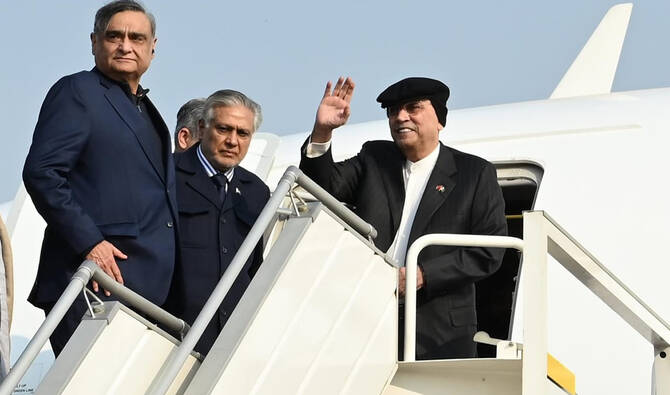
Pakistan president on China visit to boost economic, trade cooperation

This file photo, taken on February 4, 2025, shows Pakistan President Asif Ali Zardari departing for an official visit to China, at Nur Khan Airbase in Rawalpindi. (Handout/PPP/File)
Short Url
Updated 12 September 2025
Follow

Pakistan president on China visit to boost economic, trade cooperation

  • Asif Ali Zardari will visit Chengdu, Shanghai and Uygur autonomous region from Sept. 12-21
  • Pakistan signed investment, joint venture agreements with China worth $8.5 billion last week

ISLAMABAD: Pakistan President Asif Ali Zardari has embarked on a 10-day visit to China to hold discussions with the Chinese leadership on enhancing bilateral economic and trade cooperation, Zardari's office said on Friday.

The visit is taking place days after Prime Minister Shehbaz Sharif’s official trip to China last week, where Islamabad signed investment agreements and joint ventures worth $8.5 billion with Beijing.

Zardari's trip from Sept. 12-21 would include visits to Chengdu and Shanghai cities, and the Xinjiang Uygur Autonomous Region where he will meet Chinese provincial leaders, according to the Pakistani foreign office.

“The discussions will encompass Pakistan-China bilateral relations, with a particular focus on economic and trade cooperation, CPEC and future connectivity initiatives,” it said in a statement.

Pakistan views China as an important investment partner and strategic ally, which has funneled billions of dollars into the country under the China-Pakistan Economic Corridor (CPEC) energy and infrastructure project for over a decade.

The foreign office said Zardari’s visit would reaffirm both countries’ support over core interests, advance economic and trade ties and underscore their commitment to regional peace.

China is its largest trading partner, with bilateral trade topping $25 billion in recent years. Chinese firms have invested heavily in Pakistan in power, transport, infrastructure and telecoms projects under the multi-billion-dollar CPEC.


Pakistan launches second indigenous EO-2 satellite from China, SUPARCO says

Updated 8 sec ago
Follow

Pakistan launches second indigenous EO-2 satellite from China, SUPARCO says

  • Earth observation satellite launched from Yangjiang Seashore Launch Center in China
  • EO-2 to enhance disaster response, governance, resource management capabilities

KARACHI: Pakistan has successfully launched its second indigenous Earth Observation satellite, EO-2, from China’s Yangjiang Seashore Launch Center, the national space agency SUPARCO said on Thursday.

The launch marks a significant step in Pakistan’s efforts to strengthen its domestic space and remote sensing capabilities, with the satellite expected to improve imaging continuity, disaster monitoring, agricultural planning and strategic resource management.

In a statement, Pakistan’s SUPARCO said the EO-2 satellite would enhance the country’s earth observation and imaging capabilities and support governance and planning functions across multiple sectors.

“Pakistan’s second indigenous EO-2 satellite has been successfully launched,” SUPARCO said, adding that the mission represents a “milestone” in the expansion of the country’s satellite fleet.

According to the agency, EO-2 will provide critical data for planning and resource management while improving the continuity and accuracy of national earth observation systems.

The satellite is expected to support disaster management, urban planning, environmental monitoring and infrastructure development by supplying updated geospatial imagery and data.

SUPARCO said the launch demonstrates growing indigenous capability in satellite development and reflects Pakistan’s broader objective of strengthening its national space program through locally developed platforms.

Pakistan has gradually expanded its space cooperation with China in recent years, including satellite launches and joint missions, as Islamabad seeks to build technical capacity and reduce reliance on external data sources.

The EO-2 satellite is expected to play a key role in improving data availability for federal and provincial authorities, particularly in areas vulnerable to floods, climate stress and rapid urbanization.