

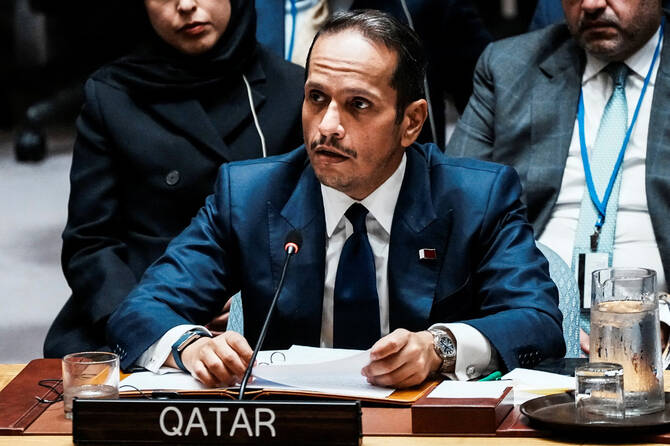

NEW YORK: “Have you seen a state attack negotiators like that?” Prime Minister Sheikh Mohammed bin Abdulrahman bin Jassim Al-Thani asked the UN Security Council on Thursday, following an Israeli airstrike on a diplomatic compound in Doha that killed several people, including a Qatari security officer.
Addressing an emergency meeting convened at the request of Algeria, Somalia and Pakistan, the Qatari prime minister described the Sept. 9 strike as a “criminal assault” and a “clear violation of Qatar’s sovereignty.”
He warned that it threatened to derail ongoing ceasefire negotiations and peace efforts in Gaza.
Israel’s airstrike hit a residential complex in Doha housing members of Hamas’ political bureau and their families. The location, Sheikh Mohammed emphasized, was widely known to diplomats, journalists, and others involved in the mediation process.
The prime minister said the Hamas delegation had been meeting to discuss the latest US ceasefire proposal when the missiles struck at approximately 3:45 p.m. local time.
“This was no accident,” he told council members. “This was a targeted effort to sabotage diplomacy, to perpetuate suffering, and to silence those seeking a way out of the bloodshed.”
Under-Secretary-General for Political and Peacebuilding Affairs Rosemary DiCarlo, delivering a message from UN Secretary-General Antonio Guterres, described the Israeli action as “an alarming escalation” and a direct violation of Qatar’s territorial integrity.
“This strike potentially opens a new and perilous chapter in this devastating conflict,” she said. “Any action that undermines mediation weakens confidence in the very mechanisms we rely on to resolve conflicts.”
Tel Aviv took responsibility for the attack, with Prime Minister Benjamin Netanyahu calling it “a wholly independent Israeli operation” in response to a deadly Hamas-claimed attack in Jerusalem the day prior.
Hamas confirmed that the son of its chief negotiator, Khalil Al-Hayya, was among those killed, though the senior leadership reportedly survived.
The UK condemned Israel’s airstrikes on Doha as a flagrant violation of Qatar’s sovereignty, warning they risk further regional escalation and jeopardize ceasefire negotiations.
Ambassador Barbara Woodward praised Qatar’s “resolute commitment” to diplomacy and dialogue, commending the leadership of Sheikh Tamim bin Hamad Al-Thani in championing peace efforts.
Woodward reiterated that Hamas must release all hostages, agree to a ceasefire, and disarm, but also criticized Israel’s ongoing military operation in Gaza City, stating: “The Israeli government’s decision to further escalate its offensive in Gaza is wrong.”
She called for an immediate increase in humanitarian aid and urged Israel to lift all restrictions, reaffirming the UK’s support for a two-state solution as the only path to lasting peace.
The US expressed concern over the incident while reaffirming its commitment to Israel’s security and the removal of Hamas.
Acting US Ambassador Dorothy Shea conveyed condolences to the family of the Qatari officer killed by Israel, calling Qatar a “sovereign nation bravely taking risks to broker peace.”
Still, she urged council members not to use the attack to “question Israel’s commitment to bringing their hostages home.”
President Donald Trump, who spoke to both Netanyahu and Qatar’s emir after the assault, believes the incident could serve as “an opportunity for peace,” according to Shea.
The US, she said, remains committed to securing a ceasefire, facilitating humanitarian access, and pushing Hamas to disarm and release all hostages.
But Qatar’s prime minister was unequivocal in his condemnation, saying that the strike had “uncovered the true intention of Israel’s extremist leadership,” which he accused of undermining any prospect of peace.
Drawing parallels to the US-Taliban talks hosted in Doha, Sheikh Mohammed said the targeting of Hamas negotiators directly contradicted the norms of conflict mediation.
“The US never once struck the Taliban negotiators in Doha,” he said. “On the contrary, it was through those channels that we ended the longest war in US history. Why is Israel trying to destroy the very possibility of a negotiated peace?”
He added that Qatar remains committed to mediation and humanitarian efforts, having helped secure the release of 148 hostages and facilitate aid corridors into Gaza.
“This attack is not only on Qatar — it is on every country striving for peace,” he said. “The international community is being tested. If the UN remains silent, it legitimizes the law of the jungle.”
DiCarlo said that “durable and just solutions in the Middle East will not emerge from bombs, but from diplomacy.”
Qatar has pledged to continue its efforts in partnership with Egypt and the US to reach a ceasefire in Gaza and secure the release of hostages. “We call for peace, not war,” Sheikh Mohammed said.
“But we will not condone attacks on our sovereignty. We reserve the right to respond within the framework of international law.”
Israeli Ambassador to the UN Danny Danon, addressing Sheikh Mohammed directly, said: “Prime Minister Al-Thani, history will not be kind to accomplices. Either Qatar condemns Hamas, expels Hamas, and brings Hamas to justice. Or Israel will."
“There will be no immunity for terrorists,” he said.
Danon added: “Today, on Sept. 11, the world remembers the brutal and murderous terrorist attack in the US.
“When bin Laden was eliminated in Pakistan, the question asked was not ‘why was a terrorist attacked on foreign soil?’ but ‘why was he given sanctuary in the first place?’
“There was no immunity for bin Laden and there can be no immunity for Hamas.”


