BRUSSELS: The UN’s migration agency is appealing for funds for around 134,000 people who need help in Afghanistan, nearly two weeks after an earthquake killed more than 2,200 people in the country’s mountainous east.
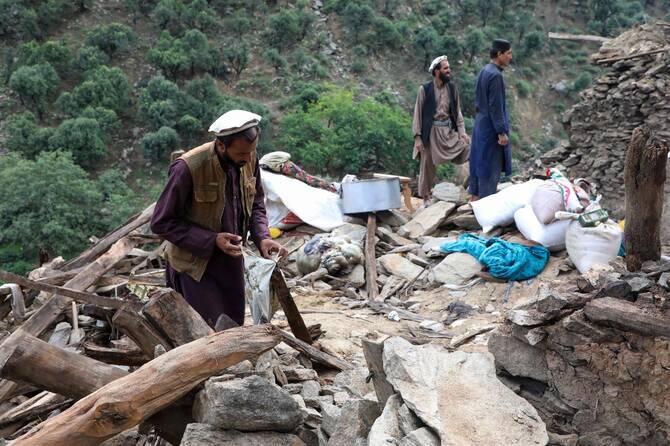
Many of the quake-hit Afghans are homeless, sleeping in the open and desperate to return and rebuild. Aid organizations are struggling to get tents and other assistance up the mountains and winter weather is expected in the coming weeks.
“We don’t want to create a camp” for the displaced, the International Organization for Migration’s Chief of Mission in Afghanistan Mihyung Park told The Associated Press.
“Those who are displaced … they’re living in a makeshift type of situation,” Park said in Brussels, after holding talks with European Union officials.
“We are trying to provide our assistance as close we can” to their current location, she added.
The deadly magnitude 6.0 quake on Aug. 31 and aftershocks that followed also injured more than 3,600 people, Afghan authorities have said. Many hard-hit areas are tough to get to, with some only reachable by helicopter. The IOM said that more than 7,000 homes were destroyed. Nearly half a million people have been affected in all.
In the 80 out of 400 hardest hit villages where the UN carried out damage assessments, “more than 6,000 homes were destroyed and over 1,300 others damaged,” UN spokesman Stéphane Dujarric said.
The UN and its partners have reached at least 60,000 quake survivors with food, and 30,000 have been provided with safe drinking water, he said, adding that malnourished children and pregnant and breastfeeding women have also received specialized nutrition aid.
But the UN spokesman said far more resources are needed, stressing the UN’s appeal for $139 million to help 457,000 people over the next four months.
Afghanistan was already facing multiple crises, including the return of more than 1.7 million Afghans from Iran and Pakistan in 2025, large-scale internal displacement and severe economic hardship.
Park said Afghans rely heavily on EU assistance, particularly since the United States stopped sending funds after the Taliban seized control of Afghanistan in August 2021 as US and NATO troops pulled out of the country, ending America’s longest war.
That support is even more important as Western countries cut development and humanitarian aid budgets to spend more on their defense, leaving less money for disaster and other support.
“There are many crises in the world,” Park said. Speaking of Afghanistan, she added that IOM is “very afraid that it’s being forgotten.”
The plight of Afghan women is of particular concern. Since the Taliban seized power, they have imposed their interpretation of Islamic law on daily life, including sweeping restrictions on women and girls.
The UN’s Dujarric said Thursday that the Taliban have restricted Afghan women working for the UN and its contractors from entering UN premises in Kabul and other offices across the country – stationing security forces outside to prevent entry.
The restrictions disregard previous arrangements between the UN and the Taliban, Dujarric said, and the UN has responded by implementing adjustments to protect staff and is assessing “viable options for continuing their principled and essential work.”


UN agency appeals for funds to help tens of thousands of quake-hit Afghans, many still homeless
https://arab.news/8nuw3
UN agency appeals for funds to help tens of thousands of quake-hit Afghans, many still homeless

- “Those who are displaced … they’re living in a makeshift type of situation,” Park said in Brussels
- “We are trying to provide our assistance as close we can” to their current location


UK child killer Ian Huntley dies after prison attack: police
- Huntley murdered 10-year-old girls Holly Wells and Jessica Chapman in eastern England in 2002
- He suffered serious injuries when he was assaulted at Frankland maximum security prison in the northeastern English city of Durham on Feb. 26
LONDON: One of Britain’s most notorious child killers, Ian Huntley, died on Saturday following an attack in prison where he was serving a life sentence, police said.
Huntley murdered 10-year-old girls Holly Wells and Jessica Chapman in eastern England in 2002, in a case that horrified the country.
Fifty-two-year-old Huntley suffered serious injuries when he was assaulted at Frankland maximum security prison in the northeastern English city of Durham on Feb. 26.
He “died in hospital this morning,” a spokesperson for the local police force said in a statement emailed to AFP.
A spokesperson for the government’s justice ministry said the double murder of Holly and Jessica “remains one of the most shocking and devastating cases in our nation’s history, and our thoughts are with their families.”
Huntley killed the two best friends after they left a family barbecue to buy sweets in the village of Soham, Cambridgeshire, on Aug. 4 2002.
Their disappearance sparked a massive search involving hundreds of police officers and appeals for help.
A photograph of the two girls wearing matching Manchester United football tops became instantly recognizable to many Britons.
Their bodies were found almost two weeks later, dumped in a ditch several miles away.
Huntley, then a 28-year-old school caretaker, aroused the suspicion of police after he gave media interviews claiming to be concerned for the girls’ welfare.
He denied murdering them but was convicted at trial in 2003.
His girlfriend at the time, Maxine Carr a teaching assistant at the girls’ school, gave Huntley a false alibi and was jailed for perverting the course of justice. She now lives under a new identity.
Revelations that Huntley had been the subject of prior rape and sexual assault complaints led to the establishment of criminal checks for anyone working with children.
He had been attacked before in prison, most seriously in 2005 and 2010.
“A police investigation into the circumstances of the incident is ongoing,” the spokesperson said, adding that prosecutors would consider bringing charges against his assailant.


