THE HAGUE: The defense lawyer for Rodrigo Duterte Thursday urged the International Criminal Court to shelve its crimes against humanity case against the former Philippines president, who he said was mentally unfit for trial.
Duterte, 80, was scheduled to appear at the ICC on September 23 to hear charges over his years-long campaign against drug users and dealers that rights groups say killed thousands.
The ICC ruled earlier this week to adjourn that hearing while judges assessed Duterte’s health, but lawyer Nicholas Kaufman urged the case be shelved indefinitely.
Duterte “is not fit to stand trial as a result of cognitive impairment in multiple domains,” wrote Kaufman in a legal filing published Thursday on the ICC website.
“Mr Duterte’s condition will not improve and, for this reason, the Pre-Trial Chamber must adjourn all legal proceedings in his case indefinitely,” he added.
The former leader is suffering from “significant cognitive deficiencies” affecting his memory, his day-to-day functioning, and his capacity for complex reasoning, according to Kaufman.
Duterte was arrested in Manila on March 11, flown to the Netherlands that same night and has been held at the ICC’s detention unit at Scheveningen Prison since.
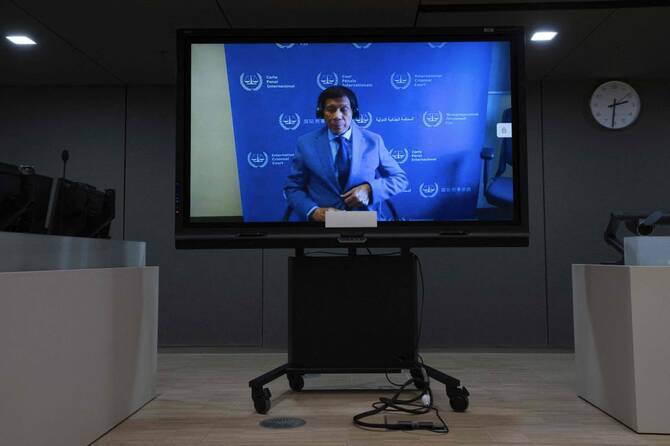
At his initial hearing, he followed by video link, appearing dazed and frail, barely speaking.
He is the first Asian former head of state charged by the ICC. He stands accused of 43 murders as a crime against humanity.
The ICC prosecutor’s application for his arrest said Duterte’s alleged crimes were “part of a widespread and systematic attack directed against the civilian population” in the Philippines.
“Potentially tens of thousands of killings were perpetrated,” the prosecutor alleged of the campaign that targeted mostly poor men, often without proof they were linked to drugs.
Kaufman said his client’s mental faculties had declined to the point where he was unable to understand the accusations against him or defend himself in court.
A lawyer for victims of Duterte’s “war on drugs” has voiced anger over the ICC’s postponement of the hearing originally scheduled for September 23.
“We expected that Duterte would do this, but the fact that he was able to convince the pre-trial chamber to postpone that indefinitely is scary,” Kristina Conti told AFP.

Duterte defense team urges ICC case shelved on health grounds
https://arab.news/89ns8
Duterte defense team urges ICC case shelved on health grounds
- The ICC ruled earlier this week to adjourn that hearing while judges assessed Duterte’s health
- Duterte “is not fit to stand trial as a result of cognitive impairment in multiple domains,” wrote Kaufman in a legal filing
India’s Parliament approves bill to open civil nuclear power sector to private firms
- The government termed it a major policy shift to speed up clean energy expansion
- The move carries global significance as India seeks to position itself as a major player in the next wave of nuclear energy
NEW DELHI: India’s Parliament approved new legislation Thursday that enables opening the tightly controlled civil nuclear power sector to private companies.
The government termed it a major policy shift to speed up clean energy expansion while the opposition political parties argued that it dilutes safety and liability safeguards.
The lower house of parliament passed the legislation Wednesday and the upper house on Thursday. It now needs the assent from the Indian president, which is a formality, to come into force.
The move carries global significance as India seeks to position itself as a major player in the next wave of nuclear energy, including with small modular reactors at a time many nations are reassessing nuclear power to meet climate targets and reduce dependence on fossil fuels.
Supporters argue the legislation marks a decisive break from decades of state dominance in nuclear energy while critics say it opens the door to risks, mainly health hazards, that could have long term consequences.
“It marks a momentous milestone for India and signals capable private sector players that the country is open for business in the nuclear energy space,” said Karthik Ganesan, director of strategic partnerships at the Council on Energy, Environment and Water, a think tank.
Junior Minister Jitendra Singh, who oversees the department of atomic energy, told lawmakers that the bill — which has been dubbed Sustainable Harnessing and Advancement of Nuclear Energy for Transforming India — seeks to modernize India’s nuclear framework in line with technological, economic and energy realities. It also retains and strengthens core safety, security and regulatory safeguards.
“India’s role in geopolitics is increasing. And if we have to be a global player effectively, we have to live up to global benchmarks, follow global parameters and adopt global strategies,” Singh said in the lower house, adding that the legislation was necessary to address the country’s growing energy needs.
India wants more nuclear power and has pledged over $2 billion in recent months toward research and allied activities. Nuclear power is a way to make electricity that doesn’t emit planet-warming gases, although it does create radioactive waste.
India is one of the world’s biggest emitters of planet-heating gases and over 75 percent of its power is still generated by burning fossil fuels, mostly coal. India wants to install 100 gigawatts of nuclear power by 2047 — enough to power nearly 60 million Indian homes a year.
Energy experts say that for the world to move away from carbon-polluting fuels like coal, oil and gas, sources like nuclear that don’t rely on the sun and the wind — which aren’t always available — are needed. But some are skeptical about India’s ambitions as the country’s nuclear sector is still very small, and negative public perceptions about the industry remain.
Opposition parties flagged concerns related to several provisions of the bill and urged the government to refer it to a parliamentary panel for examination. The government didn’t adhere to the request.
“The bill doesn’t have sufficient safeguards when it comes to mitigating the bad health of those impacted by living in areas closer to nuclear plants,” Ashok Mittal, a lawmaker from the opposition Aam Admi Party, told The Associated Press.
G. Sundarrajan, an anti-nuclear energy activist, called the bill a “disastrous law,” saying it takes away essential safeguards that are needed to make sure companies invest in safety and reduce the chances of a major disaster that can impact millions from occurring.
“It also provides little recourse for any Indian citizen to claim damages from nuclear companies even if they are affected by radiation leaks or suffer from any other health impact as a result of a nuclear plant in their region,” he said.


