THE HAGUE: The defense lawyer for Rodrigo Duterte Thursday urged the International Criminal Court to shelve its crimes against humanity case against the former Philippines president, who he said was mentally unfit for trial.
Duterte, 80, was scheduled to appear at the ICC on September 23 to hear charges over his years-long campaign against drug users and dealers that rights groups say killed thousands.
The ICC ruled earlier this week to adjourn that hearing while judges assessed Duterte’s health, but lawyer Nicholas Kaufman urged the case be shelved indefinitely.
Duterte “is not fit to stand trial as a result of cognitive impairment in multiple domains,” wrote Kaufman in a legal filing published Thursday on the ICC website.
“Mr Duterte’s condition will not improve and, for this reason, the Pre-Trial Chamber must adjourn all legal proceedings in his case indefinitely,” he added.
The former leader is suffering from “significant cognitive deficiencies” affecting his memory, his day-to-day functioning, and his capacity for complex reasoning, according to Kaufman.
Duterte was arrested in Manila on March 11, flown to the Netherlands that same night and has been held at the ICC’s detention unit at Scheveningen Prison since.
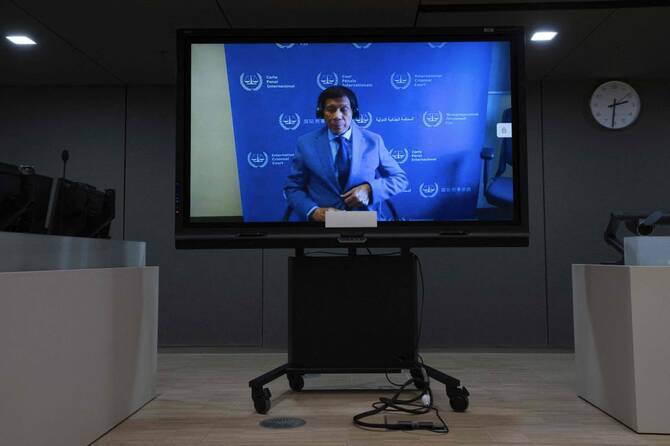
At his initial hearing, he followed by video link, appearing dazed and frail, barely speaking.
He is the first Asian former head of state charged by the ICC. He stands accused of 43 murders as a crime against humanity.
The ICC prosecutor’s application for his arrest said Duterte’s alleged crimes were “part of a widespread and systematic attack directed against the civilian population” in the Philippines.
“Potentially tens of thousands of killings were perpetrated,” the prosecutor alleged of the campaign that targeted mostly poor men, often without proof they were linked to drugs.
Kaufman said his client’s mental faculties had declined to the point where he was unable to understand the accusations against him or defend himself in court.
A lawyer for victims of Duterte’s “war on drugs” has voiced anger over the ICC’s postponement of the hearing originally scheduled for September 23.
“We expected that Duterte would do this, but the fact that he was able to convince the pre-trial chamber to postpone that indefinitely is scary,” Kristina Conti told AFP.

Duterte defense team urges ICC case shelved on health grounds
https://arab.news/89ns8
Duterte defense team urges ICC case shelved on health grounds
- The ICC ruled earlier this week to adjourn that hearing while judges assessed Duterte’s health
- Duterte “is not fit to stand trial as a result of cognitive impairment in multiple domains,” wrote Kaufman in a legal filing
India rolls out strictest anti-pollution curbs as toxic smog engulfs Delhi
- Private monitors in several parts of northern Delhi recorded AQI spikes between 550 and 700s
- Authorities invoked stage four of the capital region’s emergency pollution-control framework
NEW DELHI: India’s capital choked under a thick blanket of smog on Sunday, with the government imposing anti-pollution curbs after monitoring stations in some areas recorded extremely hazardous air quality.
Home to 30 million people, Delhi has not recorded a single “clean air” day in 2025, with Air Quality Index readings hitting high above the 50 score throughout the year.
On the AQI scale from 0 to 500, good air quality is represented by levels below 50, while levels above 300 are dangerous.
Worsening since late October, official records over the weekend were in the severe to severe-plus range of 400–500, but as 24-hour averages, they did not capture the peaks. Private monitors in several parts of North and North West Delhi recorded AQI spikes above 550 and even into the 700s in real-time.
On Saturday evening, the Ministry of Environment’s Commission for Air Quality Management invoked stage four — the highest level — of the Graded Response Action Plan for Delhi and surrounding areas.
To “prevent further deterioration of air quality in the region,” the commission suspended all non-essential construction, shut stone crushers and mining operations, stopped entry of trucks into the capital region, and ordered schools to shift to hybrid classes or online, where possible.
While authorities blamed the pollution on “adverse meteorological conditions,” residents have been demanding more government action.
“The situation is so bad in Delhi that we don’t have any option but to force kids to do online classes. The government has failed us; it has not done anything to address the issue,” said Nabanita Nayak, who decided for her teenage children to attend school online only, despite concerns over their screen addiction.
“If the kids are too much in front of laptops, that’s also an issue. As a mother, I am worried.”
Delhi’s pollution has been worsening since Diwali in late October, when the average AQI has been above 370, or “very poor.” Since mid-November, it has been over 400, which means “severe” air quality, with certain areas recording 500 and above, which is classified as a “hazardous” level.
“I don’t feel proud living in Delhi. It’s the capital city of the country … We talk about being a developed nation by 2047 — we have deadlines,” said Jagriti Arora, who is keeping her 7-year-old daughter at home to prevent allergy flare-ups caused by air pollution.
“The government has to do something … China had a big problem with pollution, but now they’ve managed to bring it down.”
Delhi’s air quality deteriorates in winter due to local emissions and seasonal weather conditions. Cold temperatures and low wind speeds result in a temperature inversion, which traps pollutants close to the ground instead of letting them disperse. This allows emissions from millions of vehicles, ongoing construction, and nearby industrial activity to accumulate in the air. Urban waste burning and dust from construction sites further add to it.
“This is not a new thing. This has been happening now for over 10 years,” Arora said. “You can see it. You don’t need to actually look at an AQI meter to see how bad the pollution is these days.”


