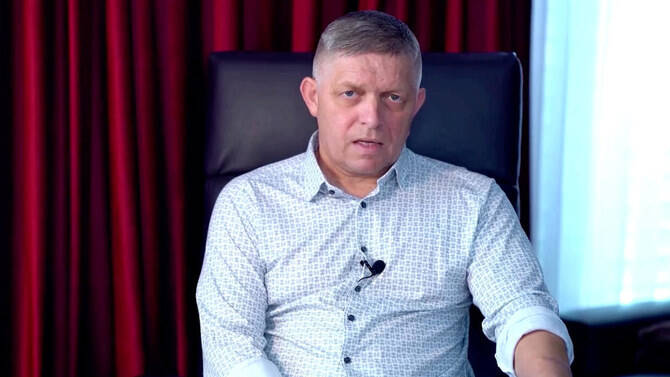
BRATISLAVA: Slovakia cannot support more European Union sanctions against Russia until it gets EU proposals to align climate targets with the needs of carmakers and heavy industry, Prime Minister Robert Fico said on Thursday.
Fico also demanded measures to tackle electricity prices in the bloc.
The EU is debating a 19th package of sanctions against Russia over its invasion of Ukraine.
EU diplomats have said a new package was likely to include more listings of Chinese companies, Russian banks and vessels in Moscow’s sanctions-evading “shadow fleet,” as well as a transaction ban on Russian oil.
Fico, who has broken ranks with European allies over his pro-Moscow stance and met Russian President Vladimir Putin three times since last year, has long argued that sanctions do not work.
Fico said on Thursday that he would “not support adoption of another package until the Commission submits realistic proposals that will align demanding climate targets with the needs of the production of cars, not only in Slovakia, and with the needs of heavy industry.”
“I will not support any further package unless the European Commission submits realistic proposals regarding electricity prices in Europe,” he added in comments after meeting EU Council President Antonio Costa in Bratislava.
Fico temporarily held up the last sanctions package, demanding guarantees against potential losses from a separate EU plan to end all gas and oil imports from Russia from 2028.
“How many sanctions packages do we have to adopt to change Russia’s approach to the war?” Fico said.
The West has imposed tens of thousands of sanctions on Russia over its 3-1/2-year-old war in Ukraine, and its 2014 annexation of Crimea, in a bid to hobble Russia’s economy.
Fico has also argued against military aid for Ukraine and said the EU should instead strive for peace.

Slovak leader Fico sets conditions for backing more Russia sanctions
Short Url
https://arab.news/gynyu
Slovak leader Fico sets conditions for backing more Russia sanctions
- Fico also demanded measures to tackle electricity prices in the bloc
- The EU is debating a 19th package of sanctions against Russia over its invasion of Ukraine
Japan protests after a Chinese military aircraft locks its radar on Japanese jets
TOKYO: Japan said early Sunday that it has protested to China after a military jet that took off from the Chinese carrier Liaoning locked its radar on Japanese fighter jets near the southern island of Okinawa, the latest spat between the two countries whose ties have plunged recently over the Japanese leader’s Taiwan remarks.
Japan’s Defense Ministry said China’s military aircraft J-15 “intermittently” targeted its radar at Japanese F-15 fighter jets on two occasions Saturday — for about three minutes in the late afternoon and for about 30 minutes in the evening.
The radar lock by the Chinese aircraft was detected by different Japanese fighters that had scrambled against a possible airspace violation by China, according to the ministry. There was no breach of Japanese airspace, and no injury or damage was reported from the incident.
It was not known whether the radar lock incident involved the same Chinese J-15 both times.
Defense Minister Shinjiro Koizumi, briefing reporters in the early hours of Sunday, said Japan protested to China over the radar lock, calling it “a dangerous act that exceeded the scope necessary for safe aircraft operations.”
“The occurrence of such an incident is extremely regrettable,” Koizumi said. “We have lodged a strong protest with the Chinese side and demanded strict preventive measures.”
There was no immediate comment from the Chinese government or military. On Friday, Foreign Ministry spokesperson Lin Jian said the Chinese navy operates in accordance with international law and that others shouldn’t hype up its activities.
The latest incident comes as relations between the two countries have worsened in recent weeks.
China was angered by a statement by Japan’s Prime Minister Sanae Takaichi in early November that its military could get involved if China were to take action against Taiwan, the self-governing island that Beijing says must come under its rule.
The aircraft carrier Liaoning on Saturday passed between the main island of Okinawa and nearby Miyako island as it conducted aircraft takeoff and landing exercises in the Pacific.
Japanese F-15 fighter jets, scrambled in case of an airspace violation, were pursuing the Chinese aircraft at a safe distance and did not involve actions that could be interpreted as provocation, Kyodo News agency said, quoting defense officials.
Fighter jets can use radars for search, or as fire control ahead of a missile launch.
It is believed to be the first instance of a radar lock involving Japanese and Chinese military aircraft. In 2013, a Chinese warship targeted a radar on a Japanese destroyer, Kyodo said.
Elsewhere in the Pacific, the Philippine coast guard said China fired three flares toward a fisheries bureau plane on patrol in the South China Sea on Saturday. Chinese forces fire flares to warn planes to move away from what they consider their airspace over the disputed waters.
Japan’s Defense Ministry said China’s military aircraft J-15 “intermittently” targeted its radar at Japanese F-15 fighter jets on two occasions Saturday — for about three minutes in the late afternoon and for about 30 minutes in the evening.
The radar lock by the Chinese aircraft was detected by different Japanese fighters that had scrambled against a possible airspace violation by China, according to the ministry. There was no breach of Japanese airspace, and no injury or damage was reported from the incident.
It was not known whether the radar lock incident involved the same Chinese J-15 both times.
Defense Minister Shinjiro Koizumi, briefing reporters in the early hours of Sunday, said Japan protested to China over the radar lock, calling it “a dangerous act that exceeded the scope necessary for safe aircraft operations.”
“The occurrence of such an incident is extremely regrettable,” Koizumi said. “We have lodged a strong protest with the Chinese side and demanded strict preventive measures.”
There was no immediate comment from the Chinese government or military. On Friday, Foreign Ministry spokesperson Lin Jian said the Chinese navy operates in accordance with international law and that others shouldn’t hype up its activities.
The latest incident comes as relations between the two countries have worsened in recent weeks.
China was angered by a statement by Japan’s Prime Minister Sanae Takaichi in early November that its military could get involved if China were to take action against Taiwan, the self-governing island that Beijing says must come under its rule.
The aircraft carrier Liaoning on Saturday passed between the main island of Okinawa and nearby Miyako island as it conducted aircraft takeoff and landing exercises in the Pacific.
Japanese F-15 fighter jets, scrambled in case of an airspace violation, were pursuing the Chinese aircraft at a safe distance and did not involve actions that could be interpreted as provocation, Kyodo News agency said, quoting defense officials.
Fighter jets can use radars for search, or as fire control ahead of a missile launch.
It is believed to be the first instance of a radar lock involving Japanese and Chinese military aircraft. In 2013, a Chinese warship targeted a radar on a Japanese destroyer, Kyodo said.
Elsewhere in the Pacific, the Philippine coast guard said China fired three flares toward a fisheries bureau plane on patrol in the South China Sea on Saturday. Chinese forces fire flares to warn planes to move away from what they consider their airspace over the disputed waters.
© 2025 SAUDI RESEARCH & PUBLISHING COMPANY, All Rights Reserved And subject to Terms of Use Agreement.


