

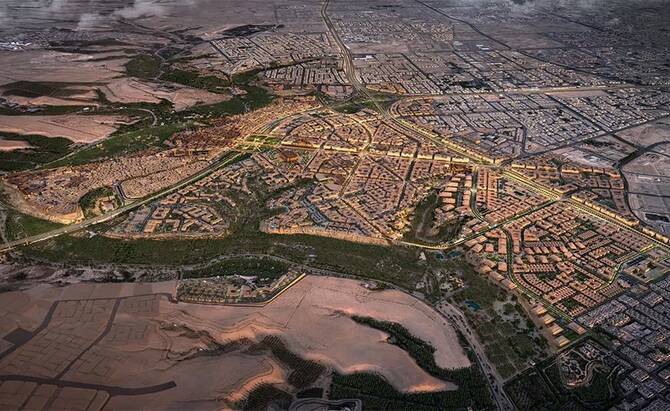
Diriyah Co. awards $5bn in H1 contracts to boost tourism push 

The total value of contracts, spanning 15 agreements including six memorandums of understanding and nine construction projects, underscores the project’s expanding scale. Supplied/File
Short Url
Updated 11 September 2025
Follow

Diriyah Co. awards $5bn in H1 contracts to boost tourism push 

RIYADH: Diriyah Co., backed by Saudi Arabia’s sovereign wealth fund, awarded contracts worth SR18.75 billion ($5 billion) in the first half of 2025, as the historic capital’s redevelopment speeds up. 

The total value of contracts, spanning 15 agreements including six memorandums of understanding and nine construction projects, underscores the project’s expanding scale, according to a press release.  

Since opening Bujairi Terrace and the At-Turaif District in December 2022, the site has welcomed more than 3.6 million visitors, with Diriyah targeting 50 million annual visits by 2030. 

Aligned with Saudi Vision 2030, Diriyah’s developments are expected to contribute over SR70 billion annually to the national economy and create 180,000 jobs, the company said. 

“The contracts we have secured, exceeding SR18 billion, are not only a testament to the gravitas of the Diriyah masterplan but also demonstrate the tangible way in which we are enhancing and celebrating our cultural and historic significance, whilst advancing toward our Vision 2030 targets,” Kiran Haslam, chief marketing officer at Diriyah Co., told Arab News.  

He added: “These results illustrate our commitment and accelerating progress in establishing Diriyah as a truly world-class integrated urban development.”  

Among the largest agreements is a SR5.1 billion joint venture with El Seif Engineering, Midmac Construction, and China State Construction Engineering Corp. to build the Royal Diriyah Opera House, set to be the site’s flagship performing arts venue.  

Another major project is the relocation of utilities and administration offices for King Saud University, secured in April under a SR4.23 billion contract awarded to a joint venture comprising China Railway Construction Corp., and China Railway Construction Group Central Plain Construction Co. Ltd.  

Construction is also underway at Diriyah Arena, a multipurpose venue honoring Najdi architectural heritage, for which a SR5.75 billion superblock contract was awarded to China Harbor Engineering.  

Meanwhile, Diriyah Square’s retail precinct saw a SR2.25 billion contract awarded in July to Salini Saudi Arabia, part of Italy’s WeBuild group, covering 73 buildings and 400 retail units. 

“During this period (first half of this year), Diriyah has made impressive progress, from awarding the Royal Diriyah Opera House project to awarding contracts for transformative developments like Diriyah Arena and Diriyah Square,” Haslam told Arab News.  

He added: “These projects aim to create not only modern landmarks but also unique experiences that redefine hospitality, entertainment, and culture, offering something special to Saudi Arabia and the world.” 

The projects are part of broader efforts to enhance the Kingdom’s cultural and entertainment offerings.  

Diriyah has also introduced new residential developments, such as the Aman Residences and Armani Residences, and launched its signature “Diriyah Tan” color in collaboration with Pantone to reflect the city’s architectural heritage. 

Diriyah’s international recognition has increased in recent years. TIME magazine included it among the 100 most influential companies in 2025, and it appeared on Wanderlust’s Travel Green List for its sustainability efforts.  

With ongoing developments in infrastructure, hospitality, and culture, Diriyah is gradually establishing itself as a key part of Saudi Arabia’s efforts to expand its tourism sector ahead of Riyadh Expo 2030. 


From consumers to creators: Saudi Arabia is engineering its own AI future

Updated 14 November 2025
Follow

From consumers to creators: Saudi Arabia is engineering its own AI future

  • KSU is training engineers to not just use AI, but design the systems

RIYADH: King Saud University’s College of Engineering is positioning itself as a proving ground for a new kind of Saudi engineer — one who treats AI not as a mere software tool, but as an engineering layer that redefines how the Kingdom designs infrastructure, energy systems, defense technologies, communications networks, and smart materials.

This transformation is not cosmetic. It is structural, embedded deep in the curriculum, linked with industry, and aligned with a national mandate. “KSU’s College of Engineering is aligning its AI push squarely with Vision 2030 toward building a talent base to deliver on the 66 of 96 national objectives linked to data and AI,” said Abdulelah Alshehri, assistant professor of chemical engineering at the college. 

“The result would be engineers who do not just adopt tools, but create local and superior technologies that boost competitiveness, security, and a knowledge economy.”

King Saud University and Saudi Data & AI Authority unite to advance AI-driven education. (Supplied)

The shift reflects a broader reality: AI is no longer an isolated discipline buried inside computer science departments. It has become a force multiplier shaping which nations lead in defense autonomy, manufacturing localization, space systems, medical devices, energy optimization, and the next generation of 6G networks. To lead, engineers must understand physics, hardware, data, and algorithms as a unified system, not as separate domains.

“Future engineers should not be just AI users; they would architect the systems within which AI is implemented,” said Alshehri. “They would frame the problem and data, build and test AI models, and finally fuse algorithms with hardware, safety and regulation so systems act responsibly in the real world.”

Opinion

This section contains relevant reference points, placed in (Opinion field)

This vision is being formalized through KSU’s flagship AI for Engineering Center, approved for launch in 2025. The center merges academic research with real-world application, acting as a living testbed where students and researchers develop and test AI-driven solutions for energy, autonomous mobility, national defense, and environmental analytics. By connecting university labs directly with industry needs, the center accelerates prototyping, real-data validation, and faster deployment for sectors such as energy and mobility.

The transformation also reaches classrooms. The college has introduced a new bilingual AI and Engineering curriculum that treats AI and engineering as one language with two alphabets: physics and data. “Unlike traditional programs where AI is a late-stage elective, KSU’s bilingual model teaches engineering students to think in two languages from day one,” Alshehri said. 

Abdulelah Alshehri, assistant professor of chemical engineering. (Supplied)

Graduates will leave with AI literacy embedded in labs, capstones, and industry projects — not as a certificate, but as a default competency.

Majid Altamimi, dean of the College of Engineering, describes this decision as a response to the speed of global change.

“We realized that artificial intelligence is transforming every field of engineering. It is becoming the key to building smarter systems, complex automation, and creating more sustainable designs,” he said. “By weaving AI into everything we teach and research, we are ensuring our graduates are not just ready for the future, they are ready to shape it.”

Majid Altamimi, dean of KSU's College of Engineering. (Supplied)

That ambition is already taking physical form. The KSU college has inaugurated two AI-driven specialized labs, one focused on communication networks and the other on advanced materials, both aligned with national industrial priorities. “Our new labs in communication networks and advanced materials are designed to turn great ideas into real-world products,” Altamimi said.

“In one lab, we’re working on the next wave of connectivity like 6G and IoT. In the other, we’re creating new, smarter materials for energy and sustainability. Crucially, we work hand-in-hand with industry partners to prototype and test these innovations, ensuring our research makes a tangible impact on Saudi Arabia’s technological competitiveness,” he added.

DID YOU KNOW?

• KSU’s College of Engineering trains Saudi engineers to design AI systems, not just use them. The college is aligning its AI push squarely with Vision 2030 toward building a talent base. It is ensuring that its graduates are not just ready for the future, they are ready to shape it.

• The college is aligning its AI push squarely with Vision 2030 toward building a talent base.

• It is ensuring that its graduates are not just ready for the future, they are ready to shape it.

KSU is also expanding its international footprint through deep collaboration with leading global universities. The College has signed five two-year partnerships with UCL, NUS, Tsinghua, Shanghai Jiao Tong, and Zhejiang University to advance joint research, faculty exchange, and dual-degree programs. These collaborations provide students and researchers access to world-class expertise, strengthening KSU’s research capacity and reinforcing Saudi Arabia’s position as an emerging global innovation hub.

Yet the most strategic value of the College’s pivot may not lie in its labs or partnerships, but in its timing. Saudi Arabia has already built the infrastructure for an AI economy through sovereign cloud platforms, national data policies, and hyperscale compute deals. The next bottleneck is talent. The Kingdom needs engineers capable of building 6G-secure networks, autonomous defense systems, AI-guided energy grids, and locally designed materials — not just operating imported software.

AI-driven communication research at KSU explores next-generation 6G and IoT connectivity to power Saudi Arabia’s smart cities. (CCNull image)

“Tomorrow’s engineering is AI-defined from grids that self-optimize, materials discovered by algorithms, to autonomous systems coordinating at city scale,” Alshehri said. “Future engineering graduates who can architect these agentic, trustworthy systems will power Vision 2030’s diversification.”

This is the quiet race beneath the AI headlines: not who installs AI, but who engineers it. Not who consumes compute, but who designs the systems that require it. Not who imports models, but who trains the minds that build sovereign ones.

A 3D printing and prototyping lab at King Saud University supports hands-on AI engineering projects and technology localization under Vision 2030. (Supplied)

Alshehri believes the coming decade will belong to Saudi engineers ready to lead with curiosity, ethics, and skill. “The nation is investing and offering tremendous opportunities and the world is watching, so be curious, ethical, hands-on so we can lead the shift from using engineering tools to creating them in the new era of AI-driven engineering,” he said.

KSU’s bet is that the next great Saudi breakthrough will not come from a cloud console, but from a lab table where equations, code, and national strategy meet.