

Pakistan assumes chair of SCO’s permanent body on counterterrorism

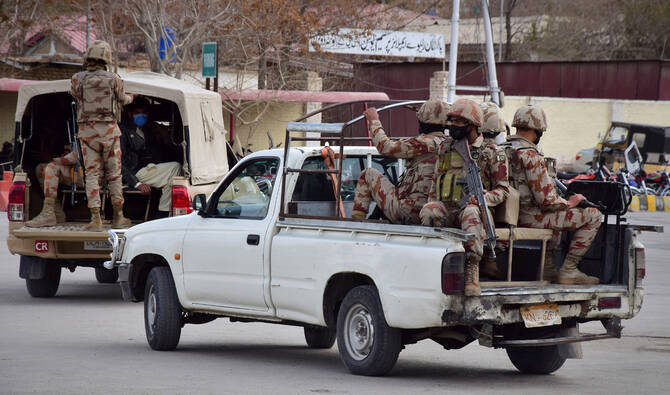
Pakistani soldiers arrive at the railway station to assist victims and survivors rescued by security forces from a train attacked by insurgents in Quetta, Pakistan, on March 12, 2025. (AP/File)
Short Url
Updated 10 September 2025
Follow

Pakistan assumes chair of SCO’s permanent body on counterterrorism

  • Regional Anti-Terrorist Structure is SCO’s counterterrorism arm which tackles separatism and extremism
  • In its capacity as chair of SCO RATs, Pakistan will foster regional cooperation against “terrorism,” says FO

ISLAMABAD: Pakistan has assumed the chair of the Regional Anti-Terrorist Structure (RATS) body of the Shanghai Cooperation Organization,(SCO) the foreign office announced on Wednesday, saying the role would allow Islamabad to foster regional cooperation against “terrorism.”

RATS SCO, founded in 2002 and headquartered in Tashkent, Uzbekistan, is a permanent organ of the SCO alliance which serves to promote cooperation among members states against “terrorism,” separatism, and extremism.

The foreign office said Islamabad assuming the counterterror body’s chair was a reflection of the confidence that SCO member states have in Pakistan’s efforts and contributions toward regional peace and security.

“In its capacity as the chair of SCO-RATS, Pakistan will work toward fostering regional cooperation against terrorism, in line with shared priorities, guided by the Shanghai Spirit of mutual trust, equality and shared responsibility,” the foreign office said.

It said as the body’s chair, Pakistan will host events on key domains such as cyber counterterrorism, information operations, border security, countering terrorist financing, and capacity-building to deepen collaboration.

Pakistan has frequently said it has lost 90,000 lives due to scores of militant attacks over the past couple of decades. Prime Minister Shehbaz Sharif said earlier this month Islamabad has suffered economic losses worth $152 billion due to “terrorism.”

“As a frontline state in combating terrorism, Pakistan continues to make unparalleled sacrifices to ensure safety and security not only of its own people but the region and beyond,” the statement said.

“Pakistan will continue to work with international and regional partners to advance collective efforts against terrorism, in line with the principles of the SCO, international law and the United Nations Charter.”

The development takes place as Pakistan battles twin insurgencies in its northwestern Khyber Pakhtunkhwa (KP) and southwestern Balochistan provinces. Islamabad blames the Afghan government for not taking action against the Tehreek-e-Taliban Pakistan (TTP) militants, alleging frequently that they operate from Afghanistan’s territory. Kabul denies the allegations.

Pakistan also accuses India of arming and funding militant groups in Balochistan, where separatist militants demand independence from the state. New Delhi rejects the allegations and accuses Islamabad of fueling insurgency in the part of disputed Kashmir it administers.


Pakistan opposition rallies in Khyber Pakhtunkhwa to demand release of Imran Khan

Updated 07 December 2025
Follow

Pakistan opposition rallies in Khyber Pakhtunkhwa to demand release of Imran Khan

  • PTI-led gathering calls the former PM a national hero and demands the release of all political prisoners
  • Government says the opposition failed to draw a large crowd and accuses PTI of damaging its own politics

ISLAMABAD: Pakistan’s opposition led by the Pakistan Tehreek-e-Insaf (PTI) party demanded the release of jailed former prime minister Imran Khan at a rally in the northwestern Khyber Pakhtunkhwa province on Sunday, describing him as a national hero who continues to command public support.

The gathering came days after a rare and strongly worded briefing by the military’s media chief, Lt. Gen. Ahmed Sharif Chaudhry, who dismissed Khan as “narcissistic” and “mentally ill” on Friday while responding to the former premier’s allegations that Pakistan’s chief of defense forces was responsible for undermining the constitution and rule of law.

He said that Khan was promoting an anti-state narrative which had become a national security threat.

The participants of the rally called for “civilian supremacy” and said elected representatives should be treated with respect.

“We, the people of Pakistan, regard Imran Khan as a national hero and the country’s genuinely elected prime minister, chosen by the public in the February 8, 2024 vote,” said a resolution presented at the rally in Peshawar. “We categorically reject and strongly condemn the notion that he or his colleagues pose any kind of threat to national security.”

“We demand immediate justice for Imran Khan, Bushra Bibi and all political prisoners, and call for their prompt release,” it added, referring to Khan’s wife who is also in prison. “No restrictions should be placed on Imran Khan’s meetings with his family, lawyers or political associates.”

Addressing the gathering, Sohail Afridi, the chief minister of Khyber Pakhtunkhwa, denied his administration was not serious about security issues amid increased militant activity. However, he maintained the people of his province had endured the worst of Pakistan’s conflict with militancy and urged a rethinking of long-running security policies.

The resolution asked the federal government to restore bilateral trade and diplomatic channels with Afghanistan, saying improved cross-border ties were essential for the economic stability of the region.

The trade between the two neighbors has suffered as Pakistan accuses the Taliban administration in Kabul of sheltering and facilitating armed groups that it says launch cross-border attacks to target its civilians and security forces. Afghan officials deny the claim.

The two countries have also had deadly border clashes in recent months that have killed dozens of people on both sides.

Some participants of the rally emphasized the restoration of democratic freedoms, judicial independence and space for political reconciliation, calling them necessary to stabilize the country after years of political confrontation.

Reacting to the opposition rally, Information Minister Attaullah Tarrar said the PTI and its allies could not gather enough people.

“In trying to build an anti-army narrative, they have ruined their own politics,” he said, adding that the rally’s reaction to the military’s media chief’s statement reflected “how deeply it had stung.”

“There was neither any argument nor any real response,” he added, referring to what was said by the participants of the rally.